New from the Learning Center: Contentful Foundations Skill Badge
blogDetail.published August 11, 2026



blogDetail.subscribeCard.title
blogDetail.subscribeCard.description
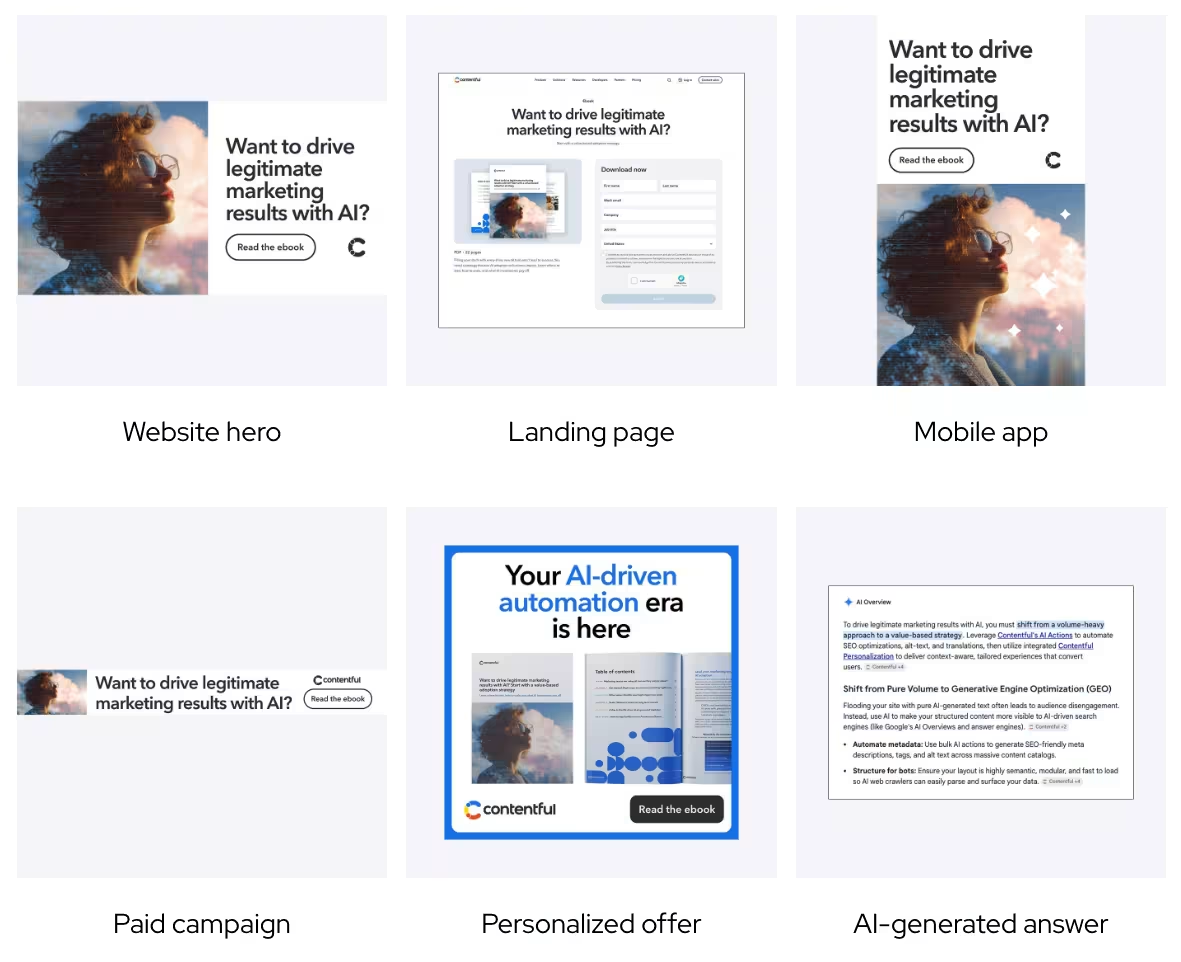
Your content isn’t just consumed by people. Alongside the buyer scanning a product page, there's a search engine building an answer and an AI agent deciding what to recommend. Humans need relevance, trust, and an experience that feels considered. Agents need structure, authority, and enough context to interpret the content and act on it. Teams that treat these as separate requirements tend to solve neither.
That reality is the starting point for the Contentful Foundations Skill Badge, a free credential paired with the Contentful Foundations learning path in the Contentful Learning Center. Together they help marketers, content creators, developers, and digital experience teams learn how AI has changed the marketing landscape, and how to use the Contentful ecosystem to build a best-in-class digital experience platform.

What you’ll gain with a Contentful Foundations Skill Badge
The badge validates that you understand the foundational concepts needed to support structured, connected, personalized, and AI-ready digital experiences in Contentful.
Specifically, badge earners can:
Explain why modern content has to serve both humans and AI agents
Describe structured content as a reusable foundation across channels, markets, and systems
Explain how Platform, Personalization, AI and Automations, and Ecosystem work together across the digital experience lifecycle
Identify how marketers, developers, and digital teams collaborate across Contentful workflows
Recognize governance considerations spanning permissions, workflows, localization, AI usage, and integrations
Apply Contentful's core capabilities to an end-to-end digital experience scenario
A Skill Badge validates a focused set of knowledge and abilities. It isn’t a certification, which proves an individual’s proficiency with Contentful in a particular role. For the full distinction, read Choosing the right Contentful training: Verified skills and certifications. Skill badges are free for customers and partners alike.
Why this badge is essential for today’s digital experience teams
Budgets are tighter, AI has flooded channels with undifferentiated content, and AI-driven search is changing how people discover brands — the dynamic our CEO Karthik Rau described in From content collapse to content breakthrough.
The hard part is rarely a missing tool: a marketer optimizing a landing page, a developer modeling content types, and an operations lead automating a localization workflow are all touching one system without shared language for how their decisions interact. Structure becomes an engineering concern, relevance a campaign concern, SEO and AEO someone else's entirely.
Contentful Foundations gives those roles common ground to build from — and the six courses below follow that thread from market context to one working lifecycle.
The syllabus in brief
Six self-paced courses guide learners step by step from market context through the structural foundation, then bring every capability together into one workflow. Throughout the path, AI appears as an accelerator rather than an author. Strategy, governance, approvals, and final decisions stay human-led.
1. Understanding Contentful
Why do intelligent experiences matter? This course covers content's two audiences, the forces behind the content collapse, what makes an experience intelligent, and how Contentful's capabilities fit together. Think of a product page that has to persuade a human buyer while being structured enough for an agent to interpret and recommend: one piece of content, two very different standards.
2. Structuring content with Contentful Platform
Structure content once for humans, channels, markets, and agents: Learners look at why page-centric models limit reuse and localization, how content models create a single source of truth, how API delivery gets content everywhere it needs to go, and how governance can speed teams up rather than slow them down. The course also introduces AI discovery: how an organization can understand, measure, and improve its presence in answer engines, often described as answer engine optimization (AEO).
Legacy approach | Structured approach |
|---|---|
Content locked in pages | Content modeled as reusable pieces |
Duplicated across channels | Delivered across channels from one foundation |
Difficult to localize | Easier to adapt by market and region |
Manual updates | More consistent updates at scale |
Hard for AI to interpret | More useful for systems and agents |
3. Improving relevance with Contentful Personalization
Learn about relevance through audience data, content, experiments, and insights. This course starts from the observation that traffic without relevance is wasted spend, then works through connecting first-party data to where content decisions get made, and the loop of discovering, segmenting, analyzing, optimizing, and monetizing. Learners see how enterprise visitors might encounter proof points about scale while small-business visitors see messaging about speed and ease of use.
4. Scaling content work with Contentful AI and Automations
Search, discovery, and answer expectations are changing. Content needs to be easy for people to find, but also structured, complete, authoritative, and contextual enough for search engines, AI agents, answer engines, and digital channels to interpret. In practice that means consistent metadata, useful summaries, clear titles and descriptions, accessibility elements such as alt text, structured supporting content like FAQs or Q&A, and review signals that show when content is current, complete, and approved. This course covers how to produce all of that at scale without relying on manual effort to hold quality together.
5. Connecting the Contentful Ecosystem
Modern digital experiences depend on many connected systems — commerce, digital asset management, localization, analytics, marketing automation, frontend delivery, AI, collaboration, customer data, AI discovery intelligence, and more. Learners see how App Framework, Contentful Marketplace, technology and solution partners, APIs, Model Context Protocol (MCP), and AI discovery intelligence help teams connect Contentful to the broader stack and build experiences around their specific business needs.
6. Orchestrating the end-to-end Contentful workflow
Bringing it all together: a modern digital experience isn’t a single page, channel, or campaign asset. It’s a connected lifecycle spanning audience and AI discovery signals, content modeling, creation, localization, ecosystem connections, personalization, launch, measurement, governance, and ongoing optimization. Learners follow a winning experiment as it becomes the default variant and goes on to shape the next campaign.
Built for practical application
The learning path is scenario-based. Knowledge checks and activities ask learners to model content, design an AI-assisted content workflow, and map their own ecosystem rather than recall definitions.
The Contentful Foundations Skill Badge test follows the same approach: scenario-based multiple-choice questions spanning the product pillars and the end-to-end workflow. A score of at least 90% is required to pass.
For teams, the value shows up as shared vocabulary. When structure, relevance, automation, and integration mean the same thing to a marketer and a developer, the conversations get shorter — and learners come away more confident explaining how structured content, personalization, AI, automations, and ecosystem integrations work together.
The credential travels, too. Issued through Credly and valid for two years, it can be shared as a verified achievement for professional development, partner enablement, or customer team readiness.
Start learning
Whether you’re new to Contentful or know only one capability well and want the whole picture, the Contentful Foundations learning path is a structured way to build and validate your knowledge.
Learning path: Contentful Foundations
Credential page: Earn Contentful verified skill badges

blogDetail.subscribeCard.title
blogDetail.subscribeCard.description
blogDetail.authors

Steve is a Senior Learning Experience Designer at Contentful with 15 years of experience in high-growth SaaS Marketing, Enablement, and Education roles. He has won numerous awards as a Creative Producer on indie TV pilots, web-series, and short films that have found homes on streaming platforms such as Netflix, Amazon, and Peacock.

Kim is a Learning Experience Designer on the Contentful Learning Services team. She creates courses and exams in the Learning Center. With over 10 years in the tech industry, Kim enjoys creating learning materials about complex, technical topics.
blogDetail.relatedArticles
Integration Roundup: AI Content Generator powered by Amazon Bedrock and Ada AI Support Agent
February 21, 2024
Upskill with Contentful Studio: New learning paths for developers and content managers
May 6, 2025

Beyond the checkbox: Building trust through compliance, resilience, and continuous improvement
September 4, 2025

Ready to start building?
Put everything you learned into action. Create and publish your content with Contentful — no credit card required.