Top headless commerce platforms: Which one is right for you?
Publié le October 20, 2026



Inspiration pour votre boîte mail
Abonnez-vous et restez au courant des meilleures pratiques pour offrir des expériences numériques modernes.
At its core, a headless commerce platform decouples the frontend presentation layer from backend commerce logic, like catalog, cart, and order processing, via APIs. For our comparison, we’ll work with a tight definition of a headless commerce platform — specifically, a commerce engine designed to be built upon. A headless commerce platform has an API-ready back end — so your frontend developers can use it as a ready-made service for the storefront.
We’ll evaluate each platform against key criteria: API coverage and quality, frontend framework compatibility, performance and scalability, channel control, multi-market support, and ease of integration with other systems and AI features. Crucially, because a decoupled, API-first system is the prerequisite for agentic commerce, we will also assess each platform’s agentic readiness to look at how seamlessly AI shopping agents can discover your products, query inventory, and execute purchases.
The differences between headless, composable, and MACH commerce
While vendors often sell under these terms, they represent distinct levels of architectural modularity:
Headless commerce simply decouples the frontend storefront from the backend commerce engine via APIs.
Composable commerce takes this separation farther by breaking different backend functionality into independent backend services — such as catalog, cart, checkout, search, and CMS — which developers stitch together.
MACH commerce (microservices, API-first, cloud-native SaaS, and headless) is a framework of four architectural principles promoted by the MACH alliance that many enterprise composable builds follow.
For a deeper dive into how these approaches differ in practice, see Contentful’s guide on composable vs. headless.
What to judge a headless commerce platform on
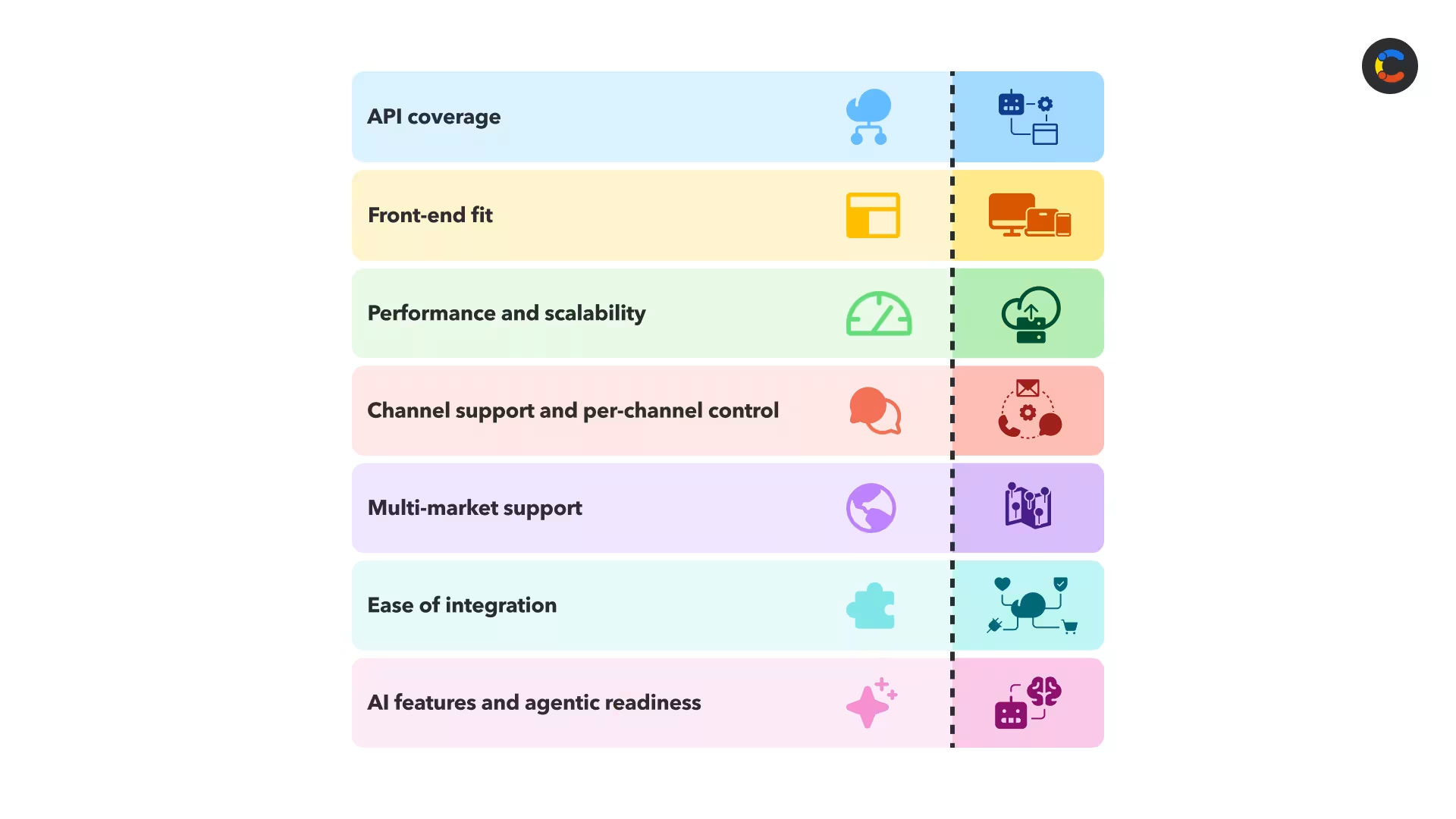
When building a shortlist, look beyond the standard marketing claims and assess how effectively each platform supports your development team and business strategy.Below are the key criteria every buyer should judge a headless commerce platform on:
1. API coverage
The API surface of headless ecommerce platforms defines the depth, architecture (REST vs. GraphQL), and developer tooling that the platform provides — directly driving your team’s development velocity. To evaluate whether one platform’s API is genuinely better than another, start by auditing its documentation for complete endpoint coverage, typed SDKs, and clear schema definitions.
More importantly, have your engineering team build a lightweight proof of concept (PoC) that executes your core flows — such as adding items to a cart and running through checkout. This should explicitly test your specific edge cases, like custom product attributes, complex tax rules, or multi-currency pricing. If the API handles these edge cases cleanly without requiring brittle workarounds, it’s a clear sign of a mature platform.
2. Frontend fit
Frontend fit measures how naturally a back end pairs with modern frontend frameworks like Next.js, React Router, Vue/Nuxt, or Svelte. You should check this carefully, because selecting a platform with SDKs that match your engineering team’s existing technical stack avoids friction and prevents developers from learning whole new tools for what should be a straightforward on-ramp.
Audit the vendor’s documentation for official, actively maintained SDKs and starter kits (such as Next.js, Remix, or Nuxt boilerplates). Have a developer spin up a local starter project — a platform with strong frontend fit should allow your team to render product catalog data on a local storefront in a matter of hours, not days.
3. Performance and scalability
This evaluates how effectively the platform handles high-query volumes, caches data, and scales API throughput, independently from the storefront. This is important because an independently scalable platform allows your presentation and checkout layers to absorb traffic surges (think Black Friday) without causing backend database bottlenecks or checkout delays.
This evaluates how effectively the headless commerce platform handles load, both during traffic surges (think Black Friday again) and as your catalog and number of orders scale over time. This matters most for the performance of your cart and checkout, as the bottleneck for these pages is usually the commerce engine, because carts and checkouts cannot be cached and must load data from the back end on every request. When evaluating each platform, review its official uptime guarantees (aiming for 99.95%+ SLAs), checkout capacity, and whether there are hard limits on API requests or catalog size.
4. Channel support and per-channel control
While any headless platform can send data to multiple frontend screens via APIs, effective multi-channel support comes down to per-channel control. Having native channel scoping lets you launch mobile apps, in-store digital kiosks, or third-party marketplaces from a single source of truth while applying distinct rules for each channel — such as mapping an in-store kiosk exclusively to local store inventory while your website draws from a central warehouse.
Check the platform’s API documentation to confirm that “Channels” exist as a first-class data model with channel-scoped API credentials. Test whether the back end natively supports per-channel controls for product availability, pricing, promotions, and stock locations (for example, web vs. mobile vs. Amazon) from a single admin catalog view, rather than requiring workaround store clones.
5. Multi-market support
This is how well a platform handles sales across multiple countries. Built-in cross-border capabilities allow your brand to expand into international markets without managing a fragmented web of backend store accounts. When evaluating platforms, look for three core capabilities out of the box: the ability to store explicit local price lists for each country (rather than relying solely on dynamic currency conversion from a base price), native support for region-specific tax and shipping rules, and the ability to store and serve product catalog data in multiple languages from a single instance.
Verify whether a single tenant instance can handle localized currency, tax jurisdictions, and language translations without requiring separate backend accounts for each country. Test a sample checkout using a foreign currency and address to ensure the API handles region-specific price lists and shipping rules smoothly.
6. Ease of integration
The integration surface encompasses webhooks, event buses, payment gateways, and pre-built connectors for headless CMSs, ERPs, and PIMs. A broader integration surface reduces the custom code required to connect your commerce platform to your broader technical ecosystem.
Review the vendor’s app directory for pre-built integrations with your existing tech stack. Also, do the webhook events you need exist? Test the infrastructure by triggering events (like order placement or stock-level changes) to inspect payload structure, delivery speed, and automatic retry handling. Check whether pre-built connectors exist for the tools already in your stack to avoid writing custom integration glue code (for systems such as CMS, PIM, ERP, or payment gateways).
7. AI features and agentic readiness
As shopping evolves, AI features must extend beyond basic admin tools to support programmatic machine interactions.
Shoppers are increasingly using AI assistants to discover products, query catalog data, and verify inventory without hitting human UI bottlenecks like CAPTCHAs or visual layout dependencies. To evaluate a platform’s agentic readiness, check whether its APIs natively support emerging machine-to-machine commerce protocols. Currently, Google’s Universal Commerce Protocol (UCP) is the primary active standard powering end-to-end agent discovery and checkout. Ensuring your commerce engine supports open standards like UCP — alongside delegated payment frameworks like AP2 — guarantees that autonomous AI agents can browse and execute transactions on behalf of consumers.
Look for first-party Model Context Protocol (MCP) servers, official AI agent packages, or clean, structured GraphQL/REST feeds that allow AI assistants to query product stock without hitting bot-blocking mechanisms. Ask the vendor directly about their native support or roadmap for agentic commerce standards like UCP and AP2.
Does a decoupled storefront cost you search visibility?
A decoupled storefront does not cost search visibility – whether for traditional SEO or AI-driven Generative Engine Optimization (GEO) – if it’s built properly. The implementation of the back end will not affect your search presence, especially when you’ve chosen a suitably performant headless e-commerce platform.
What will affect your SEO is the front end, which simply needs to deliver clean, crawlable HTML and handle the fundamentals of modern frontend essentials.
However, because you’re now fully responsible for the front end, you’ll need to take on the technical fundamentals – like choosing the right rendering strategy, creating a sitemap, setting up redirects, and adding rich schema markup so both Google crawlers and AI search engines can easily parse and surface your products.
A comparison of the best headless commerce platforms
Adobe Commerce
Best for: Large enterprise organizations already invested in the Adobe Experience Cloud ecosystem or requiring heavy, customized B2B logic and multi-source inventory fulfillment.
What it does well: Provides a deep GraphQL set of APIs built on their Magento core. The platform has robust, native B2B account structures and extensive multi-source fulfillment capabilities. Its API surface connects backend catalog functions to Adobe Edge Delivery or a custom front end. It does this while handling complex, cross-border, multi-currency and AI-assisted merchandising workflows.
Where it stops fitting: Ongoing architectural complexity and maintenance overhead require significant developer resources. Also, some legacy dependencies can slow down the all-important machine-first API execution time. License fees and implementation timelines increase in scale when compared to some pure SaaS platforms.
commercetools
Best for: With a high total cost of ownership (TCO) and a three-year initial contract, commercetools is best suited to large, global brands generating in excess of $100 million gross merchandise value (GMV), representing a cost-prohibitive investment for smaller brands.
What it does well: Comprises multiple services, each of which is independently scalable with its own GraphQL and REST APIs, offering a 99.95% uptime SLA. This enables a true microservices architecture. Its data model natively supports multichannel and multi-currency modeling. Its machine-first API surface easily ingests automated AI requests and supports emerging agentic commerce protocols (like UCP and AP2) to handle programmatic discovery and delegated checkout and payments.
Where it stops fitting: High total cost of ownership and the time taken (nine to twelve months) to get it up and running make it excessive for mid-market brands or teams lacking dedicated microservice engineering and DevOps resources.
VTEX
Best for: Enterprise retailers, multi-vendor marketplaces, and omnichannel brands with large physical store networks or a major presence in international markets like Latin America.
What it does well: Includes a native enterprise order management system (OMS) right out of the box — avoiding expensive third-party OMS licenses (like Fluent or Manhattan) for complex fulfillment and inventory routing. It features a built-in multi-vendor marketplace engine, letting you operate your own 3P seller network.
Where it stops fitting: A pricing model that combines a fixed subscription with a percentage of GMV can penalize margins for high-volume D2C sellers, and it offers less isolation for teams wanting strict microservices.
Shopify Headless (Hydrogen + Oxygen)
Best for: High-volume enterprise and Shopify Plus brands wanting an ultra-performant, React-based custom storefront for complex user experiences, benefitting from Shopify’s enterprise checkout and global scaling architecture.
What it does well: Uses the React Router-powered Hydrogen framework alongside managed Oxygen edge hosting, providing a Storefront GraphQL API to build stateful and highly customized user interfaces. It delivers enterprise-level reliability at 99.99% uptime and is able to handle up to 40,000 checkouts per minute. Add multi-marketing localization tools and zero server management to this and the architecture suits enterprise teams that need full control over their URL structure for SEO and complex frontend elements without dropping backend reliability.
Where it stops fitting: If you need more than three options per product (like color, size, material) or more than 100 variants within each option (red, green, blue, etc.) you begin to hit Shopify’s core backend constraints. Also, third-party payment gateways incur transaction fees (0.15%–2%) and the hosted checkout limits any deep machine-to-machine payment protocol customization.
BigCommerce
Best for: Mid-market SaaS merchants seeking headless flexibility without managing server infrastructure, particularly those needing strong native B2B features.
What it does well: Delivers a hybrid SaaS architecture with GraphQL, catalog, and checkout APIs, and comes with an official, ready-made Next.js starter template called Catalyst. It supports up to 600 product variants per item, charges 0% platform transaction fees across external payment gateways, and provides strong native B2B capabilities, like organization accounts and custom quote pricing.
Where it stops fitting: Automatic plan upgrades based on trailing twelve-month GMV thresholds can force unexpected cost jumps up to Performance or Enterprise tiers. Also, subscription functionality requires third-party app integrations, and its closed SaaS nature prevents developers from extending backend source code directly.
Commerce Layer
Best for: Global multi-market brands needing dedicated pricing, localized checkout, and inventory APIs to bolt directly onto any headless front end or CMS.
What it does well: Delivers a highly performant REST API and typed JavaScript SDK purpose-built for complex cross-border commerce, multi-currency pricing, and distributed inventory routing. Its machine-first API surface decouples transaction logic from consent management, allowing your developers to easily work it into headless CMSs (like Sanity or Contentful from Salesforce) or AI shopping agents for automated workflows. It also offers a generous free Developer tier (up to 1,000 SKUs and 100 live orders/month) for prototyping.
Where it stops fitting: The native dashboard focuses strictly on order and fulfillment operations rather than visual merchandising, meaning non-technical marketing teams must rely entirely on an external CMS for catalog management. For smaller brands without a dedicated CMS or with limited developer capacity, assembling and maintaining the required composable stack might introduce unnecessary technical overhead.
Medusa
Best for: Teams versed in NodeJS and TypeScript looking for full backend ownership of code, using swappable modular logic, and wanting predictable infrastructure pricing.
What it does well: Medusa is based on top of an MIT-licensed NodeJS/TS tech stack and provides a modular architecture, giving you a clean separation of concerns between the modules, workflows, and APIs. This means that modules like payments, inventory, and fulfillment can be swapped, extended, or replaced entirely. There’s also a clean REST API for JS/TS SDK, ideal for implementing a straightforward client integration and CDN caching. Medusa’s core features include things like a full post-purchase returns system, including exchanges and gift cards. There’s a dedicated translation module and regions for international setup and configuration. Medusa leads in the open-source space with its official AI tooling from the first-party Medusa MCP server, an Agent Skills package, and even a development agent to diagnose issues with cloud deployments. Medusa Cloud offers a flat, usage-based infrastructure pricing (starting at $29 per month) and 0% GMV fees.
Where it stops fitting: Since a frontend template isn’t included, you will need to build or fork one for your storefront. Though Medusa includes the regions and sales channels, the multi-locale admin interface isn’t as mature as others, which can be tricky for non-technical managers looking to run global, multi-country stores on a daily basis. More complex requirements, like multi-warehouse B2B hierarchies, typically require custom development to extend those modules to fit custom enterprise purposes.
Quick view comparison table
Platform | Best for | API approach | Main strength | Main weakness |
Adobe Commerce | Enterprise Adobe ecosystem setups | GraphQL | Deep native B2B & multisource fulfillment | High architectural complexity & maintenance overhead |
commercetools | Enterprise composable programs ($100M+ GMV) | GraphQL & REST | MACH-certified microservices with independent scaling | Long implementation timeline |
VTEX | Enterprise retail & multi-vendor marketplaces | GraphQL & REST | Built-in OMS & native multi-vendor marketplace engine | Subscription fees tied to GMV |
Commerce Layer | Global multi-market pricing & inventory | REST | Decouples checkout & inventory behind any CMS front end | Admin UI handles operations only, requiring a separate CMS |
Shopify Headless | Custom React/Remix storefronts on Shopify | GraphQL | Included Oxygen edge hosting & 99.99% uptime SLA | Hard caps of 100 variants and three options per product |
BigCommerce | Mid-market SaaS without server operations | GraphQL & REST | 0% transaction fees on external payment gateway | GMV sales thresholds force automatic plan upgrades |
Medusa | Best for control/self-hosting | REST | Swappable module architecture & official AI agent tooling | No pre-built storefront visual theme included |
Who should not buy a headless commerce platform?
The freedom to build a custom store is attractive, but it comes with its own price tag. Avoid this if:
You have a simple store with standard requirements. You’re probably better served by a one-size-fits-all solution, which is cheaper and will get you to production faster.
You’re a company without a developer capability working alongside the business team, and you don’t want the overhead of recruiting a permanent team to build and then manage the front end.
Where next?
Choose the headless commerce platform that takes your greatest backend challenge and solves it as an ordinary feature. When your toughest requirement is the bread and butter of the chosen solution, you can be more confident in the resulting product.
Once you have identified the headless commerce platform that best aligns with your team’s tech stack, channel requirements, and budget, your next step is to integrate that engine into your existing systems. Connecting your APIs, payment gateways, PIMs, and ERPs smoothly ensures a reliable rollout.
Selecting the right commerce platform is half the battle — building or finding a robust content layer and presentation front end is the other half. While your headless back end manages catalog logic, cart operations and checkouts, your customer experience depends on pairing that platform with a CMS and a frontend storefront that brings everything together.
Contentful's headless CMS was built to be integrated with other headless systems. It organizes your content in an easy-to-edit structured content model, scales to handle enterprise needs, and is easy for marketers to use. On top of this, the Contentful Platform has strong governance built in—with role-based permissions, approval workflows, and audit trails—and caters to changes made by AI agents.

Inspiration pour votre boîte mail
Abonnez-vous et restez au courant des meilleures pratiques pour offrir des expériences numériques modernes.
À la rencontre des auteurs

Esat is a Senior Product Marketing Manager at Contentful and enjoys sharing his thoughts about personalization, digital experience, and composable across various channels.
Articles connexes

Prompt engineering for content editors: 6 practical ways to get better output from GenAI
May 6, 2026

What is Nuxt? The full-stack framework built on Vue.js
September 26, 2025

Best image formats for websites: JPEG, PNG, WebP, SVG, and AVIF compared
July 7, 2026

Ready to start building?
Put everything you learned into action. Create and publish your content with Contentful — no credit card required.