Omnichannel customer engagement: Strategy, challenges, and how to get it right
Mis à jour le September 24, 2026


Inspiration pour votre boîte mail
Abonnez-vous et restez au courant des meilleures pratiques pour offrir des expériences numériques modernes.
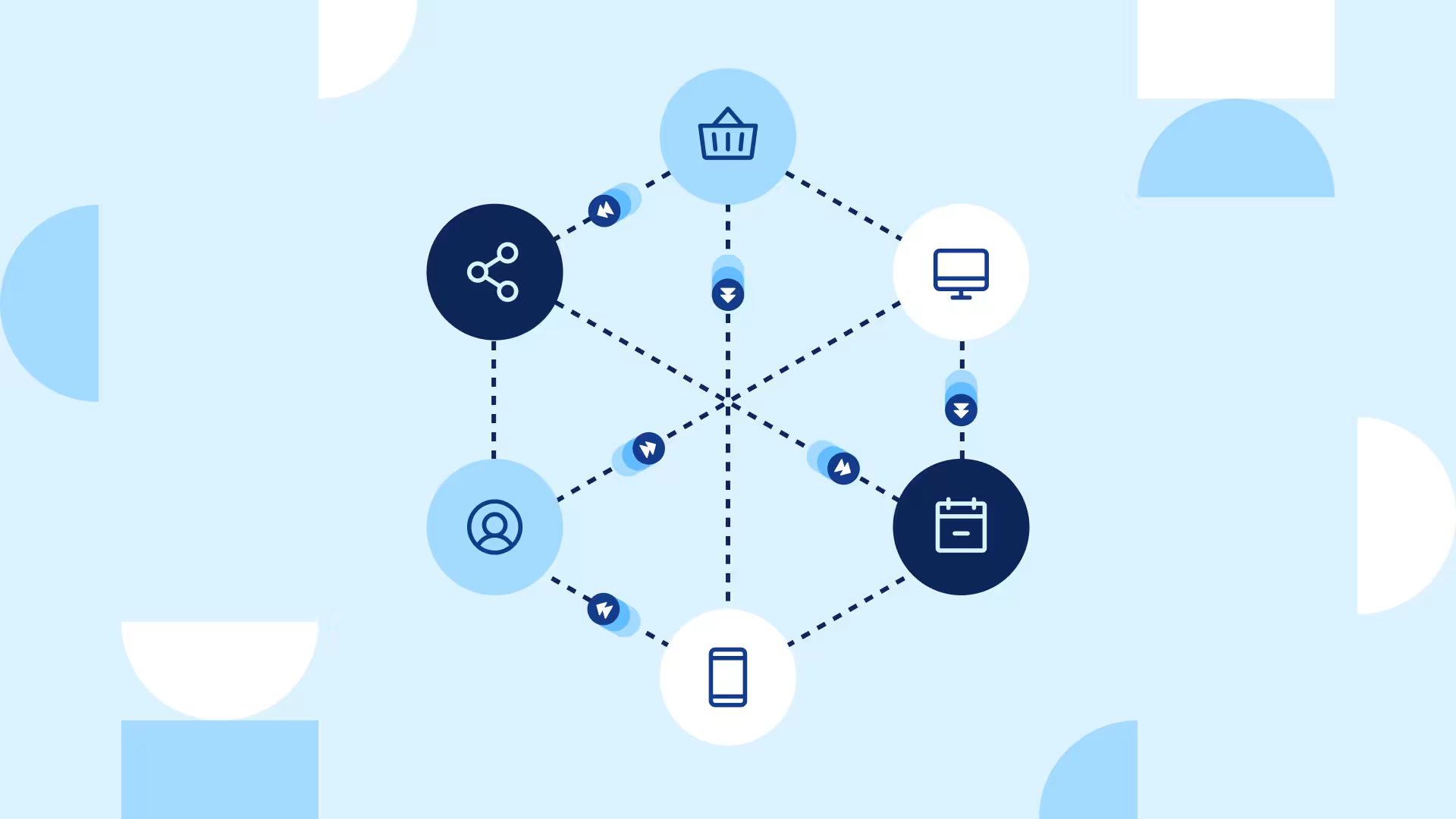
Omnichannel customer engagement is a strategy in which every channel a customer uses — website, mobile app, email, physical store, social media, support chat — shares the same underlying data and delivers a consistent experience.
The distinction matters. A customer who adds an item to their cart on a phone and later opens a laptop should see the same cart, the same pricing, and the same recommendations, without having to re-authenticate or start over.
This goes beyond simply being reachable on multiple platforms. The value is continuity: when context transfers between channels, customers spend less effort repeating themselves, and businesses gain a complete picture of behavior that no single channel can provide on its own.
Omnichannel vs multichannel: What changes?
The terms omnichannel and multichannel are often used interchangeably, but they describe fundamentally different architectures.
Multichannel | Cross-channel | Omnichannel | |
|---|---|---|---|
Channel integration | Channels operate independently. | Some channels share data. | All channels unified around one customer profile. |
Data sharing | Siloed per channel. | Partial — typically batch-synced. | Real-time, bidirectional. |
Customer experience | Varies by channel. | More consistent, but gaps remain. | Seamless — context travels with the customer. |
Example | A customer receives unrelated emails from marketing, support, and sales. | Marketing suppresses a promo email after a support ticket is filed. | A support agent sees the customer's browsing history, recent purchase, and open marketing offer in one view. |
Key components of an omnichannel strategy
Omnichannel engagement rests on four building blocks.
Channel integration: All customer touchpoints — in-store, web, mobile, social, support — are connected so a customer can move between them without losing progress. For example, a return started online can be completed in-store; a conversation begun on chat can continue over email.
Consistent messaging and brand voice: The tone, offers, and information a customer receives should not be contradictory across channels. If a homepage promotes free shipping, for example, the mobile app and email should reflect the same offer at the same time. If an insurer emails you about a van insurance product, the link they include shouldn’t take you to a page about car insurance.
Unified customer data: This is the technical foundation. Customer behavior, preferences, and history must be aggregated into a single profile that every channel can read and write to in real time. Without this, the other components cannot function: personalization defaults to guesswork, for example, and consistency depends on manual coordination.
Personalization at scale: With unified data in place, businesses can tailor content, recommendations, and timing to individual customers across every channel. Personalization is the mechanism that turns data unification into a better experience, rather than just a better database.
Benefits of an omnichannel approach
The business case for an omnichannel approach to personalization is measurable.
Enhanced customer experience
Customers who do not have to repeat themselves or restart processes report higher satisfaction.Twilio's 2025 State of Customer Engagement Report found that 88% of consumers are more likely to purchase when engagement is personalized in real time, yet only 44% of brands say they're delivering at that level.
Increased revenue
Omnichannel customers spend measurably more. Research from Capital One found that omnichannel shoppers spend an average of 16% more per order than single-channel buyers.
Combined with personalization, that increase can compound: Deloitte Digital found that personalization leaders were 48% more likely than low-maturity brands to exceed their revenue goals, and 71% more likely to report improved customer loyalty.
Improved retention
PwC's 2025 Customer Experience Survey found that while nine in 10 executives believe customer loyalty has grown in recent years, only four in 10 consumers say the same — and 29% have stopped buying from a brand after a poor customer experience, online or in-person. The brands closing that gap are those investing in connected, omnichannel experiences that reduce the friction driving customers away.
Data-driven decision-making
Brands that can retrieve, analyze, and interpret data quickly and efficiently have a huge personalization advantage. Data insight powers a feedback loop of content creation, experimentation, review, and publication, which ensures experiences are continuously optimized across every channel.
The quality and accessibility of that data and the skills of the teams managing it are critical here: Deloitte Digital found that brands say they personalize 61% of customer experiences, but consumers recognize only 43% of them as personalized. Meanwhile, Contentful’s own research shows that 37% of marketers rank personalization among their most important professional skills.
How personalization drives omnichannel engagement
When customer data is unified across channels, brands can respond to personal behavior, needs, and preferences with greater impact and accuracy rather than broadcasting generic messages to predefined audience segments.
Consider a retail scenario: A customer browses winter coats on a brand's website, adds one to their cart, but does not complete the purchase. With unified data, the brand can send a personalized email referencing the specific coat, perhaps with a time-limited discount or a note that stock is running low. Similarly, a supermarket brand could look at a customer’s in-store buying habits and then use them to craft more impactful offers and promotions the next time the customer uses the app.
The same logic applies outside retail. In a business-to-business (B2B) software-as-a-service (SaaS) context, a user who begins onboarding on desktop and completes three of five setup steps can receive contextual in-app guidance on mobile that picks up at step four, rather than step one. Similarly, a follow-up email can reference their specific progress and link directly to the next uncompleted task. The experience feels continuous because it is built on the same underlying data.
What makes this work is the combination of behavior tracking, preference inference, and real-time adaptation. Each channel contributes data to the personalization framework and each channel consumes it. The result is a customer journey where personalization compounds across interactions rather than resetting at each one.
Common challenges in omnichannel engagement
Omnichannel engagement is rarely frictionless, but you can smooth your path by anticipating the common challenges.
Data silos and fragmented customer profiles
When marketing, sales, and support each operate their own tools and their own databases, customer data can get trapped in channel-specific systems.
A customer who called support yesterday looks like a new prospect to the marketing automation platform today. Unifying these profiles requires deliberate investment in integration architecture, not just better tools.
Maintaining consistent messaging
Pricing, promotions, product descriptions, and brand voice must stay synchronized in real time. A promotional offer that appears on the website but not in the mobile app creates confusion; a support agent unaware of a current campaign undermines trust.
The challenge scales with the number of channels and the speed at which content changes.
Coordinating teams and technology
Marketing, product, sales, and support often set their own priorities, buy their own tools, and define success differently. Omnichannel engagement requires shared data, shared goals, and governance structures that most companies do not have by default.
Technology choices matter. Monolithic platforms promise integration but often limit flexibility, while best-of-breed stacks offer flexibility but require deliberate integration.
Measuring cross-channel impact
When a customer interacts across five channels before converting, attributing the outcome to any single touchpoint is misleading.
Organizations building omnichannel strategies need to define cross-channel metrics from the start: customer lifetime value (CLV), cross-channel conversion rate, repeat purchase rate, and channel-specific engagement rates. Without these, teams default to channel-level metrics that reward local optimization at the expense of the overall experience.
How to build an omnichannel engagement strategy
Don’t expect your omnichannel engagement strategy to be a one-and-done technology purchase. It should be a sequence of decisions, each building on the last.
Step 1: Map the customer journey
Identify every touchpoint your customers use and, critically, the transitions between them. Where does context get lost? Where do customers have to repeat themselves?
A customer journey map should reveal gaps. Involve customer-facing teams — support agents and sales representatives — because they see friction that analytics dashboards miss.
Step 2: Unify your customer data
This is the technical foundation, and it is not optional. Invest in a customer data platform (CDP) or equivalent system that creates a single customer profile accessible to every channel. The profile should update in real time: a purchase completed on mobile should immediately reflect in the support system and suppress the abandoned-cart email.
This step typically requires engineering resources and cross-team agreement on data standards.
Step 3: Prioritize high-impact channels
Use data from your journey map to identify the three to four channels your audience uses most.
Don’t try to be everywhere at once. Depth of integration on fewer channels delivers more value than shallow presence on many. You can expand once the core channels are connected and performing.
Step 4: Implement personalization with real-time data
Use the unified customer profile to adapt content, recommendations, and messaging per channel. Artificial intelligence (AI) models can automate this at scale — predicting preferences, optimizing send times, and adjusting product recommendations based on recent behavior.
Start with high-impact, lower-complexity use cases, such as cart recovery and onboarding sequences, before attempting full-journey personalization.
Step 5: Adopt composable technology
Composable software architecture and modular API-first tools, where each component can be selected, replaced, or upgraded independently, enable faster iteration than monolithic suites. A headless content management system (CMS), for example, lets teams manage content once and deliver it to any channel through APIs, removing the need to duplicate content across systems.
Adopting composable architecture requires developer involvement upfront but reduces long-term maintenance and speeds up channel expansion.
Step 6: Measure and iterate
Define your key performance indicators (KPIs) before launch, not after.
Use omnichannel analytics tools to track customer lifetime value (CLV), net promoter score (NPS), cross-channel conversion rate, and time-to-resolution across touchpoints. Establish baselines, then run controlled cross-channel experiments: Does adding a personalized Short Message Service (SMS) reminder to the cart recovery sequence improve completion rates?
Getting started: Practical next steps
If full omnichannel engagement feels like a commitment, you’re probably on the right track. But don’t get intimidated. It doesn’t necessarily require an all-at-once, paradigm-shifting transformation. Start with discrete, measurable steps:
Audit your current channel coverage: List every channel customers use to interact with your brand. For each, note whether customer data is shared with other channels or siloed. The gaps are your starting point.
Interview customer-facing teams: Support agents, sales representatives, and store associates encounter cross-channel friction daily. Their insights will surface problems that no analytics tool can detect — the customer who was told one thing on the phone and saw another on the website.
Pilot a single cross-channel journey: Pick one high-value journey — cart recovery, onboarding, or post-purchase follow-up — and connect it across two or three channels. Measure the result against the current single-channel baseline.
Review your content architecture: Can your CMS deliver personalized content to any channel from a single source, or does each channel require its own content pipeline? If the latter, every new channel multiplies your content workload and increases the risk of inconsistency.
Wrapping up
The organizations that succeed with omnichannel engagement are not necessarily the ones that activate the most channels or that push high volumes of content out across channels. They're the ones that connect channels deeply enough for context to travel with the customer. Start there, measure the impact, and expand when the data supports it.
That depth of connection starts with the content layer. If every channel pulls from a single, structured content source — rather than maintaining separate content pipelines — personalization, consistency, and speed all become easier to achieve.
Contentful is built for this. Marketers can create content once, deliver it to any channel via a network of APIs, and personalize each touchpoint effortlessly, without duplicating work or fragmenting experiences.
In other words, it’s a foundation for sustaining omnichannel engagement as your business grows and your audience evolves.
Ready to build and optimize your omnichannel ecosystem? Reach out to the Contentful team to arrange your platform demo.

Inspiration pour votre boîte mail
Abonnez-vous et restez au courant des meilleures pratiques pour offrir des expériences numériques modernes.
À la rencontre des auteurs

Karen has 25 years experience in Digital Marketing, Strategy and Business Value Consulting. She helps organisations leverage AI and data-driven insights to drive measurable impact. Currently evolving value methodologies for Gen AI and bridging the gap between technology solutions and business outcomes.
Articles connexes
Personalize your Black Friday marketing to increase revenue
June 30, 2025
New rules of multi-brand strategy in the age of AI discovery
April 29, 2026
Structured content: Make stronger, scalable websites and apps
November 13, 2024

Ready to start building?
Put everything you learned into action. Create and publish your content with Contentful — no credit card required.