Micro segmentation in marketing: A practical guide
blogDetail.updated June 17, 2026



blogDetail.subscribeCard.title
blogDetail.subscribeCard.description
Most marketing teams already personalize based on segmentation. They group customers by industry, job title, company size, or geography, and they build campaigns around those categories.
That approach to customer segmentation works, until it stops working. Open rates flatten. Conversion lifts shrink. The segments that once felt precise start behaving like broad averages because that’s exactly what they are. The problem is that the segments that are shaping the personalized experiences are defined too broadly to reflect what people actually do.
Micro segmentation addresses that gap. In this post, we’re going to discuss how it works in practice, what data it requires, how to build segments iteratively, and when to stop.
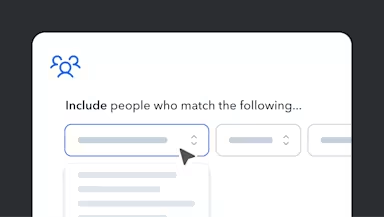
What micro segmentation changes
Traditional segmentation divides your audience into groups based on attributes. These attributes are stable and easy to capture, which is why most marketing teams start here. But stable also means static. Two people with identical demographics can have completely different intent, urgency, and content needs.
In practice, a micro segment might look like "trial users who activated the analytics dashboard within 48 hours but have not returned to it since." The segment is defined by a sequence of actions, not a profile field.
This shift matters for the following reasons:
Campaigns respond to real behavior. When segments are built on what people do, the content and messaging you deliver aligns with where they actually are in their journey rather than where a demographic model predicts they should be.
Feedback loops get faster. Behavioral segments change as people's actions change, so you can detect shifts in engagement or intent within days rather than waiting for quarterly cohort reviews.
Waste data decreases. When recognition is built on outdated demographic assumptions, it misses the mark. Segments that track actual behavior close the gap between what you think someone wants and what they are demonstrating they need.
None of this replaces demographic segmentation entirely. Firmographics still matter for targeting and lead qualification. Micro segmentation adds a layer of behavioral precision to that base, so that the personalized content you deliver is grounded in evidence rather than assumption.
The data that makes micro segmentation work
Micro segmentation depends on having data that you can act on, not just data you can collect.
Behavioral data
This is the primary input. Page views, click patterns, purchase sequences, feature usage, session depth, scroll behavior, and repeat visit frequency all describe what someone is actually doing. Demographics tell you who a customer is in theory, while behavior tells you what they want right now.
Here’s a practical example. An e-commerce team tracking product page views alongside add-to-cart actions can distinguish browsers (high page views, no cart activity) from comparison shoppers (multiple product pages in a single session, cart-adds and removals) from high-intent buyers (direct navigation to a product, immediate cart add).
Each group needs different content: the same "20% off" email sent to all three is a missed opportunity for at least two of them.
Contextual data
Device type, time of day, referral source, geographic location, and session context add real-time relevance to behavioral patterns.
For example, a user arriving from an organic search for "how to migrate CMS" has different intent from someone clicking through from a pricing comparison email — even if their behavioral history looks similar. Contextual signals help you distinguish between segments that share behavior but differ in intent.
Psychographic signals
Content engagement patterns, topic preferences, stated interests, and the depth of interaction with specific content categories reveal what someone cares about, not just what they click.
These signals are harder to capture at scale but are highly valuable for messaging decisions. A reader who consistently engages with technical architecture content should not receive the same nurture sequence as one who reads only business case studies.
Analytics as foundation
None of these data types become useful without measurement infrastructure. You need event tracking to capture behavioral signals, journey mapping to understand sequences, and conversion attribution to connect segment membership to outcomes. Without this foundation, micro segmentation is guesswork; you’re creating segments based on assumptions rather than observed patterns.
Before investing in segment creation, audit what you can actually measure. If your analytics cannot tell you which pages a user visited in sequence, or how long they spent with a specific piece of content, or whether they returned within a week, you likely do not yet have the inputs micro segmentation requires.
How to build and refine micro segments
Micro segmentation is not a one-time configuration. It follows an iterative cycle: observe, identify, segment, personalize, measure, refine. Each pass through the cycle produces better segments by establishing which distinctions actually matter.
1. Observe: Set up event tracking and behavioral analytics
Start by instrumenting the touchpoints you can control. Define the events that signal meaningful behavior: page views with scroll depth, feature activations, content downloads, email opens and clicks, form starts and completions, return visit frequency, and so on.
Setting up event tracking typically requires developer involvement to instrument your pages and define events. If your analytics stack is not yet instrumented, this is the first dependency to resolve before segmentation work can begin. You do not need to track everything, only the actions that correlate with the outcomes you care about (conversion, retention, expansion).
2. Identify: Find behavioral clusters through pattern recognition
Look at user journey data for naturally occurring patterns. Which sequences of actions precede a conversion? Where do users who churn diverge from users who stay? Intent signals — search queries, page sequences, time-to-action — reveal groupings that demographic categories miss entirely.
For example, a Software as a Service (SaaS) company analysing trial behavior might find three distinct clusters. Some users activate core features within the first three days, while others explore broadly but do not go deep on any single feature. A third group signs up and stalls entirely.
Each cluster predicts a different outcome. The segmentation follows from the pattern, not from a hypothesis about who the users are.
3. Segment: Create groups with clear action implications
Build segments based on behavioral similarity, not demographic convenience. Each segment should have a clear "So what?": A specific action you would take differently for that group. If two proposed segments would receive the same content and messaging, they are the same segment.
Start with three to five segments. Resist the urge to create dozens. Complexity scales linearly with the number of segments; every new segment requires its own content, measurement, and ongoing maintenance.
4. Personalize: Match content and messaging to demonstrated behavior
Once segments are defined, map each one to a distinct content experience, message, or offer that responds to the behavior that defines the segment.
For example, a comparison shopper segment should see competitive positioning and differentiation content. A high-intent segment should see friction-reduction content — clear pricing, fast checkout, and direct paths to conversion.
The key principle here is that personalization should follow segmentation, not drive it. Define the segment first, then decide what to deliver. Starting with "We want to show this banner" and then reverse-engineering a segment to trigger it results in arbitrary targeting, not meaningful personalization.
5. Measure: Run conversion analysis per segment
Track whether finer segments actually produce different outcomes. Run A/B tests at the segment level: Does the personalized experience outperform the default for each segment? If a segment receives tailored content but converts at the same rate as the control, the segment is not actionable.
Measure the delta between segments, not just within them. The value of micro segmentation is in the differences; if all your segments perform identically, your segmentation criteria are not capturing meaningful variation.
6. Refine: Merge, split, and iterate continuously
After a measurement cycle, merge segments that behave identically and split segments where you observe divergent outcomes within the group. This should be continuous, not quarterly or annually.
Each iteration should produce either better performance or fewer segments — both represent progress.

Micro segmentation examples
E-commerce: Segmenting by cart behavior
Rather than segmenting shoppers by demographics or purchase history alone, an e-commerce team tracks in-session behavior to identify distinct groups.
Browsers view multiple categories without adding to cart — because they need product education and discovery content.
Comparison shoppers add and remove items across competing products — they respond to competitive positioning and reviews.
High-intent buyers navigate directly to a product and add it immediately — they need urgency-driven messaging such as stock levels and delivery timelines.
A cookie-cutter promotional email sent to all of these groups wastes relevance on most of them.
SaaS: segmenting trial users by feature adoption
A SaaS company segments trial users not by company size or industry but by what they do in the first week.
Users who activate core features within three days are likely evaluating seriously — they receive advanced use case content and direct sales outreach.
Users who explore broadly without going deep on any feature may be in early research — they receive educational content about specific use cases.
Users who sign up and stall get re-engagement nudges focused on the single highest-value feature.
The segmentation is based entirely on behavior within the product, not on firmographic data.
Content and media: Segmenting by engagement depth
A publisher segments its audience by reading behavior rather than subscription tier.
Headline scanners (high page views, low time on page) receive content formatted for quick consumption — bullet summaries, key takeaway blocks.
Deep readers (high time on page, scroll to completion) receive longer-form recommendations and newsletter invitations.
Sharers (social sharing activity, email forwarding) receive content with built-in distribution hooks.
Each group interacts with the same publication but has fundamentally different engagement patterns that warrant different editorial and distribution strategies.
When micro segmentation stops working
Micro segmentation isn’t a magic bullet. It has diminishing returns, and recognising them is as important as building the segments in the first place.
Diminishing returns
At some point, splitting segments to a certain depth produces groups that respond identically. If your "high-intent buyers who arrived from paid search" segment converts at the same rate as "high-intent buyers who arrived from organic search," the referral source distinction is not adding value.
Two segments that behave the same way are, for practical purposes, the same segment and merging them will likely simplify operations without a drop in performance.
Operational complexity
Every segment requires its own content, messaging, creative assets, and measurement. Ten segments means ten variations to create, maintain, and test. Fifty segments means fifty.
The cost of maintaining segments must justify the performance difference each one produces. A segment that lifts conversion by 0.2% but requires a dedicated content stream and weekly reporting may not be worth the operational investment.
Data quality thresholds
Segments with too few members produce noisy data. If a segment contains 30 users, you cannot distinguish genuine behavioral patterns from random variation.
You need enough observations per segment to reach statistical confidence in the differences you are measuring. Small segments may feel precise, but their apparent performance may be entirely driven by a handful of outliers.
The right stopping point
The goal of micro segmentation is scalable, meaningful personalization, not infinite personalization.
The right number of segments is the fewest that capture meaningfully different behaviors and justify distinct treatment. If adding a new segment does not change what you would do differently for that particular group, you’ve likely reached the point of diminishing returns.
From broad segments to behavioral precision
Micro segmentation is not a departure from personalization but an evolution of it.
Most marketing teams already have the data and the intent they need to personalize. Micro segmentation sharpens how they act on both, replacing broad demographic assumptions with behavioral patterns that reflect what people actually do.
But maintaining multiple segment-specific experiences isn’t easy. In fact, in inflexible, page-based, legacy content platforms, it’s challenging.
Effective micro segmentation requires content that is modular, reusable, and structured for variation. This is where composable content architecture directly supports segmentation at scale. When content is built from components rather than monolithic pages, delivering a different experience to a different segment becomes a configuration decision rather than a rebuild.
Personalization platforms built on composable content enable content teams to assemble and test segment-specific experiences from reusable components, reducing the operational cost of maintaining multiple variations. Composable architecture ensures segmentation scales seamlessly as brands expand into new markets, and can adapt effortlessly as the landscape evolves, including integrating artificial intelligence (AI) tools with personalization workflows.
Remember: personalization is not about creating infinite segments. It’s about finding the sweet spots, the meaningful differences in how people behave, and responding to each one with content that fits.
Ready to take your brand’s personalization to the next level with the Contentful digital experience platform? Reach out to our sales team to take the next step.

blogDetail.subscribeCard.title
blogDetail.subscribeCard.description
blogDetail.authors

Thomas leads the Enterprise Solution Engineering Team in EMEA. With over a decade of experience in Marketing Technology, he has partnered with a wide range of customers to enhance their digital presence, streamline customer journeys, and drive sustainable growth through online engagement.
blogDetail.relatedArticles
How to build an API with the best GraphQL performance
July 9, 2025
Mastering React routing: A guide to routing in React
January 20, 2025
Webpack alternatives: 5 top JavaScript bundles
July 21, 2025

Ready to start building?
Put everything you learned into action. Create and publish your content with Contentful — no credit card required.