Contentful fait désormais officiellement partie de Salesforce ! En savoir plus
AI content management systems explained: Capabilities, architecture, and use cases
Every CMS vendor today claims to be AI-powered. But adding a chatbot doesn't automatically make a content management system AI-ready.
For a long time content management systems (CMSes) were judged on how well they helped you publish content, with features like templates, workflows and their ability to provide a UI-friendly editor for marketing teams. Generative AI has changed this dramatically: now helping you publish content can include drafting, translation, personalization, and agents that can edit or publish content directly. These are no longer just add-on features; they’re a part of the content lifecycle.
This article will walk you through what to look out for and ultimately how to evaluate an AI CMS vendor.
An AI content management system (AI CMS) uses AI to automate content creation, translation, personalization, optimization, and workflows. Learn how AI CMS platforms work, the role of structured content, RAG, APIs, and MCP, and what to look for when evaluating an AI-ready CMS.
What is an AI content management system?
An AI CMS is a content management system with AI embedded across drafting, content optimization, translation, and personalization, helping to deliver and optimize content more efficiently.
A traditional CMS only stores and publishes content. If you want any extra features, they normally provide plugins, but AI features are something you would need to develop and integrate yourself. An AI CMS’s AI features are embedded in the platform, so there's no need to build your own — marketing teams get a range of features like workflow automation, localization, and content optimization by default.
You may have also heard the term “headless CMS,” which just describes architecture where the content is separated from the user interface (UI) and served over an API. An AI CMS can also be headless, and since this is the more modern approach (many are) this means you have the option to build your own high-speed frontend layer.
Traditional CMS | AI CMS | |
|---|---|---|
AI features | Add via plugins or build/integrate yourself | Embedded by default — workflow automation, localization, content optimization |
Headless option | Available, but a separate architecture choice | Also available, and more commonly built this way, so you can pair it with a custom frontend |
Content demands have outpaced what the older, manual style workflows can handle. There are now more channels, finer-tuned personalization expected by users, and faster publishing cycles. Providing personalization at scale isn't realistically possible if every post has to be hand authored. AI CMSes are designed to meet this demand and provide your team with the tools to succeed in this challenging environment.
In summary, an AI CMS acts like a co-pilot for the daily workflow of content teams handling all of the repetitive, time-consuming manual tasks. This frees your team to keep up with content demand while focusing on strategy and other parts of the business.
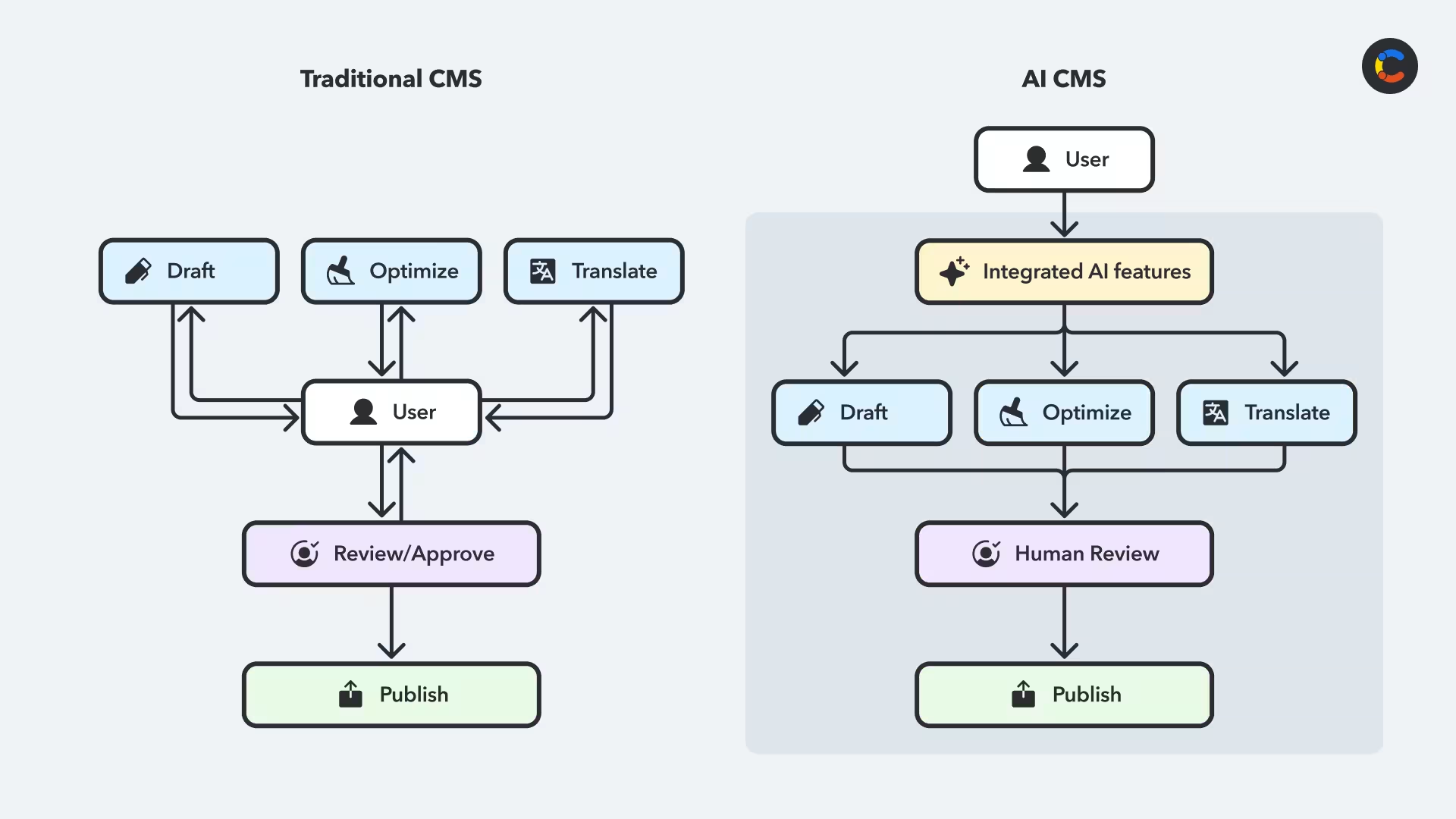
Diagram showing high-level differences between workflow in a traditional CMS vs. an AI CMS
What does an AI content management system do?
Most traditional CMS platforms were built solely to help publish content. According to Liferay's 2026 survey, only 7% of content managers draft content in their primary content platform, with the other 93% starting in Word, Google Docs, or a project management tool. In addition to being productivity boosters, AI CMSes are a way to close that gap, pulling tasks like drafting, tagging, optimization, and governance into the same platform that publishes the content.
Below are a set of the core capabilities most AI CMSes provide by default:
AI CMS capability | What it does |
|---|---|
Drafting & generation | Writes and edits content directly in the platform |
Auto-tagging & metadata | Applies tags, categories, and metadata automatically |
Translation & localization | Adapts content for new languages/markets |
Smarter search | Retrieves content by meaning |
Personalization | Tailors content to the visitor or segment |
Workflow automation | Moves content through review/approval steps |
AI agents acting on content | Takes actions on content directly and offers suggestions |
Much of this relies on retrieval, so AI CMSes use Retrieval Augmented Generation (RAG) under the hood. RAG accurately pulls in brand voice and prior content as context when necessary, providing more intelligent suggestions rather than generating freely.
If the AI CMS vendor has implemented this well, it should cover the process from ideation to publication with minimal human handoff. Content optimization also applies to all of your published content — AI continuously reviews existing pages and then uses SEO and performance data to update and improve your content. For instance, an agent might flag an underperforming article, initiate some SEO research, optimize by improving the title or adding certain sections that will help improve rankings, then hand it over for you to approve before publishing.
How to evaluate an AI CMS vendor
Nearly every CMS vendor claims to be "AI-powered" now, so it's difficult to tell whether they truly have embedded AI features that act on structured content with governance or if they just have a textbox with a chatbot bolted on. When comparing between different vendors, it can be useful to have the following questions ready.
Does the AI operate on structured content or just generate text in a box? A real answer should point to fielded, labeled content the AI can read and reach by API or MCP, not one big text field the AI has to parse and infer context from.
Can agents act through an API/MCP, or is it just a chat sidebar? A good answer to this should explain whether the platform exposes its AI capabilities through API/MCP and what the agents can do through them. A simple chatbot layer on top that only talks or makes suggestions isn’t enough.
Is content reusable across channels or locked to one front end? Yes, content should be available through a high speed API to any channel, not just tied to a single template or presentation layer.
Does the platform have support for RAG content databases? The answer should describe where retrieval pulls the data from and how that data is access controlled, not a vague gesture at "AI-powered search."
Can the platform enforce review, validation, and audits on AI-generated content? They should describe an approval workflow with governance and audit trails before anything gets sent for publishing. AI shouldn't be generating into a live field.
Vague, marketing-only answers to these questions are a red flag — a genuinely AI-ready vendor should answer each one specifically.
Why content architecture is what makes your AI CMS work
Clearly structured, API-first content is the fuel AI needs to produce good results. AI can infer meaning surprisingly well, but enterprise systems need consistency rather than guesswork. The complications of this can range from inaccurate optimizations to potentially miscalculating the price of a product.
For example, "$29.99 down from $39.99" buried in a paragraph is something AI needs to parse and interpret, compared with a price stored in a structured field (```price: $29.99) which is something it can just read. The consequence of letting your systems work with unstructured data rather than structured data spans everything from a miscalculated price on a live product page to broader hallucinations. For example, an AI assistant might tell a customer a product is in stock when it isn’t.
Older CMS systems tend to be more tightly coupled, locking content into presentation. This makes AI integration harder, since the AI can’t easily separate the content from how it’s displayed. Contentful is built structure-first: fields are clearly labeled, so the AI doesn't have to infer context, and relationships between different pieces of content are explicit, which allows the AI to pull in the correct linked context.
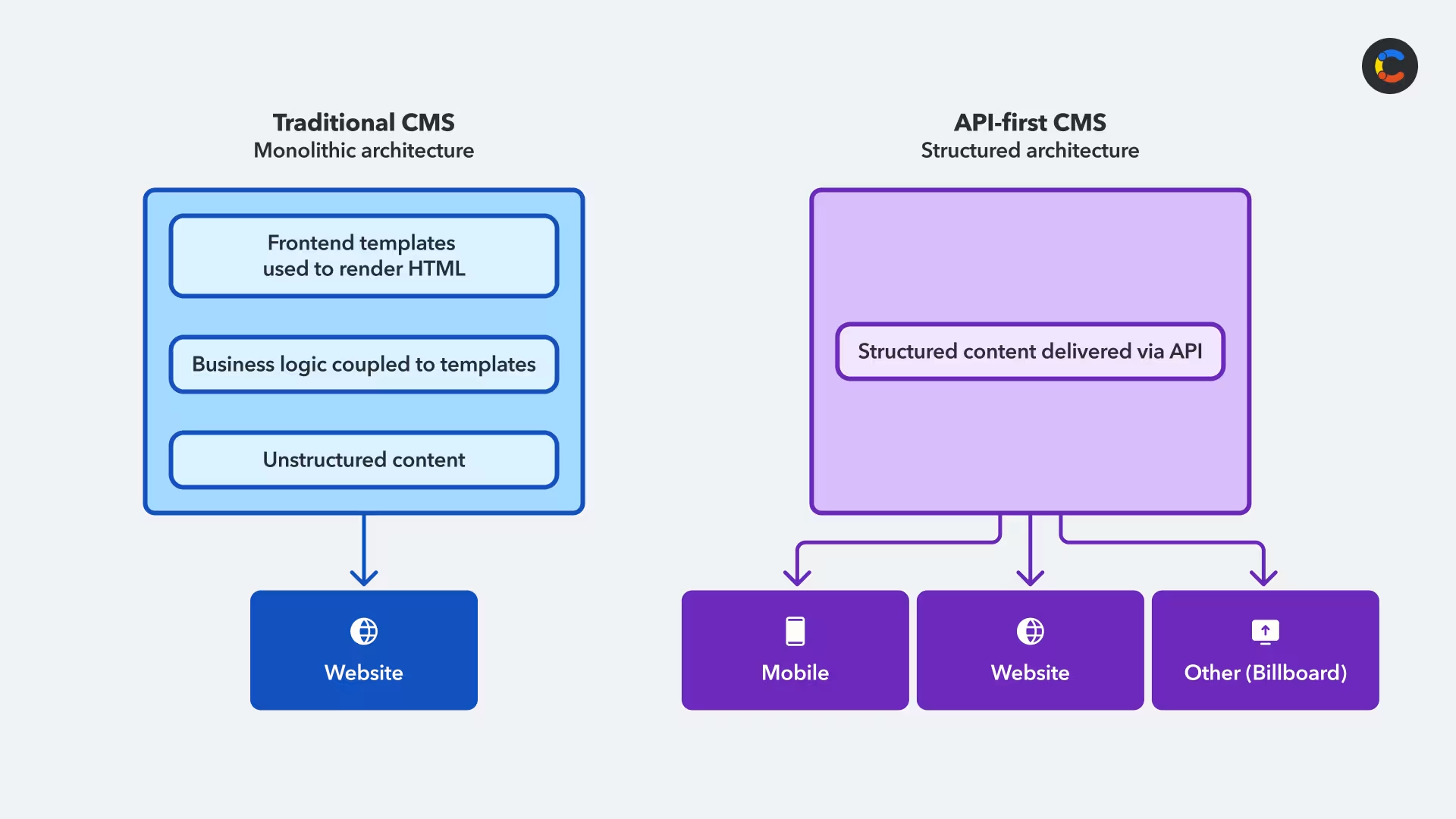
Comparison of structured/API-first architecture vs. monolithic architecture
What are the benefits of generative AI in a CMS?
There are many benefits of AI-powered CMSes, but what you get out of an AI CMS depends upon your role as a user. The users of an average business using an AI CMS can be roughly split into the following three groups:
Content and marketing teams get a major productivity boost with automated drafting, optimization, and localization, which not only allows them to produce more content at higher speeds, but also to set aside time for higher-value work like strategy and editing.
Developers get the benefit of structured content served over high-speed APIs to build against. They also get AI features (such as Agents, MCP, and RAG), which they don't have to build and maintain themselves. That's less time spent on custom integrations and maintenance and more time spent building out the features that differentiate your product.
Site visitors benefit from the result of the first two: personalization and tailored recommendations that make the experience feel relevant to them personally, rather than something generic.
What are the challenges of an AI CMS?
Generative AI accelerates the process of content creation and optimization. However, without schema validation, review workflows, and audit trails, it can create accuracy and compliance problems faster than humans can discover the issue.
Output quality and oversight are a real concern here. AI can confidently produce content that is wildly inaccurate, especially when working with unstructured input, so it still requires a human check before anything gets published. Governance is also important — AI can drift from brand voice and style guides over time if there are no rules put in place.
There are also practical costs to factor in: AI features introduce usage costs on top of the base platform, and proprietary AI CMS features or formats can make it harder to migrate away later, essentially locking you in.
No matter how many shiny features an AI CMS claims to have or how capable the model is, if it has bad content architecture with unstructured data, the AI features will consistently under-deliver. Unfortunately, part of that burden lies with you. If you currently have unstructured data, you may need to migrate all of your existing content and processes to work in a structured format.
Contentful comes with AI features embedded
That architecture problem is exactly what Contentful is built to avoid. Contentful is structure-first by design, so there's no migration burden that comes with unstructured legacy content later down the line. Contentful gives your content clear fields and relationships from day one and embeds AI features directly into the platform, rather than as an afterthought.
As an example, AI actions run on structured fields rather than free text. They can translate, rewrite, tag, and optimize content at the entry level in bulk across hundreds of entries at once — with approval and review built into each step before anything is published. Contentful covers governance and structure so you can turbo-boost your content operations without having to worry about accuracy or loss of reputation. For connection, as well as a high-speed API served over a global CDN, Contentful provides an MCP server. The MCP server gives agents direct API-level access to content, so they can perform actions on your content by creating entries, marking entries for optimization, or fetching context.
Screenshots or GIF of AI actions here