Contentful is now officially part of Salesforce! Read more
AI agents
Summary
AI agents are changing how businesses automate work by going beyond chatbots to plan, reason, and take action across multiple systems. This guide explains what AI agents are, how they work, and how they differ from both chatbots and agentic AI. You'll also learn how businesses are using AI agents to automate complex workflows, the key risks to consider when deploying them, and how platforms like Contentful help teams build, manage, and scale AI-powered workflows with secure, structured content.
What are AI agents and how do they work?
Introduction
AI agents are transforming automation. Businesses have moved on from robotic process automation and rigid task assistants to something much more capable: systems that can reason, plan, and act autonomously on your behalf.
This means they can take real actions for you, like sending emails, updating databases, or booking meetings.. And this doesn't just mean doing one isolated task at a time — modern AI agents can now chain tasks together in complex multi-step workflows, covering entire business processes from start to finish.
What is an AI agent?
AI agents are the software systems built on top of large language models (LLMs), which are the technology behind systems like ChatGPT, Claude, and Gemini. AI agents equip these LLMs with the ability to pursue goals, use tools, and retain long-term memory that persists beyond a single conversation thread.
These additional features allow an AI agent to go beyond an LLM's reasoning and conversational abilities, taking autonomous, multi-step actions on your behalf to complete tasks.
It’s important to know how an AI agent is different from a chatbot. Both are powered by LLMs, but they're quite different in practice. Chatbots equip an LLM with a conversational UI, conversation history, and a persona — but that means all they can really do is answer questions in a simple response, much like other forms of generative AI. AI agents take it one step further, taking action on your behalf to help you achieve goals.
Businesses now use autonomous AI agents to perform tasks and solve increasingly complex problems by combining multiple types of AI agents, each with different specialties. These are sometimes called multi-agent systems.
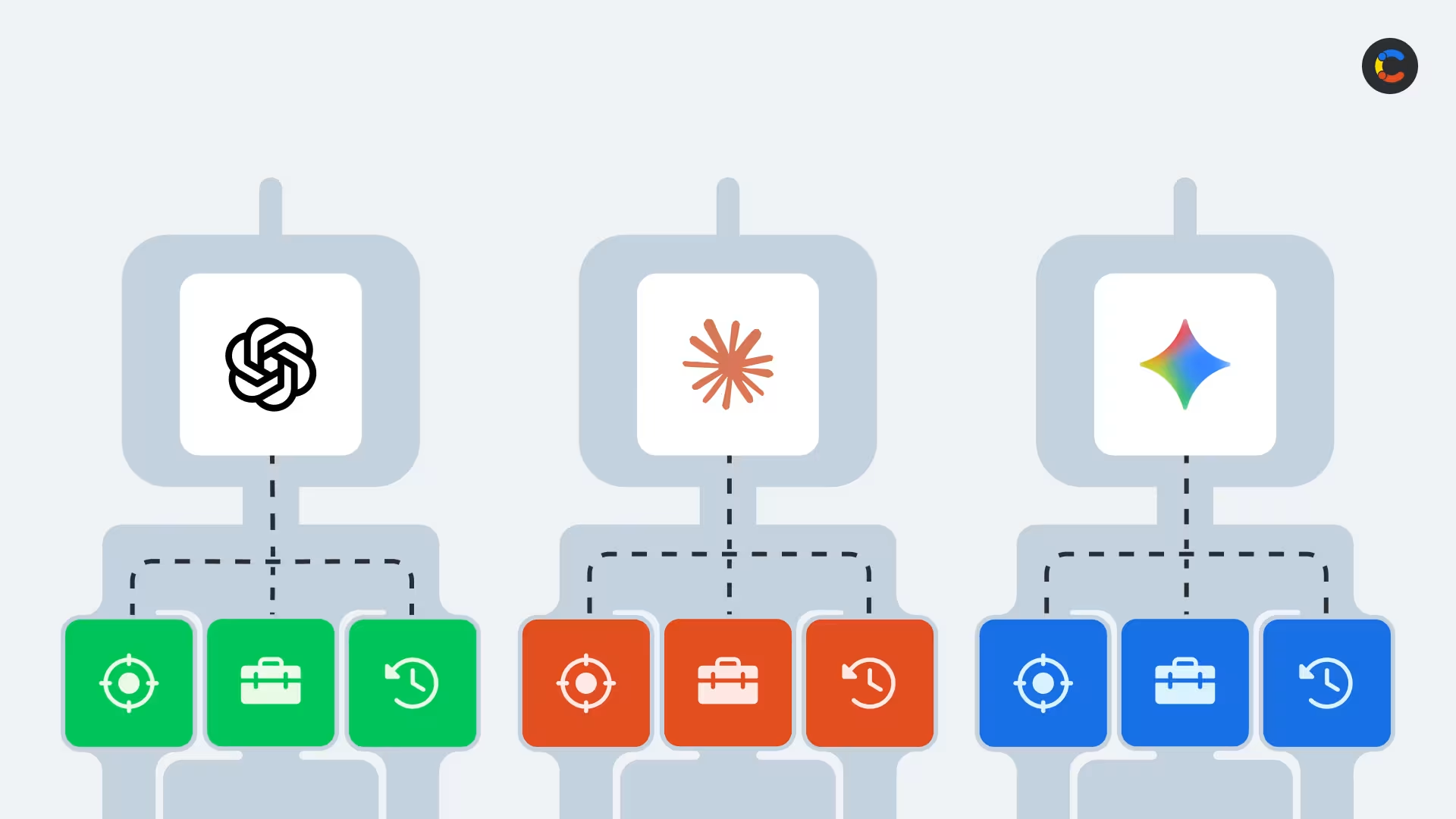
It’s important to know how an AI agent is different from a chatbot. Both are powered by LLMs, but they're quite different in practice. Chatbots equip an LLM with a conversational UI, conversation history, and a persona — but that means all they can really do is answer questions in a simple response, much like other forms of generative AI. AI agents take it one step further, taking action on your behalf to help you achieve goals.
Businesses now use autonomous AI agents to perform tasks and solve increasingly complex problems by combining multiple types of AI agents, each with different specialties. These are sometimes called multi-agent systems.
Agentic AI vs AI agents: Is there a difference?
AI agent vs agentic AI — these terms are often used interchangeably, but there is a subtle difference.
Agentic AI is an approach to solving problems, but one that uses one or more AI agents to do so.
An AI agent is a specific piece of software, whereas agentic AI is the strategy behind how businesses deploy AI agents to get things done.
For many business purposes, it’s less relevant which term you use as both convey this key piece of information: that AI (specifically LLMs) is working autonomously in connected workflows.
The AI agent loop: How AI agents work
On a fundamental level, an individual AI agent is given a goal and then works to achieve it. The most common way of doing this is running the agent in a continuous loop, where it reasons about what to do next, takes an action, and then evaluates whether the overall goal has been achieved. This loop can be one part of a broader AI agent architecture, which also covers how your agents will access tools, retrieve memory, and work with other agents within the same system.
If the goal has been achieved, it breaks out of the loop and the agentic workflow is complete. If not, it goes around the loop again, deciding on a new action, taking the action, and evaluating it again. To avoid getting stuck in an infinite loop (for example, if the agent is unable to achieve the goal), it's normal to build in a safeguard like a time limit or maximum number of times an agent can try.
This continuous evaluation loop is an agentic design pattern known as ReAct (reasoning and acting), and it's the most common reasoning pattern for an AI agent.
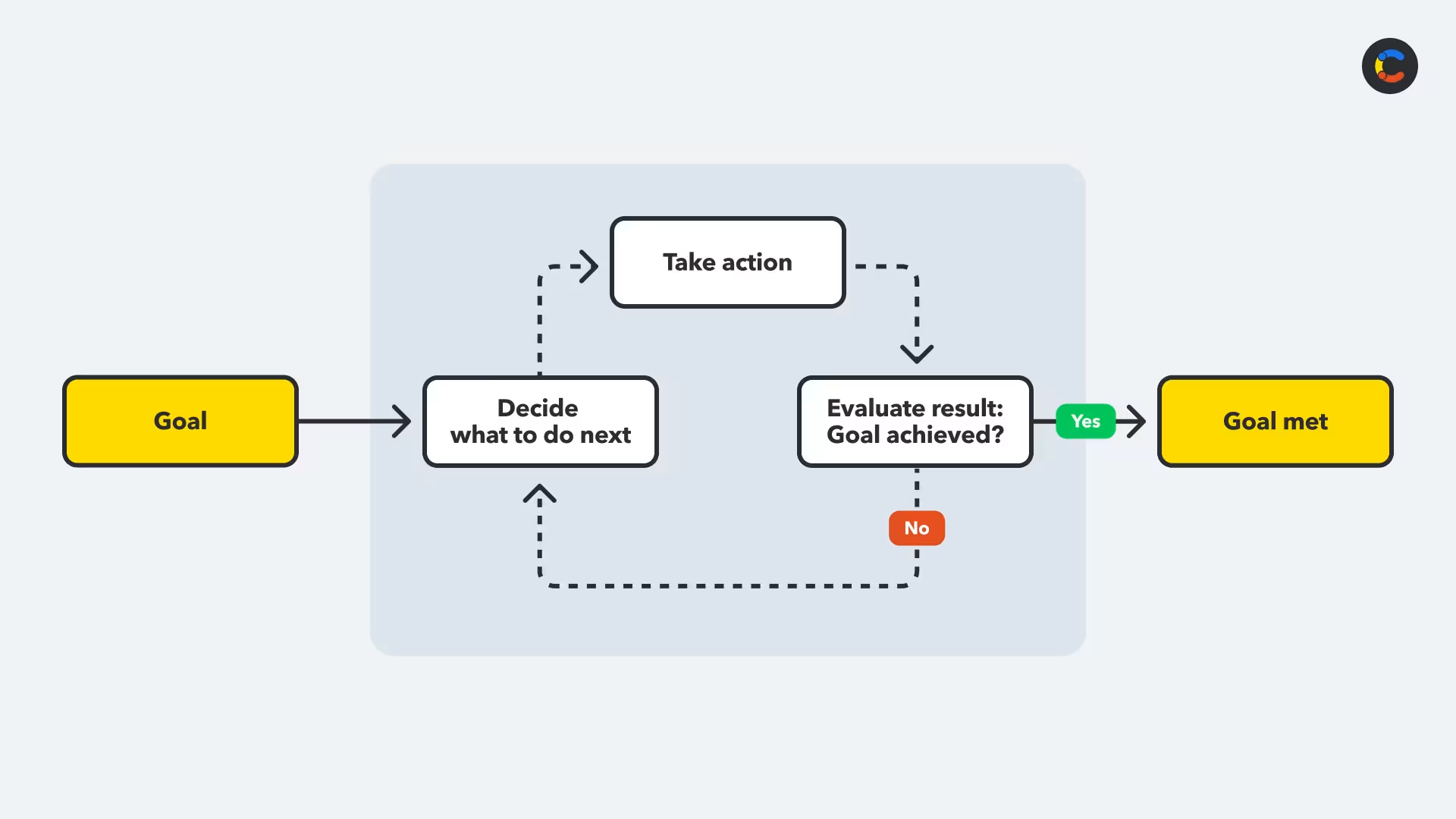
A simple example of ReAct is an agent responsible for booking meetings. Let's say you give it the goal "Schedule a 30-minute call with the sales team sometime next week."
The agent might reason that it should first check everyone's calendar for a slot when everyone is available. It then takes that action and evaluates the result: there are some time slots everyone could make, but as nothing has been booked yet, it reasons that it should go around the loop again and send an invite with a proposed time. On the next pass, it checks if the invite has been accepted by all the invitees. It may periodically check this until the goal is met and the loop ends.
The main alternative to ReAct is ReWOO (reasoning without observation), where the agent does all its reasoning upfront in a planning stage and then executes multiple actions in a row. ReWOO has the benefit of being cheaper to run, as it only calls an LLM twice: once during the planning phase and once at the very end of the chain of actions.
However, ReWOO isn’t as adaptable as ReAct. Because the agent does all its planning in advance, it can't adjust if one action in the sequence doesn't go according to plan.
So far, this has all been about how a single agent works, but multiple AI agents can work together. This pattern, called agentic orchestration, lets specialized agents work in groups on more complex workflows to tackle larger tasks together.
For example, if you want your agentic AI system to handle hiring job candidates, the goal of "hire a candidate" might be sent to an orchestrator agent that delegates each action to be taken to other AI agents within the same agentic system. Each of these other agents is optimized for one specific task, such as "screen CV," "schedule interview," "conduct background check," or "send offer letter." The agents all work together until their group goal is reached.
Automating business processes with AI agents
Businesses have been automating workflows with robotic process automation (RPA), a rule-based technology used to automate repetitive tasks, for many years. RPA can be used for tasks like automatically extracting data from invoices and inputting it into a system, but it can unfortunately be very brittle — even one tiny formatting change can break the whole automation.
Agentic process automation (APA) is now succeeding RPA to automate complex workflows within companies. This simply means applying agentic AI to your business workflows. With the rise of AI agents, backed by modern LLMs, you can easily automate complex tasks such as customer onboarding, invoice processing, or IT support triage.
AI agents are excellent at automating business processes because they use reasoning to adapt to small changes that hamper RPA. Because of this, they can handle exceptions much better. To see what real-world agentic process automation looks like in practice today, see our agentic AI examples article.
Risks of AI agents
Using AI agents in your workflows can come with certain risks, so it's good to be aware of them and have a governance plan in place. Some common risks include:
Lack of human oversight: Agents act autonomously and can take multiple actions at once, so small mistakes can compound into big problems. It can be tempting to prioritize automation over human intervention in order to save time, but it's a good idea to add human-in-the-loop checkpoints at key stages and even more so for high-stakes actions.
Hallucinations: By now, we've all experienced an AI hallucination. This occurs when a chatbot confidently gives a wrong or made-up answer. But with AI agents also taking real-world actions, the consequences of hallucinations become severe. Any AI governance plan worth its salt needs to ensure that all agent actions are monitored and can be rolled back if something goes wrong.
Security: AI agents can take actions in your name, such as sending an email from your address or updating a system from your user account. This access creates risk. If an agent is compromised (or just behaves unexpectedly), you need some form of damage limitation so it can't run amok. The solution is to apply the principle of least privilege, which is the exact same standard used to limit what human users can access on a system. When deploying agents, this means only allowing them the bare minimum access they need to do a specific job. With agentic AI, a common way to do this is to set up an MCP server — a standardized system for AI agents to access tools and data. This is fast becoming the default way to implement access management for AI agents, defining exactly what each agent is allowed to do.
Ethical considerations: AI agents are taking more and more actions that affect real people, from screening job candidates to approving expense claims and prioritizing support tickets. You need to consider whether your agents are acting in a fair and unbiased way, and keep proper audit logs that show exactly what an agent did and why. Also, keeping a human in the loop for any high-stakes decisions is the best way to ensure that your agentic AI system remains aligned with your organization's values.
How storing your content in Contentful helps you build and deploy AI agents faster
AI agents work best with structured content. It's harder for an agent to extract the information it needs from one long unstructured page than from structured data in bite-sized, properly labeled chunks.
Contentful's content model structure has well-defined fields and references for content you store in it. There's no need to set up your own MCP server, as Contentful already has one built in. This means your AI agents can easily access your structured content using the secure MCP protocol.
And before you even begin working on your own AI agents, you can use Contentful’s built-in AI workflow tools for automating content tasks, triggering multi-step agentic workflows, and adding human review checkpoints at different stages in your workflow.