Rich Text
Was sind Rich Text-Befehle?

Rich-Text-Befehle sind eine Zusatzfunktion, die darauf abzielt, die Effizienz von Editor*innen zu verbessern, die mit strukturiertem Content im Rich-Text-Editor arbeiten. Diese Funktion ermöglicht es den Nutzer*innen, Einträge und Assets schnell über ein Befehlsfeld einzubetten, ohne den Editor-Kontext oder die Tastatur zu verlassen. Das Befehlsfeld öffnet sich, sobald der/die Nutzer*in „/“ (Schrägstrich auf der Tastatur) eingibt, und bietet eine Palette von Befehlen, während der/die Nutzer*in weiter tippt.
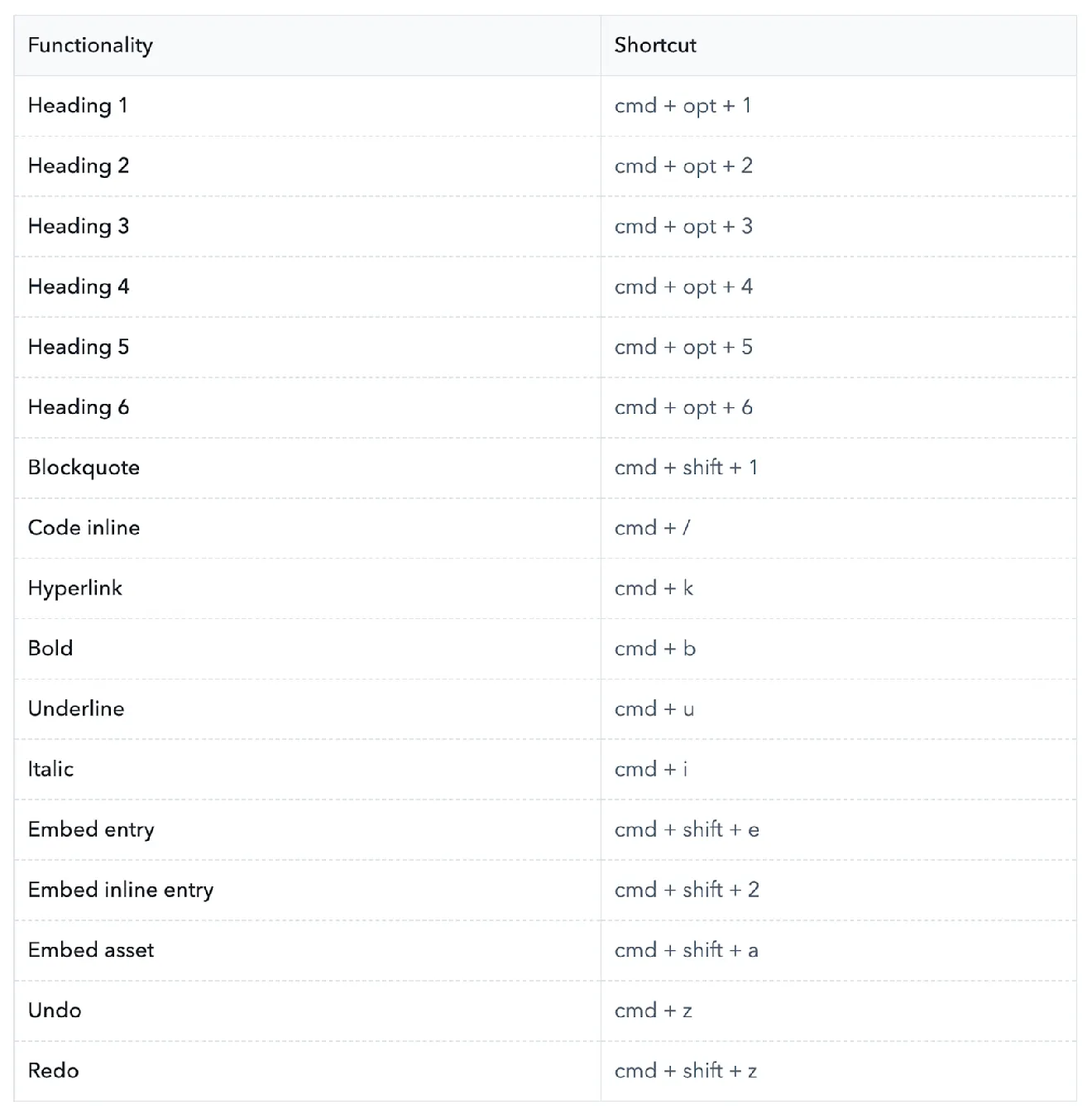
Was sind die Tastenkombinationen für den Rich Text-Editor?
What is the difference between an "Embed inline entry" and a "Hyperlink to an entry"?
Even though in the API response both of these features seem similar, the difference lies in the intended usage.
A hyperlink to an entry is still a hyperlink which is wrapped around a string and will take you to another page if you click on it.
An embedded inline entry is not wrapped around a string and you (or your developer) can choose what and if you want to render something there.
Here are some use cases of an inline entry that might help differentiate it with a hyperlink to an entry:
A reusable term, like brand name, across many pages.
An annotation modal over a term.
A user mention.
What is the difference between "Embed block entry" and "Embed inline entry"?
They both do the same thing: embed (or "link" as we say in Contentful jargon) an entry within your flow of text so that this gets rendered in your application as a widget. The difference between them is in the possible widget that will show up:
For inline entries you might get things like word annotations, or dynamic microcopy
For block entries you might get widgets like image carousels, embedded social media posts, sign up forms, related products and more.