Agentic AI examples
Summary
How AI agents are being used
Companies have moved on from using agentic AI for small pilot projects and now use it for production deployments at scale. AI agents now solve complex multi-step problems and can follow up on support requests with a 50% faster turnaround. They have reduced content localization costs by 30% for media companies, and they can handle over 1,600 chats at a telecoms company. To keep up, it’s a good idea to understand exactly what agentic AI can do.
This article will present real-world examples of how AI agents are being used by businesses, in both their internal and customer-facing use cases.
How AI agents are being used
Agentic AI isn’t the chatbot of yesterday — it’s a class of application built on top of large language models (LLMs), which harness tools and data across multiple systems. Working individually or in groups, each agent uses its agency to perform specialized tasks, all orchestrated by a managerial agent. The end goal is to provide the company or enterprise with an end-to-end process completed with minimal human supervision.
Companies are adopting agentic AI because of the clear time and cost savings. It allows their employees to focus on high-value operations, oversight, and customer service, which was previously made less than optimal by monotonous form-filling tasks.
This article will cover cases of agentic AI being used in the wild to accomplish many tasks: Internally, to optimize formal processes and improve the efficiency of daily work; And externally, to help smooth over the cracks of customer interactions and vault the hurdles that B2B and B2C life brings.
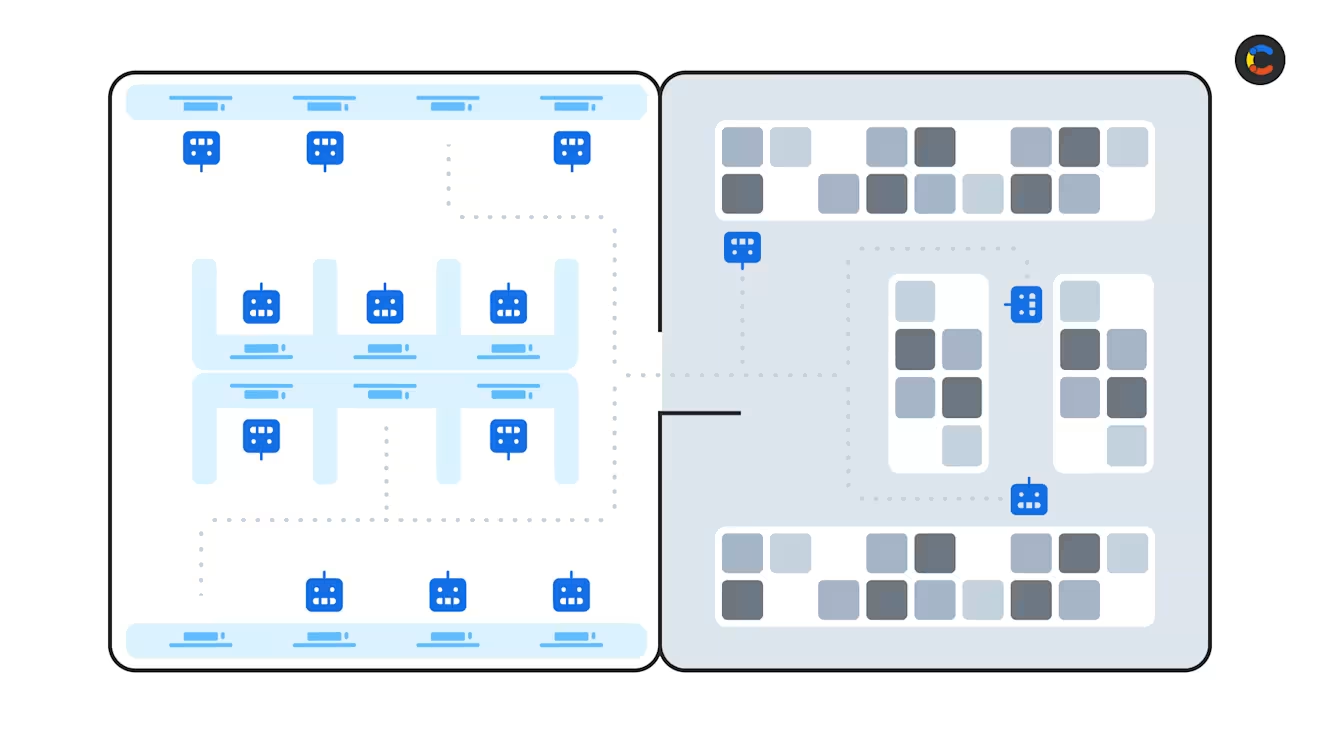
Agentic AI examples of internal business operations
Regal Rexnord
Agent: RRXy
This manufacturing company made over 500 agents (using Microsoft Copilot Studio) to integrate into systems like SharePoint, ServiceNow, and others. These integrations provide enterprise knowledge to assist human representatives. By accessing technical product information, they help streamline operational efficiency and improve self-service with corporate policies.
Regal Rexnord was able to build agents fast (some in less than 30 minutes), and they now handle thousands of queries every month, with around 2,400 hours saved every year. This, along with providing complex product documentation to service representatives, has allowed them to scale up and raise the company’s productivity by 12%.
Converteo
Agent platform: Gemini Enterprise Plus
Converteo chose Gemini Plus to build on and now operates specialized agents and time-saving orchestration agents, which handle the over processes. The various agent types can onboard new hires, identify which consultant matches a particular client’s requirements, assign internal tool access, and new contract verification.
The “agent factory” on the Gemini platform has shifted Converteo’s focus from repetitive workloads to high-value, strategic, and creative thinking. This brings a significant improvement in productivity, up around 25%, and demonstrates to their clients that they have a truly differentiated market offering.
NAGA
Agent platform: Microsoft Copilot backed by Dynamics 265
NAGA is a global consumer trading app that needed to remove the overhead of fragmentation by connecting their various campaign systems. The existing architecture held up marketing operations and launches.
NAGA has automated their campaign approach and achieved a more personalized experience for their customers by using the agents to consolidate data from across multiple platforms. The agents can remove the siloed nature of these platforms and process millions of real-time trade events and market signals.
This agentic foundation allows the agent to provide customer experiences across multiple channels, including social messaging like WhatsApp and Telegram. The move to agentic AI has brought a 50% increase in efficiency and around 150% in exposure across their multiple campaign channels, increasing user engagement by as much as 46%.
mobilezone
Agent platform: Microsoft Copilot Studio
The Swiss telecommunications provider mobilezone was using a legacy process involving a cumbersome form to provide internal support. They planned to replace this process with an agent developed using Copilot Studio and use the MCP protocol to integrate it into everything from MS Teams to Dynamics 365 and Dataverse.
The support agent “Supporto” was initially developed with Microsoft partner D ONE, and mobilezone also had Automatify build a Power Platform foundation for the company’s agents to integrate with various systems. This enabled Supporto to transform the clunky form-filling process into a virtual concierge where the agent can triage support requests, ask intelligent questions to process issues, and create support tickets where necessary.
Supporto has enabled support tickets to be more accurately and timely filled out, streamlined the process, and increased employee confidence that their issues will be followed through and supported. Resolution time has dropped by 50% across English, French, German, and other languages.
Gradial
Agent platform: Amazon Bedrock and Nova models
Gradial is implementing agentic AI by building specialized agents to work across content and digital asset management to provide marketing “at the speed of thought.”
The company built their agentic AI platform using AWS Bedrock to orchestrate their Amazon Nova models. This allows them to reduce friction between fragmented systems like Jira ticketing, asset management, and the workflow of content authoring. Website user journey analysis and simulation is also provided by Nova Act, which analyzes how users interact with online products. This in turn allows Gradial to improve navigation.
The results speak for themselves: the company had a 200% increase in efficiency and a 99.9% increase in accuracy of content operations.

Customer-facing agentic AI examples
AT&T
Agent: Digital receptionist
Wanting to shield their customers from the nuisance of scam calls and the new threat of AI-based scams, AT&T developed an agentic “digital receptionist.” The first of its kind to be deployed at such scale, the company is promoting this as the future of call handling and help to deal with scams.
The project aims to transform the customer’s experience by allowing the agent to screen incoming calls. It asks identifying questions and determines the urgency of the call, all before the customer even knows the call has been placed.
This aims to become a significant improvement over call screening systems, which ask the caller to say their name and laboriously perform their own screening. On top of that, AT&T plans for the agent to take messages, provide a live transcript of the call, and support a whitelist of numbers that must never be screened.
Google Pay India
Agent: CASE powered by Gemini
Google has produced a 21% increase in scam enforcement by developing CASE, an agent built specifically to handle reports of payment fraud and interview users about it. This agent is embedded in the Google Pay app, and it’s used when a user requests support after they believe they've been scammed. This improves the reliability of regional digital payments and customer confidence by providing a safety filter for users to report fraud.
The agent proves effective at customer engagement by ensuring that over 45% of their interviewed users answer three or more follow-up questions — a target for the company to achieve meaningful interviews. An information extractor in the agent structures transcript data for use in the downstream risk systems to prevent harmful content generation, policy violating content, and contextual sensitivity.
This shift from form-filling to “narrative” intelligence has allowed the team to detect new scam patterns and ensure a safer, more responsive payment ecosystem.
McDonald’s
Agent: ArchiQ
With fierce competition ever present in the fast food industry, McDonald’s is currently piloting an agentic AI drive-thru ordering service across five locations. This AI voice ordering system is part of ArchiQ, which is a wider AI company platform that links to other systems like kitchen operations and equipment monitoring.
B2B agentic AI examples
Avid
Agent platform: Google Gemini and Vertex AI
Known for creating professional audio and video production software, Avid is seeking to help today’s creative professionals who need immediate access to their media during post-production. To combat the legacy work of meticulously cataloging, tagging, and organizing huge (and growing) amounts of media, they built an agentic AI ecosystem to make the archives active and queryable with natural language.
The solution is embedding Google’s Gemini models into Avid’s industry leading tools, letting editors find specific shots using descriptions of things seen, rather than named. This descriptive searching can identify actions, people, and even emotions. This vastly reduces discovery time from potentially weeks to seconds and empowers production houses to scale productions up overnight.
The return on investment for those in the industry has liberated creative professionals, allowing them to stay in their “editorial flow” and retain focus on narrative, emotion, and matching visual styles, all while still in full control of the editing process.
Prime Focus
Agent: CLEAR AI using Claude LLM via Amazon Bedrock
Prime Focus Technologies set out to integrate Amazon Bedrock and LangGraph to build an agentic “supervisor”. This would orchestrate specialized AI agents for complex, long-running tasks.
PFT worked with the AWS Prototyping and Cloud Engineering (PACE) team to transform Anthropic’s Claude LLM into a reasoning system. They aimed to develop CLEAR, a system supporting media workflows for clients like Disney, CBS, and Channel 4.
The transformative results have produced up to a 30% reduction in localization costs and up to 40% in turnaround times, as well as a 30% improvement of subtitling and transcript content. All this enables operational teams and their creative staff to scale their content libraries while retaining quality.
Haast
Agent: Custom agent pipeline built on Amazon Bedrock
Seeing that legal and marketing teams are struggling against the tidal wave of content produced by the AI world, Haast recognized the need for agentic products to simulate the nuanced contextual judgement of professionals.
They built a suite of agents on top of Amazon Bedrock to autonomously analyze their clients' documents, websites, and social media for brand and legal compliance risks before publication. Agent reviewers are specialized to specific fields, and they can be used in highly-regulated areas like banking and insurance.
These agents check for non-compliant content in multimedia as well as text, and they can provide the exact place or timestamp where it was found. They then identify risks, classify them by severity, and report back with instant, actionable recommendations. Any issues are flagged to human reviewers, who can jump straight to the flagged section — which is complete with full context and reason for flagging — and then make a final decision.
The project has resulted in savings of over 500 hours of review time and an 80% improvement in team productivity. By reducing campaign launch times by up to 300%, Haast is helping enterprise teams move faster without sacrificing compliance to legal standards.
Contentful
Agent: Internal custom AI platform
The fragmented tasks of operations and the workflows of disparate teams (and their tools) have long plagued project leadership and the time to market of many enterprises.
Contentful built their custom agentic AI platform to bridge the gap between these tools and bring an automation and workflow system to eliminate busywork and strengthen brand reputation. Along with using AI to handle repetitive content management tasks — like tagging, status updates, and approvals — Contentful also provides agentic analytics and integration for the Model Context Protocol (MCP) as a standardized way of connecting to external systems.
Global enterprises like Docusign and Ruggable have successfully navigated the demands of Black Friday personalization and ultimately benefitted customers by liberating creative teams from the administrative overhead that so often weighs down otherwise talented teams.
Conclusion
Companies are reaping the benefits of integrating agentic AI into their operations and their products. With AI Actions and MCP for intelligent operations, Contentful is the best option for companies who are managing content across multiple markets, brands, and channels.
The automations and workflows from Contentful means your AI governance is always under your control, ensuring your customers’ trust is maintained.