Do llms.txt files actually improve AI search visibility?
Published on June 3, 2026



Inspiration for your inbox
Subscribe and stay up-to-date on best practices for delivering modern digital experiences.
Interest in answer engine optimization (AEO) is growing as more discovery journeys begin inside AI-generated responses, search summaries, and conversational interfaces.
That shift has created a familiar kind of uncertainty for marketing and content teams: When the rules are still changing, every new tactic starts to look like a potential shortcut. One of the most discussed tactics is llms.txt, a proposed machine-readable file intended to help large language models (LLMs) or retrieval systems understand which content on a site is most useful.
Because the evidence is still emerging, this post does not offer a definitive verdict on llms.txt. Instead, it examines what llms.txt is, why it is getting attention, what credible sources currently say about it, and how teams can evaluate it without mistaking speculation for strategy.
The key takeaway: llms.txt may be worth watching, and in some cases testing, but it should not distract from the work that already improves content discovery and trust.
A quick note on AEO and GEO
AEO, or answer engine optimization, is often used to describe the work of improving visibility in AI-assisted answers, including Google AI Overviews, AI Mode, voice assistants, and other answer-led search experiences.
GEO, or generative engine optimization, is often used more broadly for improving how generative AI systems understand, retrieve, cite, or summarize a brand’s content.
For this post, we'll use AEO as the primary term because the discussion centers on web-search-enabled answer experiences, while recognizing that GEO is often used as the broader umbrella for generative AI discovery.
Whatever acronym you prefer, the underlying goal is the same: helping high-quality, accurate, well-structured content remain discoverable as interfaces evolve.
What is llms.txt, and why is it gaining attention?
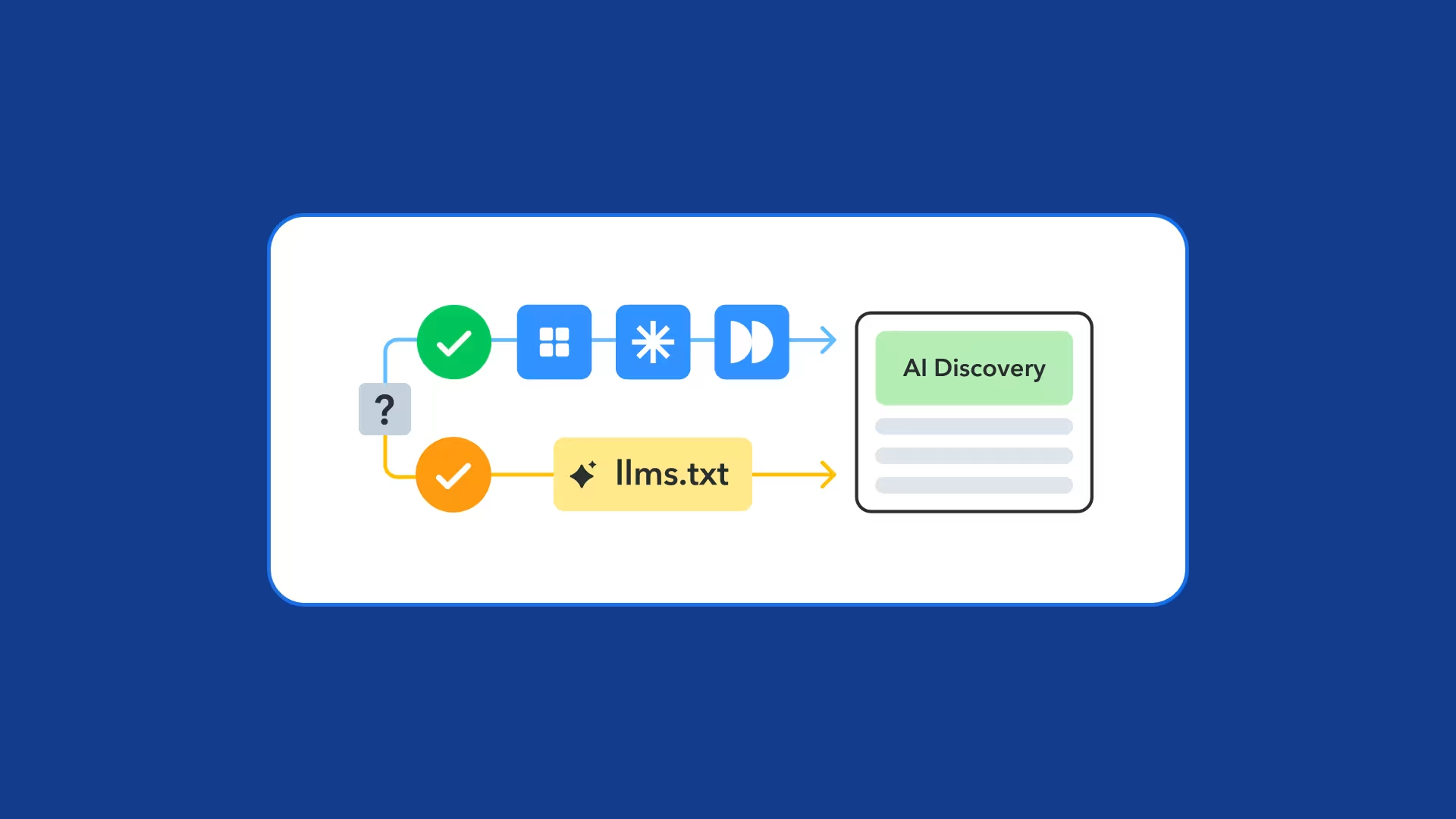
An llms.txt file is a proposed text file that website owners can place at the root of their domain.
In theory, it gives AI systems a concise, structured guide to important pages, documentation, policies, or other resources.
The basic idea is that it flags what's important, making it easier and faster for LLMs to digest content and identify what to serve to users.
For example, a software company might use an llms.txt file to point AI systems toward its product pages, pricing, and support resources rather than forcing those systems to discover everything on their own.
It’s easy to understand because it resembles familiar web infrastructure:
robots.txttells crawlers what they are allowed or not allowed to access.sitemap.xmlhelps search engines discover URLs, especially on large or frequently updated sites. A site may use one sitemap, multiple sitemaps, or a sitemap index file to submit many sitemaps at once.llms.txtattempts to summarize or point AI systems toward content that may be useful for language-model-driven retrieval or generation.
That comparison is also where teams should be careful. robots.txt and sitemaps have well-established roles in search crawling and indexing. llms.txt doesn't currently have the same level of formal standardization, platform adoption, or public documentation from major AI providers.
The original proposal came from a practical need: teams want a simpler way to give AI systems and agents concise, useful context about a site without requiring those systems to crawl, scrape, and interpret every page on their own.
But while llms.txt could make some AI interactions more efficient or accurate, it does not necessarily follow that adopting it will improve search visibility or increase citation frequency.
The promise: What proponents claim
Supporters of llms.txt generally argue that it could help AI systems identify authoritative content, understand a site’s structure, and cite preferred sources more reliably. Some also suggest it could improve inclusion in AI-generated answers by reducing noise and giving retrieval systems a cleaner map of a brand’s most useful content.
None of those claims are inherently unreasonable. Modern AI search experiences often rely on retrieval, ranking, and synthesis rather than simply generating answers from a model’s internal training data. In that context, structured signals may matter. A clear information architecture, descriptive headings, canonical pages, schema markup where appropriate, and consistent entity information can all make content easier to understand and reuse.
And it's easy to see why the idea is appealing. If AI systems increasingly determine what content gets surfaced, most teams would love a simple way to signal which pages matter most.
The real question is whether there’s evidence to support those claims. Most claims about llms.txt are currently anecdotal or theoretical. There is a difference between “this file is a tidy way to summarize our site” and “this file causes AI systems to cite us more often.” The first may be true. The second needs proof.
What Google’s guidance changes
The strongest evidence we have today comes from Google itself. The search engine’s recent guidance for generative AI features in Search makes the current picture clearer, at least for Google Search.
Google states that its generative AI features are rooted in core Search ranking and quality systems, including retrieval-augmented generation (RAG) and query fan-out. In other words, generative AI search is not a separate optimization universe. It still depends heavily on the fundamentals of search: crawlability, indexability, helpful content, technical structure, and quality signals.
Google is also explicit about what site owners don't need to do. Its guidance says teams don't need to create new machine-readable files, AI text files, special markup, or Markdown files to appear in generative AI search, and it specifically names llms.txt in that category.
Google also says there is no requirement to break content into tiny pieces for AI systems (otherwise known as “chunking”), no need to rewrite content solely for AI, and no special schema markup required for generative AI search.
That does not settle every question about every AI platform, however. Google Search is one ecosystem, and its guidance does not necessarily apply to browser agents, standalone AI assistants, enterprise retrieval systems, or other non-Google answer engines.
But it does set an important baseline: if the goal is visibility in Google’s generative AI search experiences, llms.txt should not be treated as a priority tactic.

How AI systems actually discover and use content
A simplified version of the process helps explain why the fundamentals still matter. AI systems may draw on information from model training, search indexes, real-time retrieval systems, licensed datasets, first-party integrations, or a combination of these sources.
In retrieval-augmented systems, relevant documents, passages, or structured records may be retrieved and used as additional context for generating a response.
This is why clarity matters. Content with a clear purpose, descriptive headings, consistent terminology, concise explanations, useful metadata, and strong internal linking is easier for humans to navigate and easier for machines to parse. The goal is not to write for bots. It is to make expert content understandable, trustworthy, and reusable across channels.
For Contentful customers, this is where structured content becomes especially relevant. A well-modeled content system helps teams define what each content type represents, manage relationships between entries, reuse approved messaging across surfaces, and keep information current.
Those capabilities matter whether the consuming interface is a website, app, search result, AI answer, chatbot, or agentic experience.
Could llms.txt create risk?
There's no strong evidence that adding a clean, accurate llms.txt file is inherently harmful, and there's also no evidence that the file itself triggers penalties.
The larger risk is strategic distraction. Early SEO history is full of tactics that attracted attention because they appeared to offer a shortcut. Some became legitimate practices; others became irrelevant. Some, when used manipulatively, created long-term risk.
The same caution applies here. A lightweight llms.txt experiment is different from reorganizing an entire content program around an unverified tactic.
So the practical question isn’t whether the file itself poses a risk, but whether your team should embrace an unproven tactic as a strategic priority.
Investigating the evidence: Does llms.txt work?
Today, there is no widely validated evidence that llms.txt reliably improves AEO visibility, citation frequency, referral traffic, or inclusion in generated answers. That does not mean it will never matter. It means teams should label it correctly: experimental, low-cost, and low-confidence.
Practitioner perspectives can be useful here, especially from agencies or teams actively testing AI search visibility. But early signals should be treated as directional, not definitive. A case study may show that an llms.txt file was present when visibility changed; it still needs to account for other factors before claiming the file caused the change.
At Seer,
llms.txtfiles aren't a priority recommendation for most clients. Google has explicitly stated they don't use the file for their AI experiences, and server log audits back that up. Actual LLM crawlers largely aren't fetching it. The time is better spent on content quality, structured data, and entity clarity, which have demonstrated impact on visibility in generative search.Olivya Pastis, Senior SEO/GEO Analyst at Seer Interactive
Proving impact is hard for several reasons.
AI-generated answers are non-deterministic, meaning the same prompt may not always produce the same result. Many interfaces provide limited source attribution. Referral data from AI tools can be incomplete or inconsistent. Search and AI systems change frequently. And visibility may improve for reasons unrelated to llms.txt, such as stronger page authority, fresher content, improved internal linking, increased brand mentions, or normal ranking volatility.
This is where teams might accidentally fool themselves. For example, a company might launch an llms.txt file in May, see more AI citations in June, and assume the file caused the change. But that same period could also include content updates, ranking improvements, brand mentions, or changes in the AI platform itself. Without a controlled test, that conclusion is unreliable.
How to test llms.txt responsibly
Testing makes sense, as long as it's done carefully. A responsible test starts with a clear hypothesis, such as: “Adding llms.txt increases inclusion or citation of selected Contentful resources in AI-generated answers for a defined set of queries.”
From there, teams should define the query set, identify which pages are included in the file, and compare performance against similar pages that are not included. The comparison group matters. If the pages in the file are already stronger or more authoritative, the test will not isolate the file’s impact.
Measurement should focus on directional signals rather than absolute certainty. Useful indicators may include inclusion in AI answers, citation frequency, changes in AI referral traffic where available, log-file evidence that known AI crawlers accessed the file, and changes in visibility across monitored prompts.
The test should also run long enough to reduce noise and account for the variability of generated answers.
Where llms.txt fits in an AEO strategy
The best place for llms.txt in an AEO strategy is near the bottom, not the top. It may be worth testing because it is relatively simple to create and monitor. But it should not outrank higher-confidence work.
For most teams, the stronger priorities are clear:
Publish original, expert-led content that adds value beyond generic summaries.
Keep important pages crawlable, indexable, and technically sound.
Use a clear content model so information can be structured, reused, and updated consistently.
Maintain strong internal links between related concepts, products, use cases, and resources.
Define entities, acronyms, and technical concepts clearly.
Refresh high-value content when facts, features, or market language change.
Those practices help across search, AI answers, site experiences, and owned channels. They also align with Google’s guidance: useful, non-commodity content and a clear technical structure matter more than speculative hacks.
What to watch going forward
AEO and GEO are still early. That makes the space both exciting and noisy. As with the early days of SEO, some tactics that seem important now will become standard practice, while others will fade as platforms clarify how they discover, rank, and cite content.
The signs to watch are practical. llms.txt would become more meaningful if major AI platforms documented support for it, if a formal standard emerged, if server logs showed consistent bot behavior tied to the file, or if independent case studies showed reproducible impact across multiple domains and query types. Until then, the right posture is cautious curiosity.
The bottom line
So where does that leave llms.txt? While llms.txt is an interesting experiment in the evolving AEO landscape, it's not a proven strategy for improving AI discovery.
Google’s current guidance is clear: site owners don’t need llms.txt or other special AI-specific files to appear in generative AI search experiences. More broadly, there's not yet enough public evidence to claim that llms.txt reliably improves inclusion, citation, or traffic across AI systems.
That doesn’t mean teams should ignore it completely. It means they should put it in the right category: experimental and secondary to fundamentals.
The durable work is still content quality, structure, authority, technical accessibility, and adaptability. Brands that invest there will be better prepared for AI-generated answers, agentic experiences, and whatever discovery interface comes next.

Inspiration for your inbox
Subscribe and stay up-to-date on best practices for delivering modern digital experiences.
Meet the authors

Asia is the SEO & GEO Manager at Contentful, where she supports organic search and AI-driven content discoverability strategies. Based in Berlin, Germany, she’s passionate about the evolving intersection of search, AI, and customer experience.

Jason McGhee is a technical leader and engineer focused on AI, agents, and human-centric product design. He joined Contentful through its acquisition of Writ, where he was CTO and co-founder, and now leads strategic initiatives.
Related articles

Headless architecture: Seven things to know
March 27, 2025
All about Next.js ISR and how to implement it
March 19, 2025

Build a blog with Next.js, Tailwind CSS, and Contentful
July 24, 2025

Ready to start building?
Put everything you learned into action. Create and publish your content with Contentful — no credit card required.