What is agentic architecture? The new way to automate your workflow
Published on March 31, 2026


Inspiration for your inbox
Subscribe and stay up-to-date on best practices for delivering modern digital experiences.
Autonomous systems aren’t new, but LLMs have changed how they work. Earlier agents were built utilizing if/else logic and fixed rules. Now, modern AI agents use natural language instructions instead of rigid logic and have the ability to interpret complex input and choose different tools dynamically.
This post will explain what agentic architecture is, how it works, and some of its use cases. It will also explore how Contentful can be used with agentic systems, along with some design principles for implementation.
What is agentic architecture?
An agentic architecture is an autonomous system that combines LLMs, tools, APIs, and memory to perceive inputs and context, reason about that information, take actions to achieve a goal, and then reflect on the outcome for improvement. This architecture manifests as AI agents: autonomous systems that operate using this loop.
This represents a significant shift from static LLM responses and hard-coded pipelines to dynamic, goal-driven systems that can operate autonomously.
To illustrate how AI agents might be used in the workplace, imagine a company changes a product name, perhaps after an acquisition or rebrand. Normally, this would require a content team changing hundreds of pages across different domains, like the marketing site, blog, help center, and so on. With AI agents, you can automate the entire process by having the agent scan the content repository, flag areas that use the outdated product name or incorrect terminology, and then decide on the appropriate change to make.
How agentic systems work
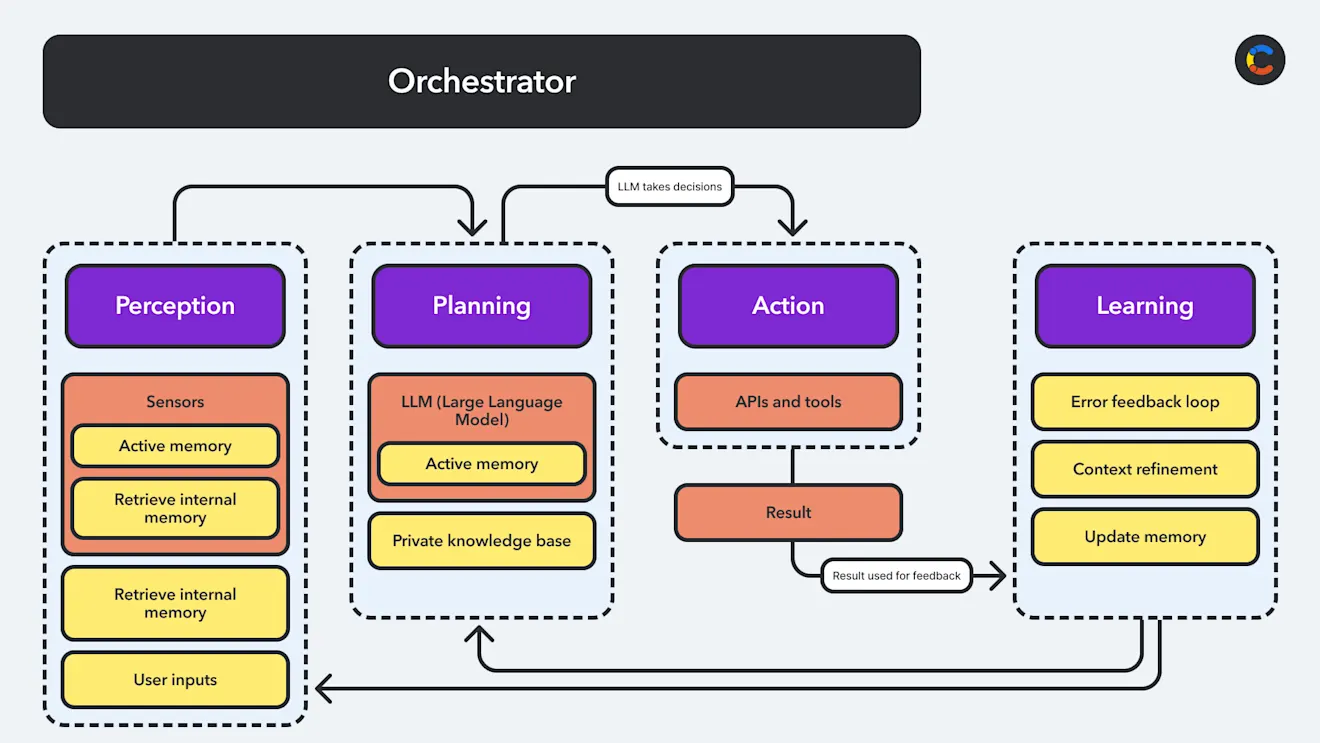
Agentic systems operate in a continuous loop: they begin with perception, continue to planning, take action, and finally reflect on the outcome, feeding that information back into perception.
The input that the system perceives can come from anywhere: It can be a user prompting the LLM, other systems, alerts, or an automated pipeline. The AI agent then reasons about the input, decides what should happen next, and breaks the task down into steps. It executes the plan using tools or APIs, fetching data, updating systems, or generating input.
Finally, the system uses a feedback mechanism that strengthens the agent. This process improves the agent’s ability to determine what worked and what didn’t, strengthening the agentic loop. The feedback mechanism can be implemented through prompt-tuning, fine-tuning the model, or more advanced approaches that use reinforcement learning (RL).
Agents work best when tasks are narrowly defined. They struggle when overloaded with too many responsibilities, so tasks should be divided into smaller agents (like an agent being solely responsible for structuring the output and another for displaying the results).
Core layers of an agentic system
A typical agentic system is composed of the following core layers:
Orchestration: Manages workflows, decides when to use tools, and coordinates agents. In simple (single-agent) setups, orchestration happens inside one model. In multi-agent architectures, an external orchestrator may route tasks across multiple specialized agents, sometimes even using hierarchical orchestrators for complex systems.
LLM: Handles reasoning, interpretation, and decision-making using natural language.
Tools/APIs: Allow the system to fetch data (from a database or real-time streaming), update systems, or execute actions in external systems.
Memory: This is where agents look up trusted information. Memory is retrieved dynamically. The line between APIs for fetching data and memory is blurry. Essentially, memory is an API and a tool. It is also where agents look up past experience to correct their approach. This is what makes agentic systems powerful: They are able to adapt to feedback you provide, recognize past mistakes, and adjust their approach based on what worked or failed previously.
Agentic systems vs. traditional automation systems
AI agents differ from traditional automation systems in a few key ways.
Agents can handle variable data and unexpected situations more effectively, making them more robust than traditional systems. They can also partially complete tasks or adapt to failures. For instance, if an API rate limit prevents an agent from completing analysis, the agent can return partial work and further guidance, whereas a traditional system would simply fail.
Additionally, agentic systems are expanding the horizon on what’s possible by enabling tasks that would be extremely complex or impossible using rule-based automation. LLMs’ flexibility enables non-deterministic reasoning, extraction, and analysis.
Why content matters in agentic architecture
Agents reason more accurately when given structured, machine-readable content. In contrast, when given unstructured or inconsistent content, they waste resources inferring structure and risk hallucinations.
Providing structured content from the outset allows the agent to focus on the task at hand and improves accuracy. So, it’s important that the platform your agents pull data and context from has consistent content models, rich metadata and labels to provide context, and clean content schemas so that there’s no guessing about the way the data is shaped.
If you supply your agents with poor content structure, then you should expect poor agent behavior. For instance, if your content is lacking metadata or is mislabeled, the agent could end up incorrectly routing requests.
A content platform like Contentful is well suited for providing a structured content layer for agentic systems, as it not only allows you to define consistent, reusable content models but also provides structured metadata and enforces schemas across content types.
How Contentful powers agentic systems
The Contentful platform provides a foundation for agentic systems to safely access, adapt, and deliver content efficiently with minimal errors.
Structured content as a reliable knowledge base
Agents can retrieve clean, contextual content from Contentful instead of disparate unstructured sources. When your data source is centralized within Contentful, you can quickly update the data schema, letting agents easily adapt to different data formats. Contentful works well for a wide range of content types: FAQs, docs, product content, workflows, or policies.
Its Content Semantics feature allows you to convert your content entries into vectors so that the system can understand the meaning beyond just keywords. This allows the system to detect duplicates or suggest relevant references. You can also query content semantically through the API, essentially giving you access to the retrieval component of RAG without having to set it up yourself.
API-first, composable access for agents
Contentful’s delivery and management APIs integrate well with agent tool-calling, making it easy for agents to fetch content, propose updates, or trigger workflows using REST and GraphQL endpoints. The API also comes with guardrails, such as permissions built in.
Omnichannel output without complexity
Contentful has omnichannel delivery built in, meaning agents can produce or adapt content once, and that content can then be served everywhere (for example, web, mobile, help centers, apps). This can help with content standards: Since there is a single source of truth, agents don’t have to generate separate versions of the same content for different channels, reducing the risk of error.
Connecting agents and Contentful with the Model Context Protocol (MCP)
Model Context Protocol (MCP) is a standardized way of connecting AI to external systems.
AI agents, or users controlling an LLM, can now take actions through the MCP servers of previously siloed systems. The MCP servers expose a machine-readable interface that details “tools” or functions that the agent can understand and call to retrieve, modify, or create data in a specific system. The possibilities for functionality are wide ranging, but MCP excels at performing tasks that are well defined and repeatable, such as creating or bulk-updating tickets in a project management system.
Before MCP, connecting AI to external systems required custom integrations, which could be costly, depending on the use case.
With Contentful’s MCP server, you can now retrieve entries, search content, create drafts, and update content entirely through natural language. This allows you to bypass the UI and control Contentful from an LLM of your choice.
MCP provides a consistent, well-defined way for agents to interact with Contentful, simplifying how tools are exposed to LLMs. Because agents can operate against explicit tools and schemas rather than inferred behavior, actions become easier for them to reason about, test, and monitor. All agents’ actions go through Contentful’s existing permissions, roles, and content models.
Where agentic architecture excels with Contentful
Agentic architecture paired with a content platform like Contentful opens up a small number of high-impact use cases that would have otherwise been difficult or risky to implement with traditional automation.
Content auditing, compliance, and large-scale updates
In regulated industries, content accuracy is critical, as it is a compliance requirement. Teams must be meticulous and make sure that content is accurate, up to date, and aligned with strict regulatory, legal, or brand guidelines. Manual review processes can be slow, expensive, and error-prone.
Agentic architecture helps with content auditing by scanning large content repositories, identifying issues, and taking action based on defined rules and context. Agents can proactively detect outdated information, incorrect terminology, or content that no longer meets compliance requirements. It can then flag any content that requires review or remediation and, if authorized, draft updates for approval. Then, someone with the correct role within Contentful can sign off on any flagged content or large-scale suggested updates.
Analytics-driven automated actions
In a large content-driven system, performance issues can often be overlooked and sometimes surface when it’s too late to act. Metrics like bounce rate, conversion drop-offs, or engagement anomalies signal problems with content quality, relevance, or accuracy.
Agentic systems allow systems to move from just monitoring signals and reporting to taking action when certain metrics are hit. Agents can ingest performance signals, reason about their significance, and take corrective action.
For example, when the bounce rate spikes beyond a threshold that you’ve predefined, an agent can investigate the related content, consider potential causes, and then take action, such as unpublishing a page, reverting to a previous version, or flagging the content for you to review. This promotes cohesiveness between analytics and content teams and improves responsiveness.
This vision is already taking shape with Contentful Analytics, which introduces an embedded, agentic analytics assistant that flags performance issues and recommends contextual optimizations directly within your content workflow.
Design principles for implementing agentic systems
To implement agentic systems safely and effectively, it’s essential to follow a few core design principles:
Process map
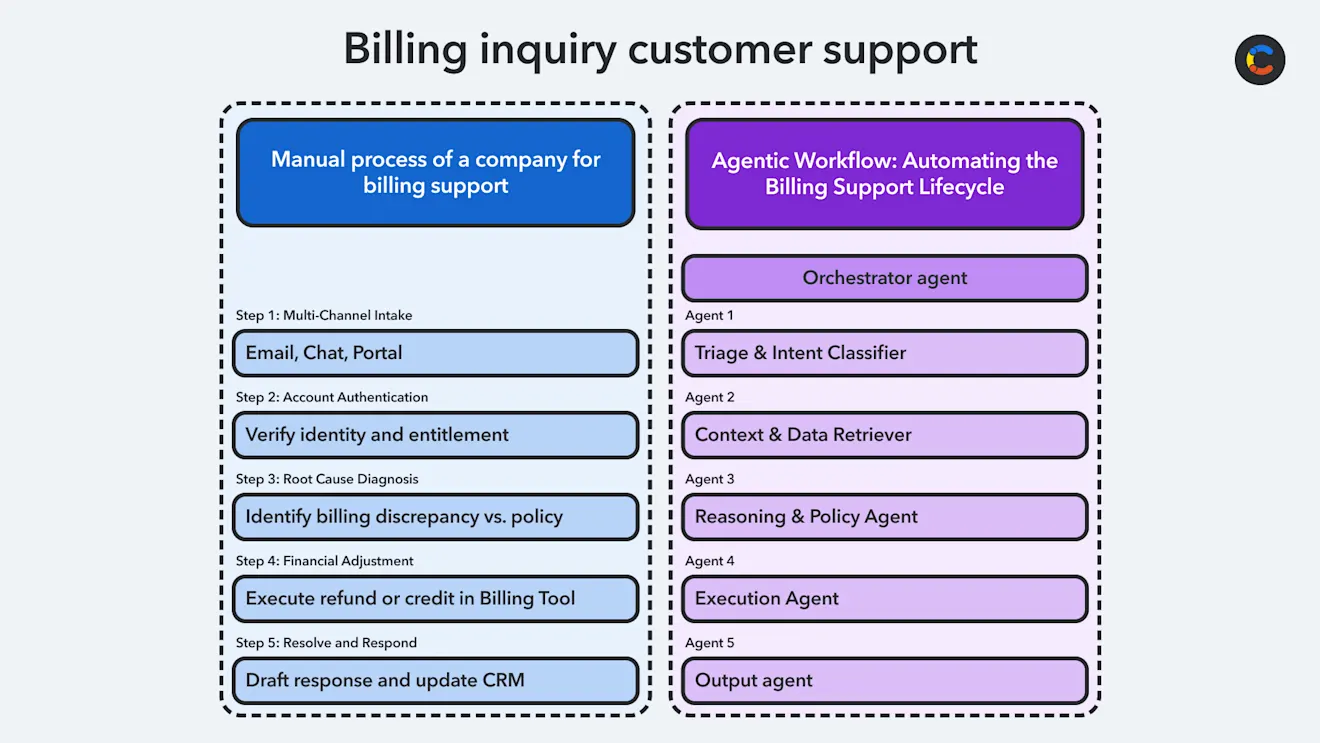
It’s best to start with one high-value workflow (for example, support, onboarding, or product updates). Workflow clarity is critical before you even get to implementing agents. Companies often fail with AI agents because they skip process mapping.
Think of it like a factory: Robots are not introduced into production without designing the workflow first. It’s important to know the exact steps in your workflow, what tools are required, where hand-offs occur, and which steps can be automated safely. If agents are applied without a defined process, they may still produce output, but it may not align with your intended outcome.
Model content for machines
Use clear fields, consistent schemas, and strong metadata so that agents don’t need to infer structure. This keeps the agent’s resources focused on the task you need completed and avoids complications that can arise from poorly inferred structure.
Define safe tool boundaries and approval workflows
Agents should operate with explicit permissions. There needs to be clarity around what they can modify and publish and what needs human review before going ahead. If you skip this step, you open up the possibility for error. In a worst-case scenario, the agent might delete something important. At the very least, any sensitive actions like deleting or publishing should be reviewed by a human.
Implement feedback loops
Design feedback loops at the system level: Use analytics, agent logs, and outcomes to refine behavior, improve accuracy, and reduce errors over time. Lightweight reversible adaptations are preferable to continuous model retraining or reinforcement learning, as the latter are slow, hard to roll back, and better applied when systemic changes are insufficient.
Use emerging open standards to avoid fragmentation
Open standards are becoming critical to prevent fragmented, one-off implementations. Initiatives like the Agentic AI Foundation (AAIF) aim to establish shared conventions for how agents are instructed, evaluated, and integrated across systems.
An example of this is AGENTS.md, which is a project-level file that defines how agents should behave within a given codebase or system. Similar to how README.md files guide humans, AGENTS.md provides explicit instructions for agents, covering goals, constraints, available tools, and expected behavior, helping enforce consistency.
Get started with Contentful for agentic architecture
Starting your journey in agentic architecture doesn’t require a full platform overhaul. You can start small, define the workflow, focus on structure, and scale from there.
💡 Tip: Contentful’s Automations & Workflows feature is a great way to implement structured, rule-based actions before introducing fully autonomous agents. It provides a safe, governed foundation you can build on as you scale into agentic architecture.
Here are the steps to get started with agentic AI:
Audit your content structure for AI readiness: Make sure models, schemas, and metadata are consistent and machine-readable.
Expose Contentful APIs and tools to agents using MCP, enabling safe, governed actions through natural language.
Start with a single, high-value workflow. Then scale it as confidence in the system and capabilities grow.
As AI agents begin to operate autonomously, governance becomes non-negotiable. Contentful’s audit logging provides full traceability of AI-driven actions, from individual changes to bulk updates. This means every decision and modification can be inspected and reviewed, giving you peace of mind.
With the right setup, Contentful can be a reliable content layer for intelligent, autonomous systems.

Inspiration for your inbox
Subscribe and stay up-to-date on best practices for delivering modern digital experiences.
Meet the authors

Stephen is a Senior Product Manager for Core Agents. Stephen has been building data, machine learning and AI products customers love. Outside of work he is a data nerd, enjoys sport and reading but he is mainly trying to figure out parenthood with two young kids.
Related articles
Where creativity meets reality: Optimizing marketing asset management for faster campaign delivery
December 1, 2025

Enterprise generative AI: Transforming operations and unlocking new possibilities
June 26, 2025

Website replatforming explained: Mitigating risks and maximizing your ROI
March 21, 2025