From data to insight: The growing role of AI in analytics
Published on May 8, 2026




Inspiration for your inbox
Subscribe and stay up-to-date on best practices for delivering modern digital experiences.
We’re living in an age of data abundance. Not only do we know more, but we have the means to collect information faster and at a greater scale than ever before.
The problem is, that’s not always a good thing, especially when it comes to content marketing analytics (sometimes known as data analytics). In many brand ecosystems, data is spread across multiple systems, tools, and dashboards, and brand teams have to navigate increasingly complex internal infrastructure to identify and access the data they need.
An abundance of analytics data isn’t particularly useful if brands (and their data analysts) can’t convert it into meaningful insight, and act on it within their content operations. In fact, research shows that, even with data at their fingertips, over 60% of marketers aren’t satisfied with their ability to measure content performance, and nearly 50% don't even factor data into their decision-making process.
The good news is that the disconnection between analytics data and action is disappearing thanks to artificial intelligence (AI), and in this post, we explain why.

What do we mean by AI in marketing analytics?
Brands have used AI tools to analyze their data for years. Until recently, the technology was limited to helping teams spot patterns in data and support reporting processes. However, the current generation of AI tools, incorporating large language models (LLMs) and natural language processing (NLP), has been more transformative.
To understand that transformation, let’s take a look back at where analytics used to be.
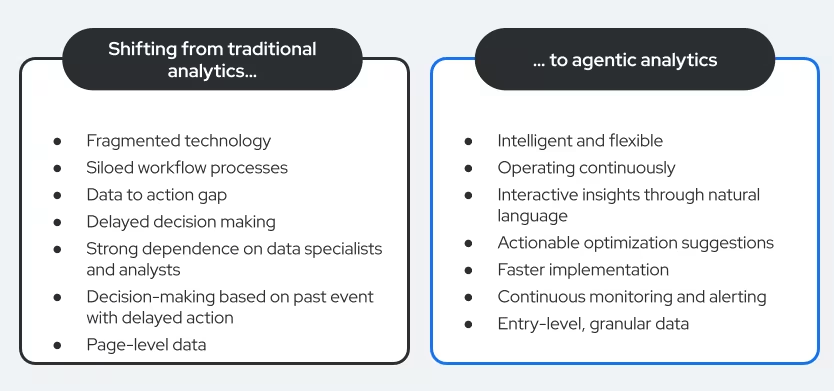
Traditional approaches to marketing analytics are largely static, dashboard-led, and tool-heavy. Or, to put it more bluntly, slow.
That’s because, in these environments, data lives across multiple platforms, fragmented and disconnected, and insight is surfaced through navigation across multiple dashboards.As part of that process, users often have to manually copy and paste data between UIs and then rely on technical expertise to interpret and generate insights, which not only slows analytics outputs but also increases the risk of error.
This complexity makes it harder for brand marketing teams to adapt when needs change. If new insight is needed in traditional data analytics models, teams need to rethink and rebuild their dashboard solutions, and then revise the process they use to generate insight. It also forces them to depend on data teams to interpret data and build dashboards, which means that important insight might not be actioned on time, delayed, or even missed completely.
In the age of the Great Content Collapse, with marketers under increasing pressure to scale and more besides, we need a way to deal with all that.
Enter agentic AI
AI changes that picture by leveraging generative AI (GenAI) and natural language processing, and building agentic functionality into the data analysis process. Agentic AI makes conversational analysis possible; users can talk to their data by asking their analytics platforms questions and receiving answers in seconds.
Rather than combing through different dashboards and metrics, tracking down siloed knowledge, and then waiting for experts to parse data and deliver insight, users can ask things like: “What were our top performing content entries last week?” “How long did customers spend on this page?” and “Why did these assets perform so well?”
Critically, agentic AI analysis isn’t layered on top of existing analytics solutions or applied externally; it’s a core part of the analytics solution, built into it as a native functionality from the ground up. That native integration supports the natural language functionality, but also ensures seamless access to the relevant content data — with no risk of compatibility or formatting errors.
How does agentic AI make a difference?
Although they deal with the same information as traditional analytics, agentic AI analytics tools do so faster, more efficiently, and more accurately, without the same technical barriers.
Here are the key differences.
Frictionless analysis
Traditional, dashboard-led analysis offers only snapshots of a bigger picture, often displaying data in isolation without any implicit connection between metrics. It's up to brand teams to synthesize that insight, but doing so involves friction. Analysts have to find the right dashboards, ‘swivel chair’ between platforms and UIs, and copy and paste between environments — all of which increases the potential for data fragmentation and human error.
Agentic AI streamlines that process, unifying data and making it accessible through a single UI. In that environment, teams don’t have to track down or synthesize insight but can ask for it instead.
Analysis for everyone
Traditional analytics has always been limited by expertise. Accessing meaningful insight involves understanding data models, navigating dashboards, and relying on technically skilled analysts to interpret results.
Agentic AI lowers that barrier. There’s no need to build specialist knowledge into the workflow to find and interpret data: Marketers, content creators, product teams, and other stakeholders can access the AI agent, ask it straightforward questions, and receive answers in real time. The accessibility factor allows non-technical teams to build a direct relationship with technical data, and expands the optimization feedback loop so that everyone in the content workflow can contribute to it.
Faster content velocity
In traditional data analysis, teams need to define their request for insight, extract the data, interpret the output, and iterate on the result. And the more manual effort those steps involve, the longer it takes for brands to obtain and make decisions on the insight. The impact goes further: The longer it takes to make decisions, the less value brands get out of their content, and the poorer their return on investment (ROI).
Agentic AI accelerates analysis by reducing the process to a single moment; a question, and an answer provided in seconds. That speed means decisions can be made instantly, increasing content velocity across the board: faster results, faster iteration, greater value, better ROI, and so on.
Better decisions
In traditional analytics, the analysis itself is stop-start; it’s a series of hand-offs and reports between teams — one team reports what happened with their content, another team works out why, and then reports back again. That process creates a divide between content performance and business outcomes, which can obscure insights and understanding.
Agentic AI closes that divide, tightening the feedback loop between performance, analysis, insight, and action. In short, it helps brands not only make faster decisions, but better decisions about their content.
Rather than a retrospective reporting function that explains “what happened”, the emphasis falls on predictive analytics, and the analytics solution becomes an optimization engine that constantly feeds new information into the digital ecosystem; “What should we do next?” “Did it work?” “How can we make it better?”
Agentic analytics challenges
While brand teams understand the potential benefits of AI analytics, almost half of users remain wary of the risks of AI integration, especially when it comes to the technology’s accuracy and reliability.
Hallucination: AI tools can sometimes generate outputs that appear accurate and authoritative but are not fully grounded in the underlying data. These hallucinations can lead to misinformed decisions or non-compliant content outputs.
Explainability: AI systems can be opaque in how they turn inputs into outputs. This lack of transparency can reduce confidence in analytics results and slow down decision-making.
Data privacy: AI systems that work with customer and business data must comply with relevant regulations, such as the EU’s GDPR — at the risk of significant fines and penalties.
Bias: AI tools can reflect biases present in their training data, leading to skewed or incomplete insights. This bias can distort understanding of analytics data.
Addressing AI risk
It goes without saying that brands must guard customers and employees against AI risks as a priority. Effective AI governance and controls not only ensure that integrations remain transparent, compliant, and accountable, but strengthen trust and confidence, helping users get the most out of their tools.
If you want to know more about how to implement AI safely, Contentful has plenty of information to help you, including how to build LLM guardrails and AI governance into your digital ecosystem.
Transforming agentic analytics with Contentful
It is easy to talk about the transformative potential of AI in content operations, but managing the shift to agentic AI analysis successfully and safely requires prioritizing investment in technology.
That means addressing the risk outlined above through effective AI governance, but also integrating agentic speed, responsiveness, and flexibility seamlessly with content operations.
Contentful understands that, and we’ve developed our digital experience platform (DXP) to give brand teams everything they need to realize agentic potential.
Embedded agentic AI
Contentful doesn’t treat AI as an add-on to the analytics workflow; it’s embedded into our platform. Contentful Analytics (currently in Beta) is an agentic platform that sits within the digital experience workflow, and will provide marketers with direct, real-time access to data insight. No need for developer hand-holding, and no waiting on insight to arrive after content has stopped being relevant.
Entry-level analysis
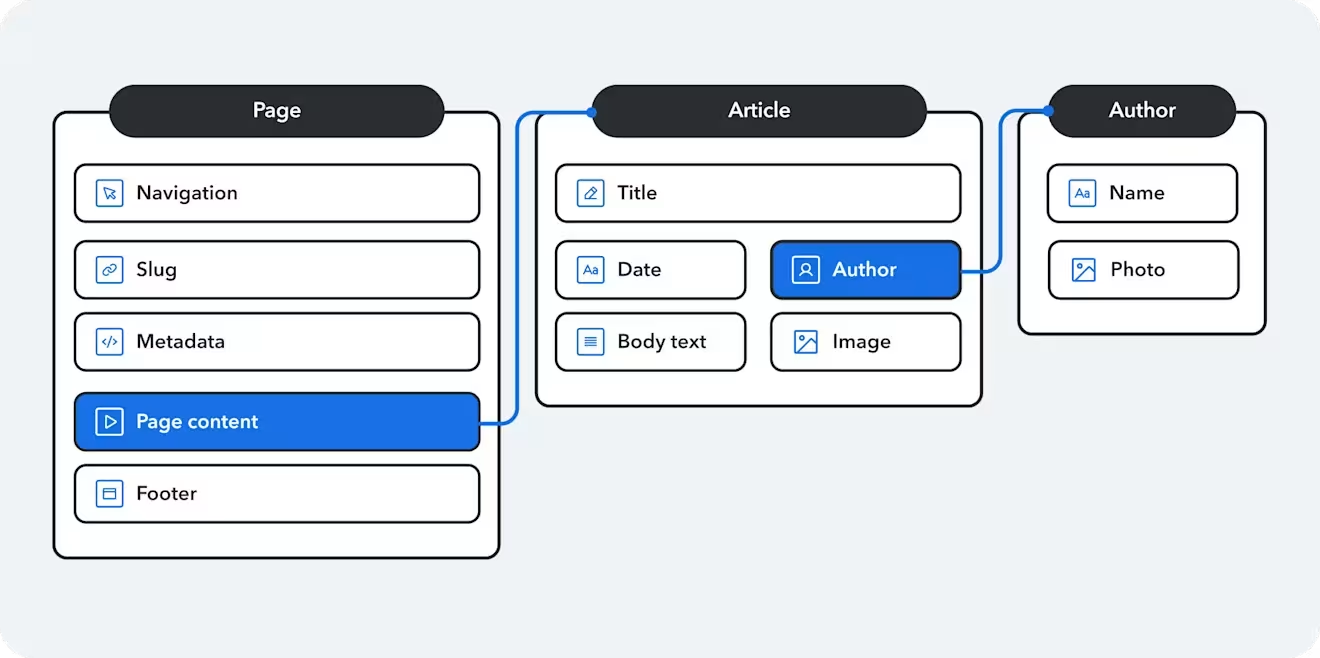
Building a structured content model within Contentful frees marketers from page-level analytic constraints, and enables them to conduct analysis at a component, or content-entry level: content types, formats, elements, and so on. That structuring is intuitive and more efficient for AI-powered analysis, and supports granular insight into content performance, helping brands to quickly identify exactly what parts of their content experiences are not working, and replicate what is.
Closing the feedback loop
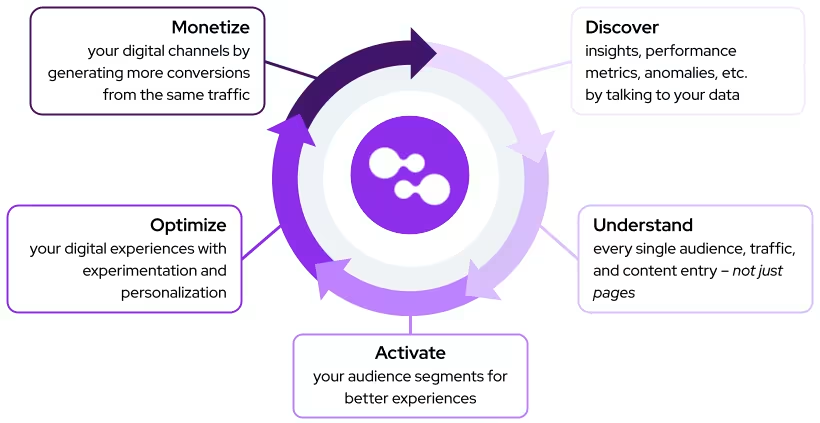
Contentful closes the feedback loop between content performance and business outcomes, connecting insight and performance metrics to understanding, iteration, and improvement. We do that by improving the speed and responsiveness of content operations, ensuring marketers receive information, and are able to make informed changes in real time, in a continuous cycle of measurement, insight, and optimization.
Future-proof architecture
Contentful’s composable architecture makes it easy to adapt and extend capabilities as needs change. Working in a composable, API-first tech stack, teams can add new apps and tools to the tech stack, adjust AI capabilities, and refine analytics workflows continually without disrupting wider services or triggering system overhauls. In other words, Contentful is a foundation for building value over the long term by ensuring brands can scale content operations seamlessly.
Wrapping up
Analytics is no longer something that happens outside or after the content workflow, or a mysterious discipline restricted to the domain of data scientists.
In the age of agentic AI, it’s an integral part of how content is created, delivered, and optimized.
By embedding agentic AI within the analytics experience, Contentful transforms data from a static resource into a dynamic, responsive feature that feeds into the digital content ecosystem seamlessly in order to help brands improve continually.
Contentful Analytics promises to put people at the heart of that process, empowering everyone in the ecosystem — developers, writers, editors, and marketers — to analyze data, generate impactful insight, and make better decisions.
Ready to take the next step? Find out more about Contentful’s conversational analytics tools or explore our full range of AI automations. To book a demo, reach out to our sales team.

Inspiration for your inbox
Subscribe and stay up-to-date on best practices for delivering modern digital experiences.
Meet the authors

Aparna is a Principal Product Manager at Contentful, shaping the future of AI-native Analytics. She leads strategy, discovery, and execution to turn bold ideas centered around AI and Data into scalable products that deliver real impact.

Esat is a Senior Product Marketing Manager at Contentful and enjoys sharing his thoughts about personalization, digital experience, and composable across various channels.
Related articles
Translation and localization: What’s the difference?
June 10, 2026

How to choose the right personalization tool for your business
May 9, 2025

How to optimize the Request for Proposal (RFP) process
July 16, 2026

Ready to start building?
Put everything you learned into action. Create and publish your content with Contentful — no credit card required.