Five hard truths about successful content marketing in 2026
Published on January 28, 2026



Inspiration for your inbox
Subscribe and stay up-to-date on best practices for delivering modern digital experiences.
Every B2B SaaS content team is using AI now, but it hasn’t changed content outcomes nearly as much as expected.
In partnership with Contentful, my research company Benchmarker surveyed 321 B2B SaaS content, brand, and demand leaders across company sizes, growth models, and performance tiers. The goal? Create benchmark data for how these teams produce, measure, and organize digital content (which we hope you’ll put to good use as you refine your 2026 content strategy).
Before reviewing answers and crunching numbers, we assumed that with everyone using AI, we would see an exponential increase in how much content is being produced. We also thought there would be far less dependence on agencies and contractors to create content.
But that’s not what we found.
Instead, the research gave us a clearer picture of how content operations have evolved in this new era — where things break down, when AI is used heavily, and what separates the companies that hit their numbers from the ones that don’t.
In this post, we'll share five findings that stood out.
1. AI isn’t increasing content production
Most B2B SaaS teams publish content at roughly the same pace, with volume increasing based on company size.
The median company produces 11–20 blog posts per quarter, 51–100 social posts per quarter, and 3–5 webinars per quarter. High-growth and high-performing teams land in almost the exact same ranges.
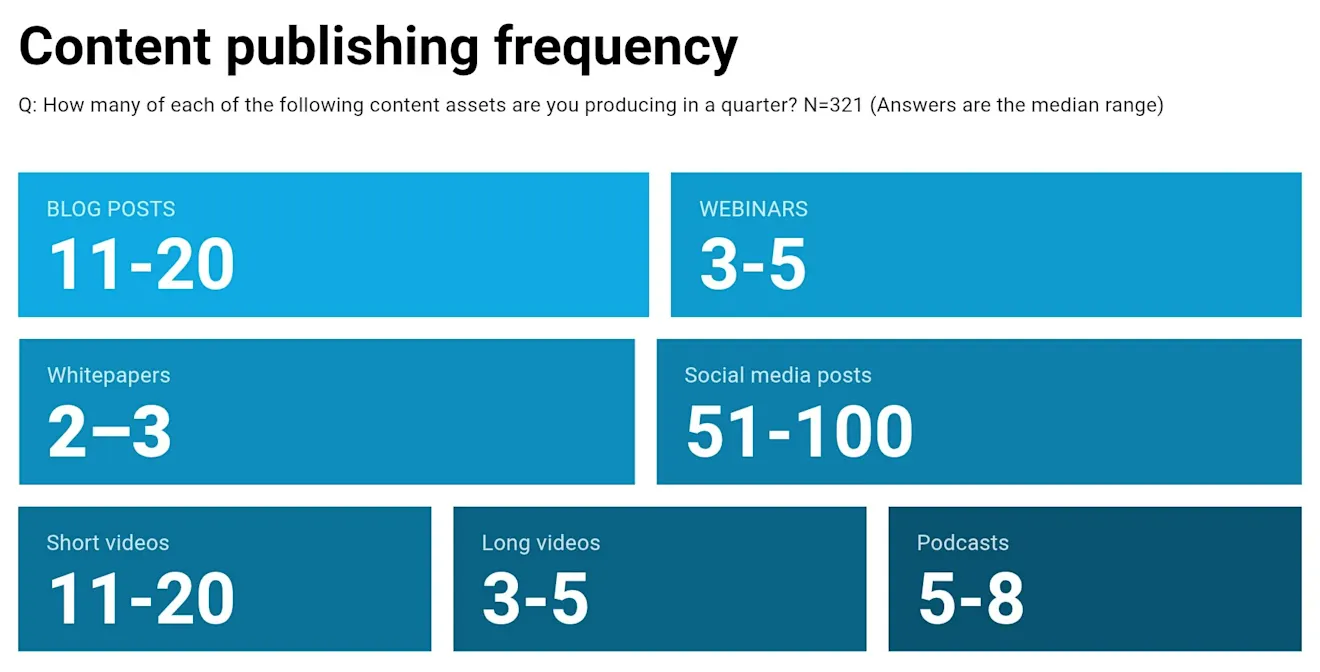
This boils down to about one blog post a week, and a social post every other day — not very different from what everyone did before ChatGPT.
We also found that performance doesn’t spike once teams push past these ranges. Blog views, video views, and webinar registrations all cluster tightly around predictable medians — roughly 1,000–2,500 views per asset or 250–500 registrations per gated piece.
For those of us in marketing, these findings come as a comfort. They support that quality is more important than quantity (after a certain point). It also shows that content output is still naturally constrained by limiting factors such as idea generation, editing, approvals, and sharing enough proprietary or valuable information.
More than anything else, marketers are wary of fatiguing their audience, and they're showing that, despite AI making it easy, content production is still a carefully vetted process.
2. Companies are still outsourcing content production
As AI took off, we figured it would mean the end of real-life, human-supported agencies. But our research shows that they live on. In fact, nearly half of all content is produced externally.
Across the full research sample, 47% of teams outsource 26–50% of content production, and full in-house models nearly disappear once companies pass $100M in revenue.
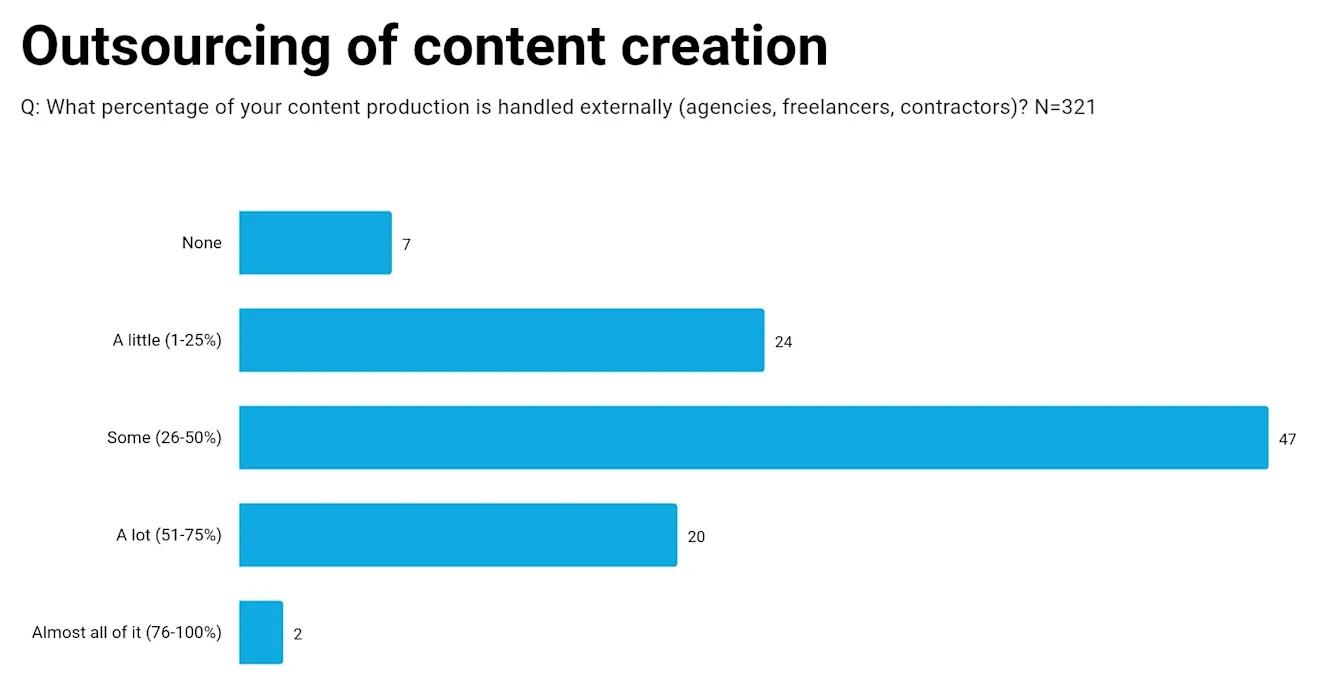
High-growth teams follow the same pattern, relying on agencies and freelancers to keep pace without blowing up headcount.
Even with 77% of teams using AI writing tools, work tied to more granular operations within the content production lifecycle has to get done — like creating briefs, editing, distributing, and refreshing content — which is difficult to automate altogether. External partners now function less as “extra hands” and more as capacity insurance.
Smaller companies are less likely to use external partners, and AI goes a long way in helping them keep up with demand. But for larger teams, outsourcing is still the norm.
3. Blog posts don’t drive impact the way they used to
When we asked which formats drive the most business impact, blog posts landed squarely in the middle of the pack.
Only 11% of respondents cited blog posts as their top impact driver. Social content came in first at 32%, followed by video (16%), webinars/events (15%), and case studies (13%).
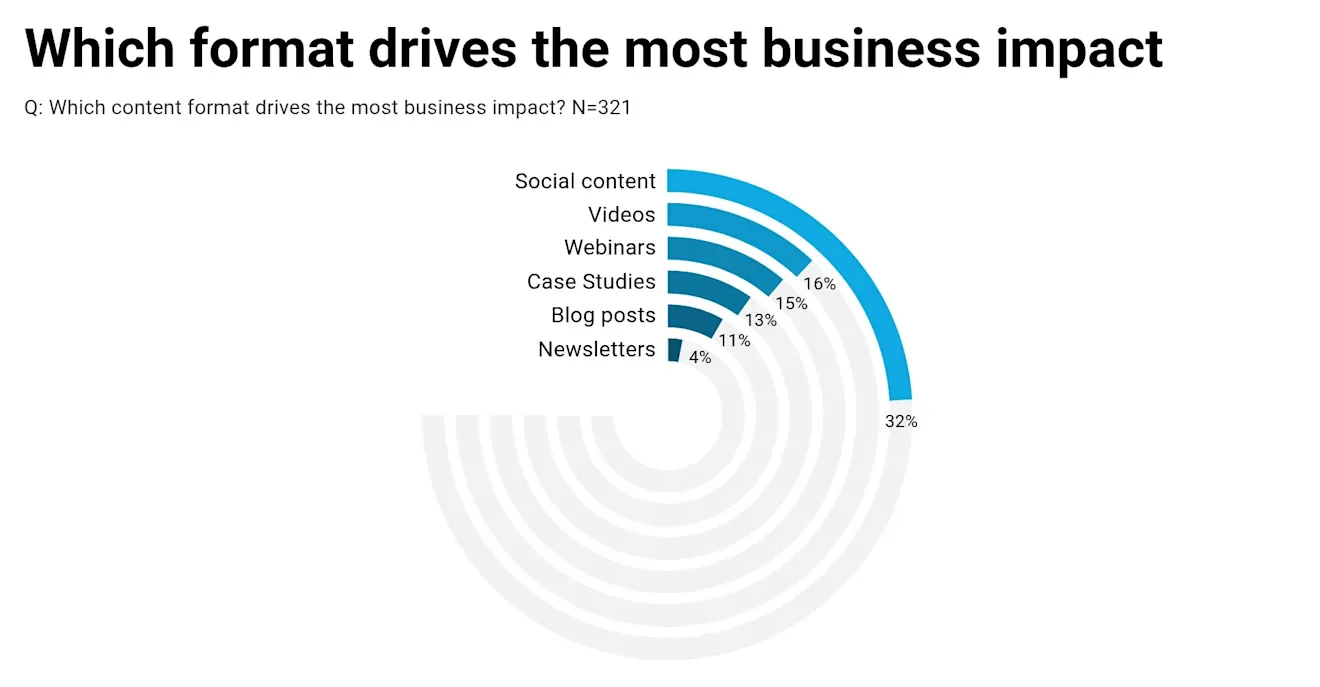
The pattern sharpens as companies mature.
Smaller teams lean heavily on social for reach. Enterprise-focused and high-performing teams spread impact across webinars, case studies, and video, especially assets that support evaluation and buying decisions.
Blogs still matter, but more as infrastructure than as heroes. They feed SEO, support journeys, and give other formats something to point back to. On their own, they no longer carry the weight they once did.
If anything, the data suggests blogs work best when paired with distribution and deeper assets, not when treated as the main event.
4. Teams are better at distributing content across the funnel, and measuring it
When it comes to which funnel stage they create content for, most teams still over-index on awareness. On average, 31% of content targets top-of-funnel, compared to 25% consideration, 24% decision, and 20% post-purchase.
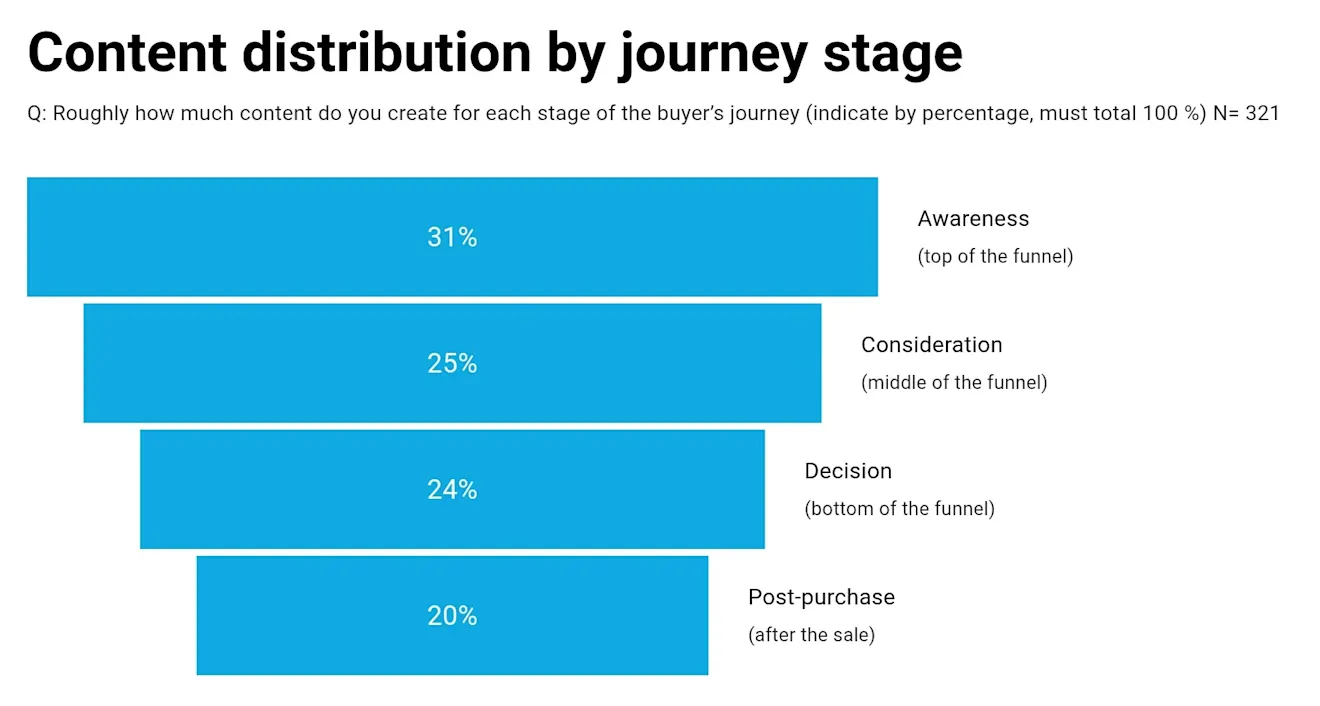
Low performers push this imbalance further, allocating 39% to awareness and just 18% to decision-stage content. High performers look different. They distribute effort more evenly across all four stages, with nearly identical shares devoted to awareness and decision.
How we measure performance tells the same story.
Yes, 75% still track engagement metrics, and 67% track brand awareness. But more than half now go further: 59% measure direct conversions and 54% track pipeline influenced by content. Attribution remains messy — only 33% use formal attribution models — but content has clearly entered the revenue conversation.
Modern content marketers are taking on more specialized material that may have previously been produced by the product marketing or sales enablement teams.
5. AI shows up where pressure is highest
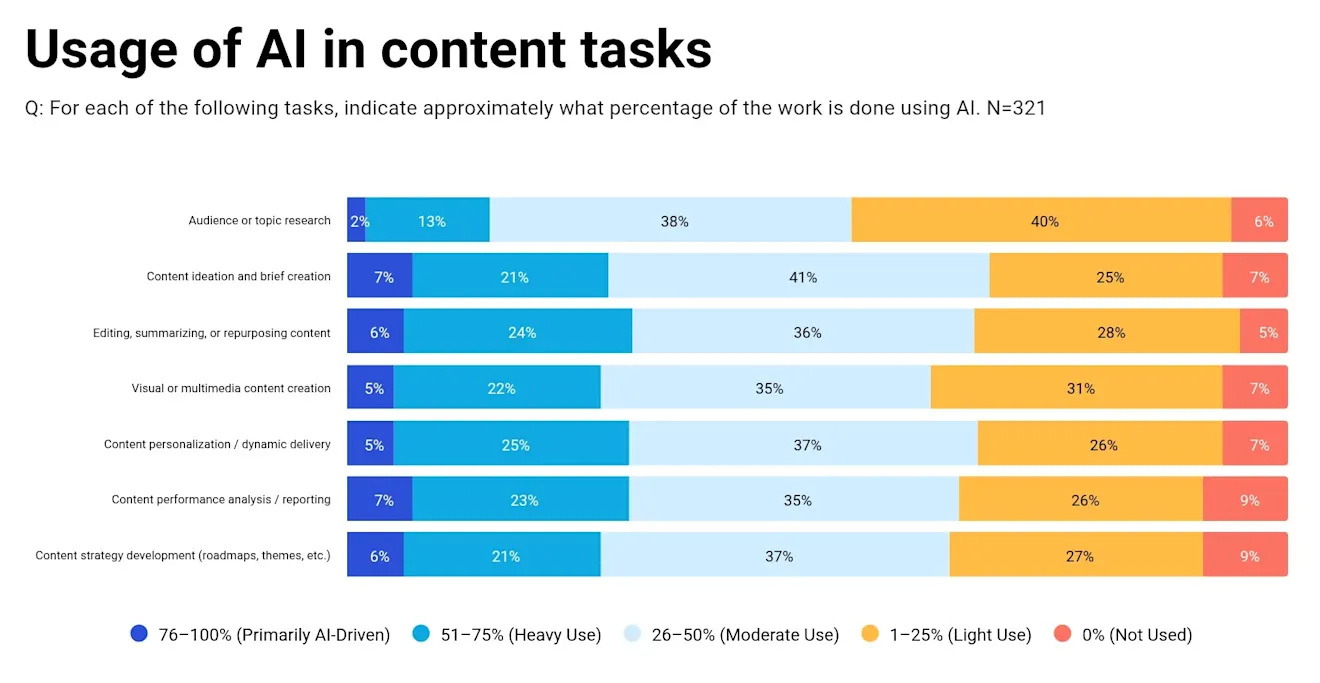
AI shows up most consistently in execution-heavy tasks.
Roughly 60–70% of teams use AI heavily/moderately in their work across content ideation, writing, and editing. AI-generated visual content (images/video) lag behind the written word for now but are sure to catch up soon.
AI use is lightest in audience or topic research, which feels like a missed opportunity since oftentimes, it’s better at doing the research than the writing. It may also reflect a marketing team’s challenges in accessing and analyzing reliable customer data for content ideas.
The more interesting gap shows up in the tech stack.
The average team runs 5.5 content tools, but AI features inside those tools go largely unused. Only 29% activate AI inside their CMS, 26% inside DAM systems, and 34% use platform-native AI features overall.
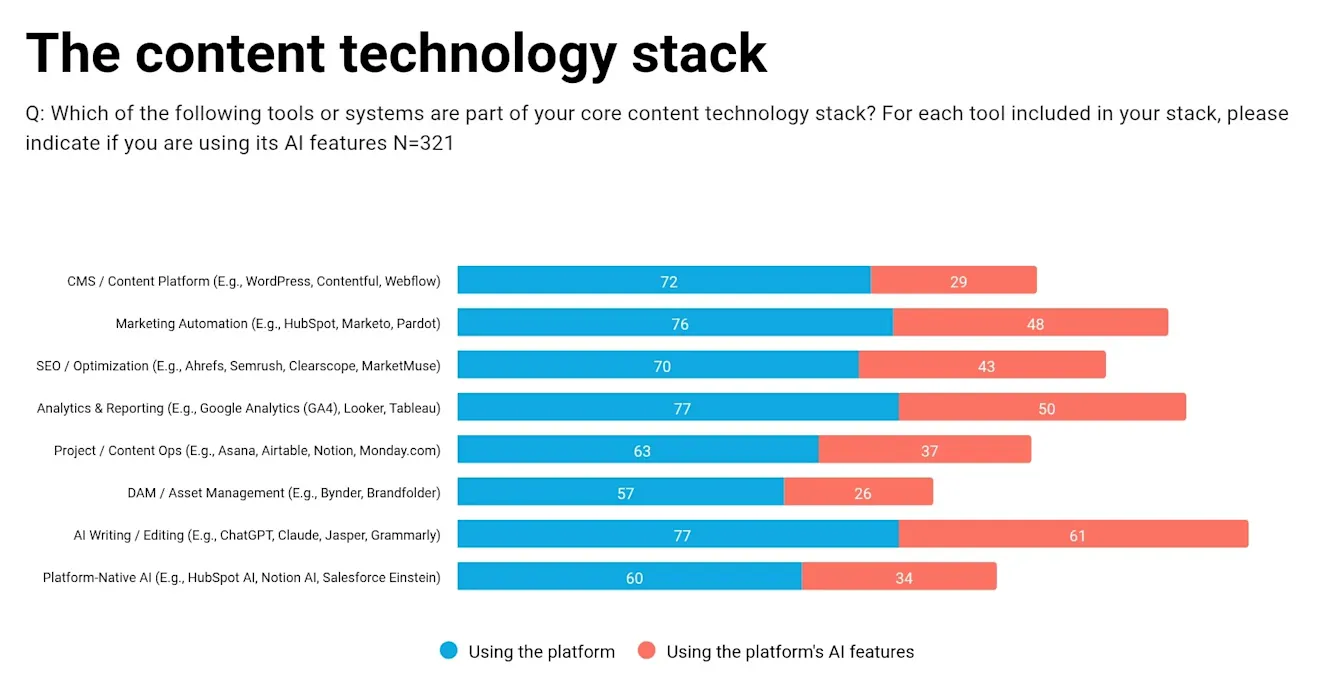
High performers stand out, not because they own more tools, but because they activate AI features more consistently across the stack, especially in SEO, analytics, and automation. Low performers, by contrast, rely heavily on standalone AI writing tools while under-using the systems they may already be paying for.
This isn’t to say that high-performing teams are using AI more (although there appears to be some correlation). Rather, it shows that teams that are more skilled, and more knowledgeable about their tech stack’s capabilities, tend to get better outcomes than those who aren’t.
What this all adds up to
The most striking thing about this research is how little has changed despite such seismic shifts in technology.
Content teams publish at similar volumes as they did five years ago. They still rely on outside help to hit quotas. They support distribution with paid channels. They spread effort across the entire customer journey. They use AI to move faster, not to think for them.
They measure more than attention, and they treat content like an operating system, not a series of one-off bets. And that, more than any single tactic, is what now separates content programs that look busy from ones that actually move the business.
This post is based on the 2026 B2B SaaS Content and Website Performance Benchmarks, produced by Benchmarker in partnership with Contentful and based on responses from 321 B2B SaaS marketing leaders.

Inspiration for your inbox
Subscribe and stay up-to-date on best practices for delivering modern digital experiences.
Meet the authors

Omar has been publishing research and advising companies on marketing excellence for the last decade. As the Founder and Principal Analyst of Benchmarker, he provides B2B marketing leaders with benchmark data and qualitative research to help assess and improve their marketing performance, practices and strategy.
Related articles
How does Contentful help with SEO and GEO?
July 4, 2025
2025 SEO/GEO predictions and five takeaways
July 9, 2025

How we built Joy 101 with Hoda Kotb: From vision to personalized wellness membership
December 17, 2025