SAP Commerce storefront sunset: What it means for your content management
Published on May 12, 2026


Inspiration for your inbox
Subscribe and stay up-to-date on best practices for delivering modern digital experiences.
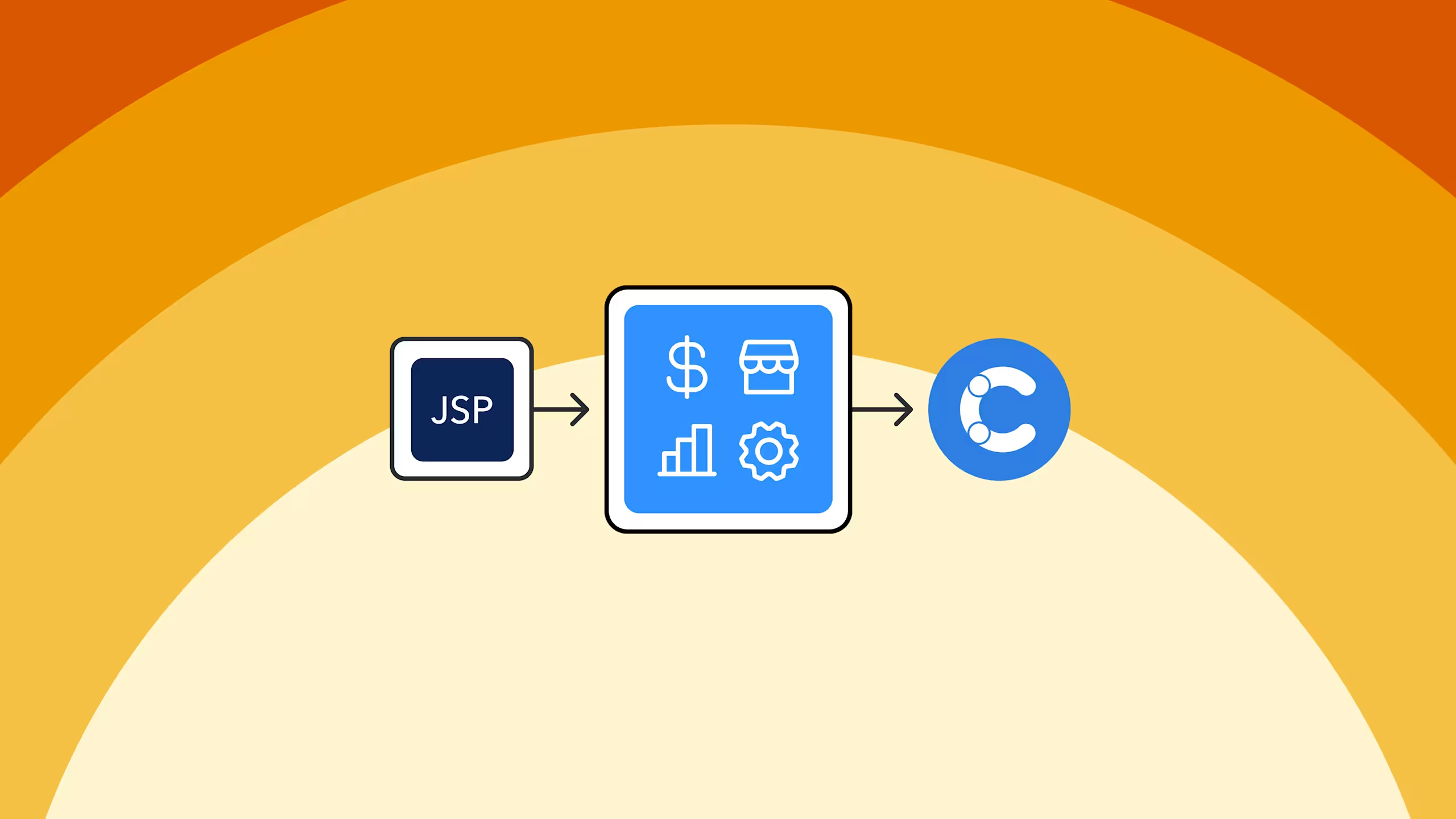
If you’re running SAP Commerce with the JSP-based Accelerator storefront, the timeline is getting real. SAP deprecated the JSP-based Accelerator templates in the 2205 release. The framework will be removed from SAP Commerce Cloud 2211 in September 2027, with extended support ending in 2028.
But the storefront is only half the story. The legacy WCMS Cockpit, the content management interface many SAP Commerce customers still depend on, has already been removed from the latest 2211 releases. And if you’re still on-premise, the final version, 2205, reaches the end of mainstream maintenance in July 2026.
These deadlines are converging. Here’s my view: too many organizations are treating this as a technical upgrade when it’s actually a strategic inflection point. The question is not “What replaces the Accelerator?” It’s “What should our digital experience stack look like going forward?”
Having worked with dozens of organizations on this decision, my honest opinion is that those treating the deadline as a straightforward storefront swap usually regret it within 18 months, when the next digital demand lands and they’ve rebuilt yesterday’s architecture.
The risk is not only missing a deadline; it's spending the next migration budget on a stack that still cannot support faster launches, localization, personalization, or AI-assisted experiences.
What’s changing, and why it matters
The JSP-based Accelerator and the WCMS Cockpit were built for a different era. The Accelerator was a monolithic, tightly coupled frontend where every change meant modifying JSP templates and redeploying the full application. The WCMS Cockpit let content teams manage pages and components, but within rigid structures that almost always required a developer.
Neither tool was designed for what organizations need today: launching campaigns quickly, personalizing experiences without developer involvement, or evolving the frontend independently.
SAP’s direction is clear. SmartEdit replaces the WCMS Cockpit as the in-context content editor. The Composable Storefront, formerly Spartacus, is an Angular-based progressive web app (PWA) communicating with SAP Commerce Cloud through OCC REST APIs. Together, they form SAP’s officially supported path forward.
However, they are not the only path. For many organizations, the simultaneous end of both the storefront and the CMS layer creates an opening to rethink content and customer experience entirely. Skipping that opportunity can turn a required migration into a missed chance to reduce future rework.
The real decision: Optimize within SAP or transform?
The right path depends on content complexity, multi-market ambitions, team capabilities, and how central digital experience is to your competitive position.
When transitioning to SmartEdit and Spartacus makes sense: If your commerce operation is relatively contained, say a single storefront with limited editorial content, adopting Spartacus with SmartEdit is the most pragmatic move. You stay within SAP’s ecosystem. You get a modern, API-driven frontend. SmartEdit covers the essentials: WYSIWYG page editing, personalization, and content versioning. This works well when content is not a strategic differentiator and the product catalog does the heavy lifting.
When moving to a composable architecture makes sense: The picture changes when content becomes central to how you compete. If you manage complex product information across markets, serve technical buyers who need rich documentation, run heavy promotional content, or need to free marketing teams from developer bottlenecks, SmartEdit becomes a constraint.
Decoupling the CMS from the commerce platform opens up capabilities a tightly integrated system cannot match: content reusable across channels, independent publishing workflows, faster campaigns, and frontend and content layers that evolve on separate timelines.
Beyond that, it also unlocks the ability to experiment with deeper segmentation, deliver more contextual 1:1 personalization at scale, and produce richer localized experiences tailored across different brands, geographies, and channels.
This is the composable model: best-of-breed tools for each layer, connected through APIs. If content plays any meaningful role in how you win customers, this is the direction to consider.
What a modern CMS enables in a composable stack
The value of a headless CMS shows up in daily operations. Contentful is a Digital Experience Platform with a headless CMS endorsed by SAP for SAP Commerce Cloud. It's purpose-built for the structured, API-first content model that composable architectures depend on.
And with Contentful Studio, content creators can visually design and publish pages without filing a developer ticket. In an anonymized Valtech migration for a global B2B industrial manufacturer running SAP Commerce Cloud, the team reduced time to publish a new campaign or product landing page by roughly 70%.
Structured content is where the compounding value sits. Content is modular, channel-agnostic, and delivered through APIs. The same content can serve a web storefront, a mobile app, or an AI-powered conversational agent without being rebuilt each time.
This matters as organizations explore AI-driven experiences: structured, API-accessible content lets AI agents retrieve, assemble, and deliver the right information in real time. Without it, AI initiatives hit a wall at the content layer.
A practical migration approach
This kind of transition doesn’t happen overnight. The organizations that get it right start with clarity, not code.
At Valtech, we’ve built a structured migration approach informed by more than 17 years as an SAP partner and deep experience implementing Contentful at enterprise scale, including being recognized multiple times as Contentful’s Partner of the Year. Our experience sits at the intersection of these kinds of project demands: SAP Commerce Cloud as the commerce engine, Contentful as the content layer, and a delivery model that brings the two together.
The approach starts with an assessment: auditing the current CMS landscape and frontend architecture, analyzing gaps, and producing an architecture blueprint with a phased plan and effort estimation. In our experience, roughly 30% of legacy content in a typical SAP Commerce WCMS can be retired or consolidated rather than migrated. That’s usually the first quick win.
The migration itself follows a clear sequence: solution architecture, content modeling, migration scripting, frontend development and integration, and then user acceptance testing (UAT), editorial training, and go-live. This is also where AI is increasingly making a real difference, from accelerating content modeling and automating content migration to speeding up development and testing. The assessment remains the critical starting point.
Three patterns we see in practice
The single-brand B2B business: They run one SAP Commerce storefront, primarily catalog-driven, with minimal editorial content. Moving to Spartacus with SmartEdit addresses the deprecation deadline while keeping the architecture simple.
The B2B manufacturer with rich product content: They sell technical components or industrial products across multiple markets. Their storefront is only part of the picture: they need detailed product documentation, localized specifications, campaign landing pages, and partner-facing content. We recently worked with a global B2B industrial manufacturer in exactly this situation. Content updates were slow, inconsistent across markets, and entirely dependent on the development team. Moving to Contentful as the content layer, paired with a modern single-page application frontend, cut their content production cycle by more than 60% and gave them a single source of truth across markets.
The enterprise investing in AI and personalization: They’re already rethinking their experience stack, with composable commerce and AI-driven personalization on the roadmap. Contentful becomes the content backbone, where structured content feeds the storefront, AI agents, recommendation engines, and conversational interfaces.
Looking ahead
The simultaneous end of life for the JSP-based Accelerator and the WCMS Cockpit is a deadline, but it doesn’t have to be a crisis. For organizations willing to treat it as a strategic moment, it’s a genuine opportunity to rethink how content, commerce, and customer experience fit together.
There’s no single right answer. Some will, and should, stay close to SAP’s native tooling. Others will adopt a composable stack with more flexibility, editorial speed, and control. What I would push back on is the middle path: spending real budget to rebuild a monolithic stack that looks modern on paper but hits the same limits within a couple of years.
The first step is not choosing a frontend framework or CMS. It is assessing how content, commerce, localization, personalization, and AI will need to work together over the next three to five years.
What matters most is making that decision with intention. Understand where you are, be clear about where your business needs to go, and start now, while there’s still time to plan rather than react under pressure.
Further reading

Inspiration for your inbox
Subscribe and stay up-to-date on best practices for delivering modern digital experiences.
Meet the authors

Bertrand Payet is Composable Practice Director at Valtech, where he helps enterprise organizations navigate the shift to composable and headless architectures. A founding member of the MACH Alliance and multiple-time Contentful Partner of the Year, Valtech has been an SAP partner for more than 17 years. Bertrand brings deep expertise at the intersection of commerce, content, and modern digital experience strategy.
Related articles
What is agentic architecture? The new way to automate your workflow
March 31, 2026
Data personalization that customers actually love
September 2, 2025
Agentic workflows: What they are and how they work
September 8, 2026

Ready to start building?
Put everything you learned into action. Create and publish your content with Contentful — no credit card required.