Every click tells a story: Audit logging for enterprise‑scale content platforms
Published on December 4, 2025



Inspiration for your inbox
Subscribe and stay up-to-date on best practices for delivering modern digital experiences.
Visibility builds trust.
Enterprises managing complex digital experiences rely on clear records of change to maintain trust and control. Distributed teams ship content across dozens of markets, AI accelerates the pace of change, and regulators expect you to prove exactly who did what, when, and why in your content platform.
Audit logs are how you tell that story. Done right, they become the backbone of enterprise trust: a continuous narrative of activity that you can replay any time something looks off, or when an auditor asks you to show your work.
In this post, we’ll share how continuous innovation in Contentful’s audit logging — including AI activity tracing, multi-cloud delivery, and enhanced reliability — empowers enterprises to operate with the transparency, flexibility, and governance today’s digital landscape demands.
Why audit logs matter more than ever
At their core, audit logs are a chronological record of actions taken across your digital ecosystem. A detailed account of who did what, when, and how. They’re your single source of truth for tracing changes, investigating incidents, and proving compliance.
The way enterprises build and manage digital experiences has changed dramatically in just a few years. Content platforms now sit at the center of a much larger ecosystem.
Marketing, product, engineering, and agency teams all work in parallel, often across regions. AI accelerates publishing by touching thousands of entries in minutes. Global regulations raise expectations for privacy, security, and data retention. And security teams increasingly rely on centralized observability stacks and SIEM (Security Information and Event Management) tools to keep everything in view.
In that environment, visibility and traceability are essential for three reasons:
Compliance and governance. Frameworks like SOC 2 and ISO 27001 require you to demonstrate who has access, what changed, and how you control it. You can’t do that reliably without audit logs that cover your content platform.
Operational control. When something breaks, you need to know whether it was a token rotation, a role change, a bulk update, or a misconfigured integration, and you need that answer fast.
Security and incident response. If a token is compromised or an account is abused, your incident response team needs a reconstructable trail of activity: which entries were touched, which spaces were accessed, which actions were taken, and when.
At Contentful, audit logging is built as a core platform capability that gives enterprises the transparency and control needed to operate confidently at scale. As highlighted in our building trust through compliance article, trust is earned through ongoing investment in transparency, governance, and control, principles embedded in the core “trust layer” of our platform.
What Contentful audit logs capture today
At a high level, Contentful audit logs are designed to answer a single question: can you reconstruct what happened in your organization, across spaces and environments, when it really matters?
To do that, they focus on the events that matter most for security, governance, and operations:
Critical configuration and access changes: such as API token creation and revocation, role and permission changes, and other sensitive configuration events.
Content and space‑level operations: changes that affect entries and assets, including bulk operations that modify many records at once.
Organization‑wide visibility: logs span your entire Contentful organization, not just individual spaces, giving central teams a unified view of activity across environments.
Audit logs are available on premium plans and are treated as part of the broader governance and platform trust toolkit, alongside SSO (Single Sign-On), SCIM (System for Cross-domain Identity Management) provisioning, workflows, and advanced token management.
Owning your logs: Multi‑cloud storage and open standards
One of the most important design choices in Contentful’s audit logging is where the logs live.
Rather than locking them in a proprietary user interface, Contentful delivers audit logs to your own storage so you can plug them into your existing security and observability stack.
Your logs, in the cloud you trust
Audit logs can be exported to AWS S3, Azure Blob Storage, or Google Cloud Storage, giving you multi‑cloud flexibility and letting you centralize logs alongside the rest of your infrastructure data.
That means security teams can ingest Contentful audit data into tools they already rely on, such as SIEMs, log analytics platforms, and threat detection systems. Platform and operations teams can then correlate that activity with infrastructure metrics, application logs, and network traces, all in one place.
Looking back on 2025: Strengthening trust through deep visibility and control
As 2025 comes to a close, it's clear that this has been a big year for audit logs and the surrounding trust surface area. Several releases focus on making sure every meaningful action (human or AI) is captured, delivered reliably, and governed by strong identity and access controls.
One example? In addition to logging user IDs, audit events now clearly identify who acted, with name and email details. Let’s look at a few other key updates in more detail.
1. AI Actions and bulk operations in the audit trail
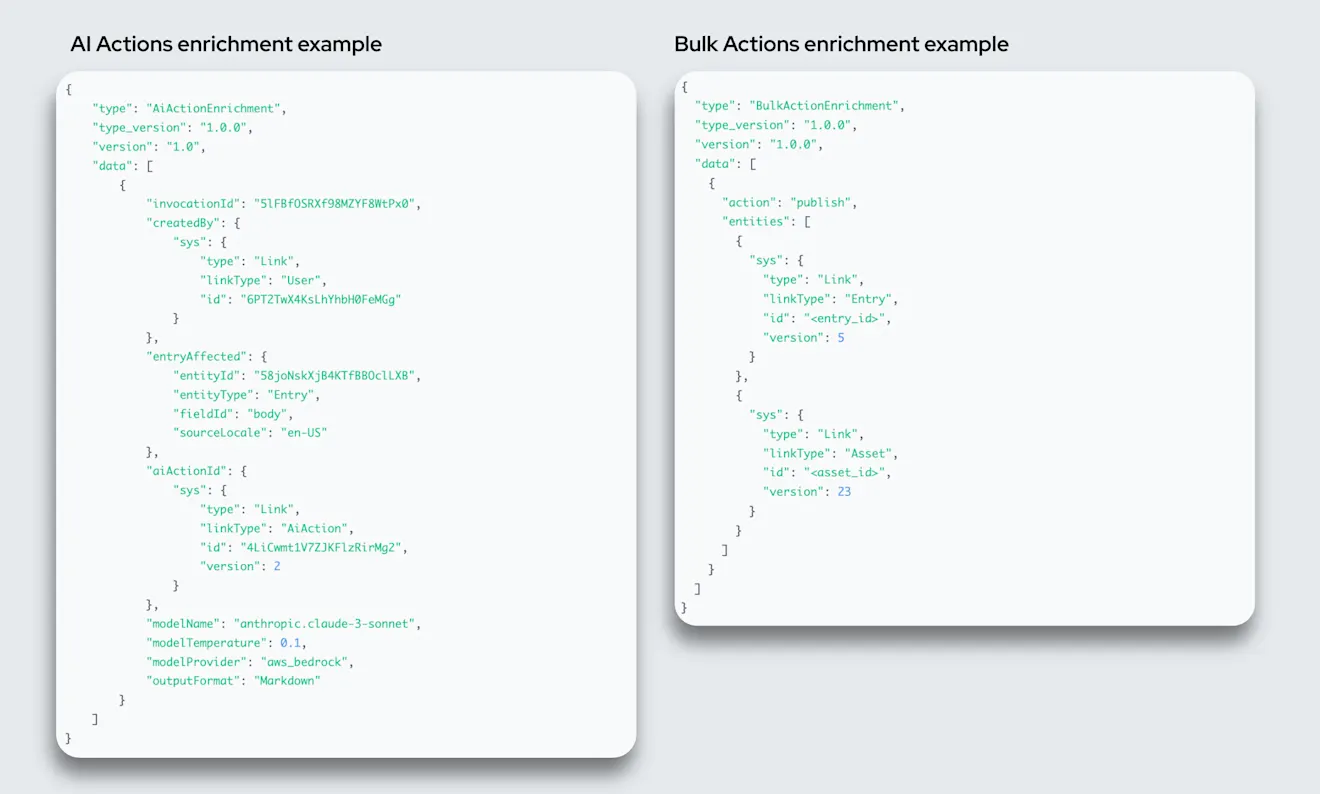
AI is now part of everyday content operations. That’s powerful, but it can also be risky if you can’t see what it’s doing. Recent updates are designed to capture Contentful AI Actions, including bulk actions, in audit logs.
You can see:
Who initiated an AI Action.
Which entries or assets were affected.
When the action ran.
That the change originated from AI, not a manual edit.
This is crucial for AI governance. When a piece of content looks off, teams can immediately answer, “Was this a human change, an AI suggestion, or a bulk AI update that went sideways?”
It also helps satisfy emerging internal policies and external expectations around AI: You’re not just using AI, you’re accounting for AI in your audit and approval processes.
With AI Actions in audit logs, you don’t have to choose between speed and accountability. You get both: rapid content generation and a precise trail of how, when, and where AI was involved.
2. Google Cloud Storage support for audit logs
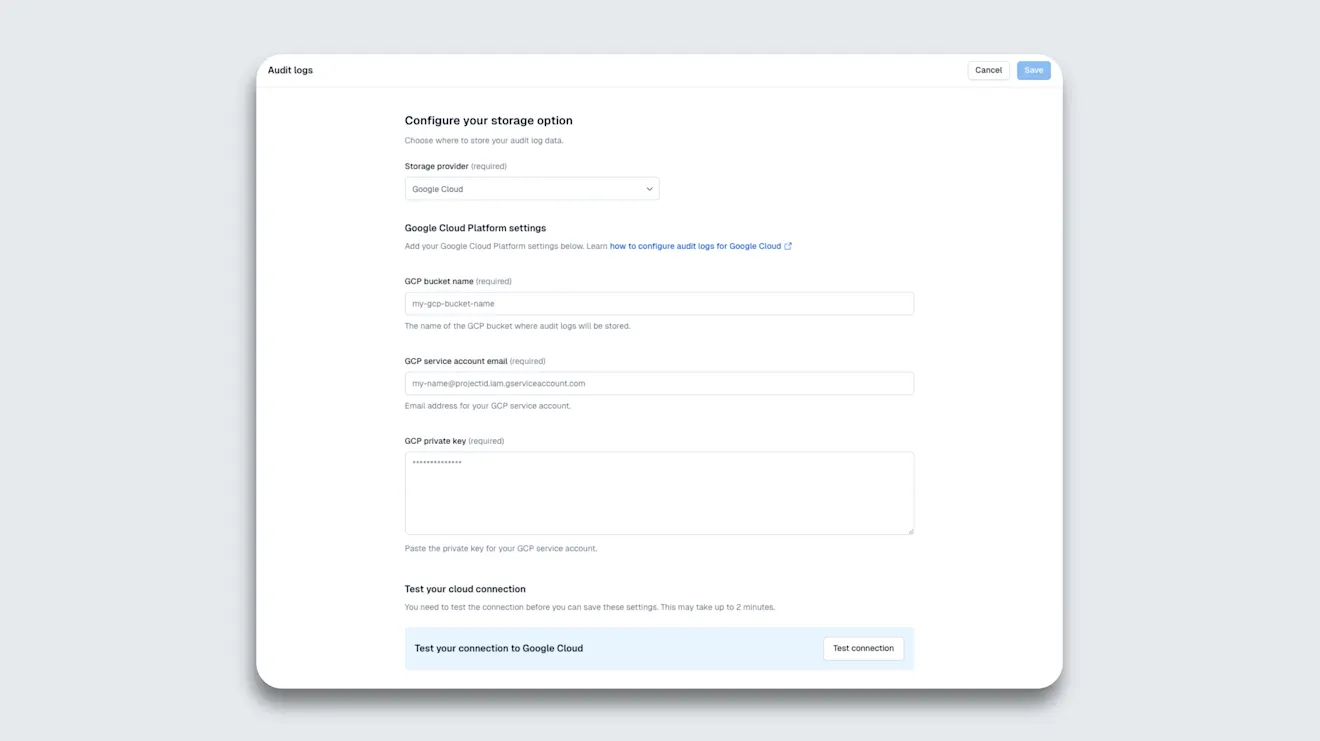
For organizations standardized on Google Cloud, keeping security and operations data in GCP (Google Cloud Platform) is non‑negotiable. To support that, audit logs now export directly to Google Cloud Storage, in addition to existing AWS S3 and Azure Blob options.
Combined with OCSF formatting, this makes it straightforward to feed Contentful logs into Google‑centric ecosystems for analysis, correlation, and alerting — without adding another bespoke pipeline.
3. Treating log delivery as a first‑class reliability concern
Audit logs are only useful if they arrive. Silent gaps in the log stream are far from an ideal scenario for security and compliance teams.
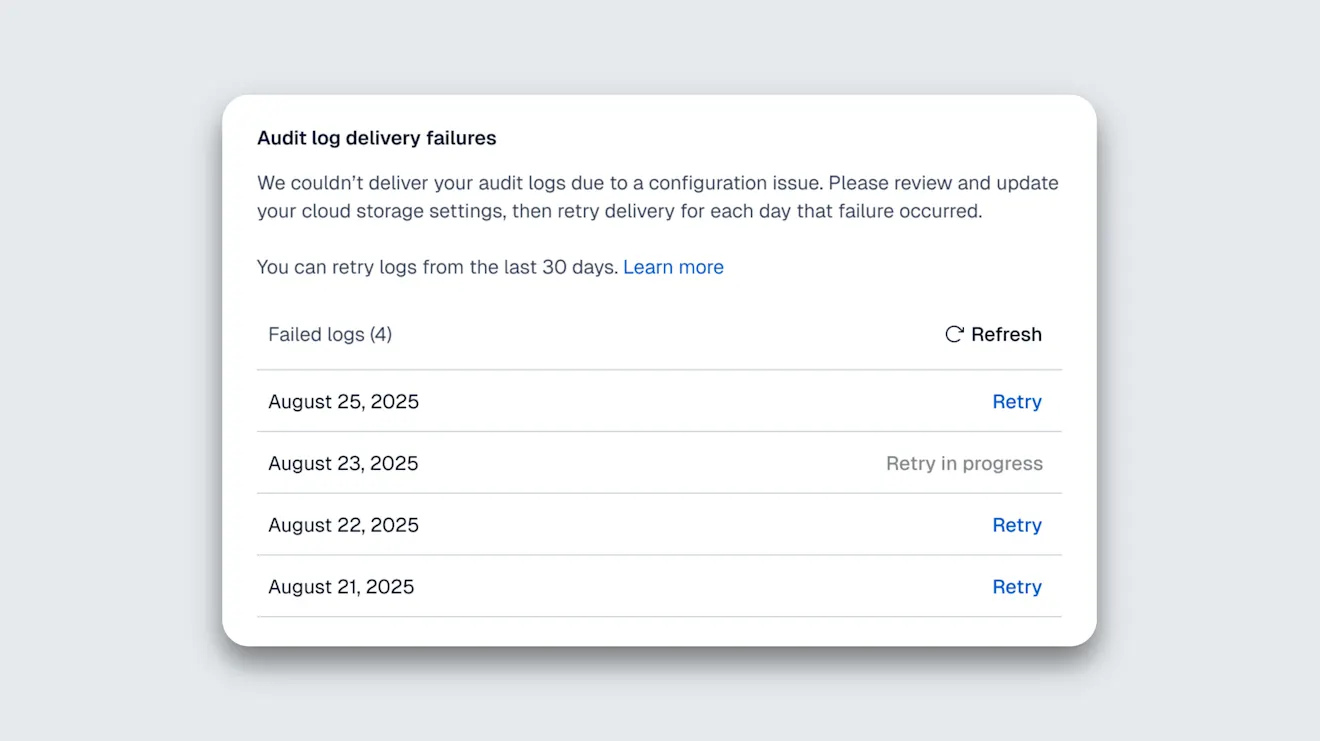
To address that, Contentful has introduced better visibility and recovery paths when audit log delivery fails, including clearer surfacing of failures and a straightforward way to retry exports.
This shift treats audit logging like any other piece of critical infrastructure:
You’re informed when delivery breaks, instead of discovering missing logs weeks later.
You can quickly restore coverage by retrying failed exports, reducing the risk of irrecoverable blind spots.
4. Static IPs for audit log delivery
Many enterprises require IP allowlisting for secure log ingestion. Audit logs are now delivered from a fixed set of static IPs, scoped by data residency, so security teams can easily allowlist traffic and comply with stricter network policies.
What this enables:
Align with firewall rules by allowlisting a small, predictable IP set, reducing exceptions and reviews.
Support environments (like Azure) that require static egress for third-party services.
Keep existing pipelines: only the network layer changes; log content, format, and cadence stay the same.
Region-scoped IP lists (default and EU) are published for quick copy-paste into allowlists or infrastructure templates.
Guardrails around the logs: Identity, access, and secure configuration
Audit logs capture what happened. Equally important is who is allowed to do what in the first place, and how quickly you can clamp down when something goes wrong.
While we’ll cover identity and access management (IAM) in a separate deep dive, this year’s focus has been on strengthening the fundamentals, hardening authentication, improving token hygiene and administrative controls, and tightening org-wide guardrails, so the “who” in “who did what, when, and why” consistently maps to your identity provider and policy without slowing teams down.
Spotlight: Sec‑check security posture from your CLI
The Contentful CLI now provides a feature that helps teams assess their Contentful organization’s security posture and surface actionable misconfigurations as part of everyday workflows, or CI (Continuous Integration), rather than waiting for manual periodic audits.
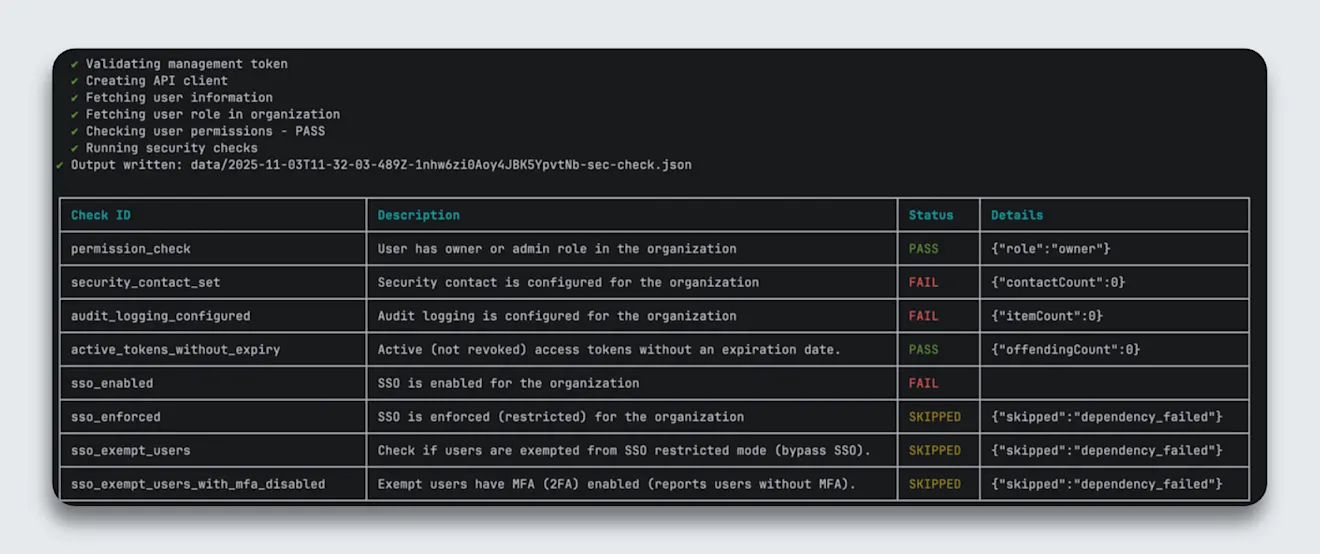
What that means in practice is that you run a single check to quickly identify common security-configuration gaps that increase risk, with guidance to remediate them quickly, well before they lead to an incident review.
Bake sec-check into CI so security-posture drifts are caught alongside code and content-automation changes. Pipe the output (JSON) into your ticketing or notification system and keep guardrails where work actually happens.
Here’s how it complements audit logs: sec-check helps prevent risky states from being introduced, while audit logs provide the forensic narrative when something slips through or when external systems behave unexpectedly.
Used together with delivery-health visibility for audit-log exports, this creates a prevention-and-detection loop. You harden before incidents, but you can still reconstruct events when you need to.
We’ll unpack IAM improvements, tokens, SSO/2FA enforcement, and practical rollout patterns in a dedicated post. For now, keep sec-check close to where your teams ship changes, and let the audit trail do what it does best, tell the full story when it counts.
From compliance to operational intelligence
It’s tempting to think of audit logs as a compliance tax — something you enable to pass an audit and then ignore. That mindset leaves a lot of value on the table.
When you combine rich, structured audit logs with your existing SIEM and analytics tools, they become a source of ongoing operational intelligence:
Change insights: build dashboards to understand how frequently content, roles, or tokens change, and which teams or environments generate the most activity.
Anomaly detection: set up alerts on unusual patterns like spikes in bulk updates, unexpected source IPs for sensitive operations, or AI Actions running outside normal hours.
Incident acceleration: during an incident, quickly answer questions like:
“Did this start with a bulk content operation?”
“Was this token used outside its expected context?”
“Was this change made by a human, a script, or an AI Action?”
Governance proof points: use logs to demonstrate that SSO enforcement, 2FA policies, and token authorization controls are not only configured but actually working as intended over time.
The most mature teams treat audit logs as part of their operations command center — a live feed into how their content platform behaves — not just a ledger to pull out when the auditor shows up.
Looking ahead: Enterprise trust, continuously improved
As AI accelerates the pace of change and composable architectures widen your surface area, the platforms that win will be the ones that can explain themselves. With clear attribution, end‑to‑end traceability, and evidence that’s always within reach.
We’re exploring the possibility of expanding observability capabilities to deepen visibility across Contentful APIs and reduce time‑to‑detection, bringing insights closer to where investigations and operations actually happen. We’ll share more as it progresses.
If composable gives you room to move, auditability gives you the confidence to move faster. Contact us for a tailored demonstration, and we’ll show you how.

Inspiration for your inbox
Subscribe and stay up-to-date on best practices for delivering modern digital experiences.
Meet the authors

Malin is a Senior Product Manager at Contentful, leading the Platform Insights team in providing customers with greater visibility into their use of the platform. By delivering analytics, reporting, and governance capabilities, he helps organizations make data-driven decisions, optimize their usage, and ensure transparency. With over a decade of experience in B2B SaaS across mobile and web, Malin specializes in building insights-driven solutions that empower customers. Outside work, he enjoys cycling long distances, running, illustrating, and exploring psychology.

Marco is a B2B content creator and product marketer blending technical with creative skills. From the early stages of product ideation to a successful market launch, all the way through to sales enablement, he loves to take products and translate them into clear, relatable messages.
Related articles
Contentful achieves AWS Consumer Goods Competency
December 2, 2024

API traffic on Black Friday 2025 climbs 33% year over year to 4.6 billion calls
December 7, 2025
From creation to optimization: Automate your content process with new AI innovations from Contentful
March 31, 2025