The funnel is shifting upstream: What AI-driven discovery means for marketing leaders
Published on March 2, 2026



Inspiration for your inbox
Subscribe and stay up-to-date on best practices for delivering modern digital experiences.
Marketing leaders today are navigating a huge structural shift, the kind that occurs only once in a generation. Organic traffic patterns are changing, AI-generated summaries are absorbing early discovery, and buyers are forming opinions before they ever visit your website.
I recently sat down with Shannon Ryan, Chief Growth Officer at Valtech, to unpack what this shift means in practical terms. We weren’t focused on hype. We focused on infrastructure, influence, and execution. Because when discovery starts upstream, marketing strategy has to evolve with it.
Let me give you the most reassuring takeaway upfront: the funnel still exists. It’s still waiting for you to apply your human creativity and imagination. But the earliest and most influential stages are increasingly happening before a buyer clicks.
Visibility and traffic are no longer the same thing
For years, marketing performance followed a predictable progression: rank well, earn the click, guide prospects into the funnel.
That progression is becoming less reliable.
A growing percentage of Google searches now trigger AI overviews, and click-through rates on top-ranked pages have declined significantly. When AI-generated summaries satisfy informational intent directly within the interface, traffic no longer maps cleanly to visibility.
During our conversation, I described this as a decoupling of visibility and traffic. We’re operating in what many are calling a “zero-click” environment, where AI systems extract informational value and keep the user within the search experience, meaning they may never actually click through to your webpage.
Traffic decline is measurable. The deeper issue is influence.
If a buyer forms their initial understanding of your category, your competitors, and your positioning inside an AI-generated summary, then part of the decision-making process is happening before your site is ever visited.
That changes the role of marketing at the top of the funnel.
Your brand is being interpreted before it’s experienced
AI systems are not simply retrieving links. They are synthesizing information into narratives. They frame comparisons. They summarize differentiators. They establish context.
In our discussion, I said that your digital front door is often no longer your homepage. It may be a three-paragraph summary you didn’t author. In this new era of search, an AI overview may become the primary storyteller of your brand. This is something that all marketers need to think about.
Shannon described this as “the collapse of the front door.” The website is no longer the single point of entry. It’s one node among many in a distributed discovery ecosystem.
In a traditional search results page, users could scroll and evaluate options. In an AI-generated summary, inclusion is selective and space is constrained. There is no “below the fold” in a three-paragraph answer.
If your brand is not included or if it is summarized inaccurately, then influence is already diminished.
And this isn’t just about traffic loss; it’s about a compression of the narrative. The struggle moves beyond just getting them to your site to learn more about your brand; it’s about ensuring the answer engine overview accurately reflects who you are.
Discoverability now depends on structure, not just messaging
One of the most important points in our conversation was this: the shift is fundamentally structural in nature.
Most legacy systems were built for a page-based, click-driven web. Content was designed primarily for human navigation. Search engines indexed pages. Users clicked through.
Answer engines operate on a different scale. They ingest structured data, parse signals, and synthesize summaries based on what they can reliably interpret.
As Shannon neatly puts it, these systems aren’t seeing pages — they’re seeing code.
This matters because if your content isn’t structured in a way that answer engines can interpret consistently, the risk isn’t just ranking lower. The risk is being excluded from the synthesized answer altogether.
Rest assured that SEO still remains foundational and keyword strategy still matters, but discoverability now also requires machine-level intelligibility.
Treating content as structured, governed data rather than static pages has become a strategic requirement.
Authority extends beyond what you publish
Another shift we discussed: authority is no longer confined to owned channels.
Large language models (LLMs) and answer engines draw from a broad ecosystem of signals, including community platforms and social conversations. What is being said about your brand in those spaces increasingly influences how AI systems interpret and represent you.
That introduces a new layer of complexity. Marketers have historically worked to control variables; things like tone, design, messaging hierarchy. But in an AI-influenced discovery environment, interpretation becomes part of the equation.
At the same time, AI has made content creation dramatically easier. Volume is up across nearly every category.
But abundance does not equal impact.
When content becomes cheap and ubiquitous, generic messaging loses signal strength. Answer engines prioritize clarity, consistency, and distinctiveness. And buyers themselves are more skeptical of content that feels automated or templated.
Authority must be explicit. It must be repeatable. And it must be embedded in how content is structured, not just how it is written.
Speed now matters twice
When you have a reduced click volume, it follows that the value of each visit is substantially higher. And when someone does reach your site, you have to be ready with an experience that’s fast, relevant, and cohesive.
But performance now extends beyond page load speed.
During our conversation, I described this idea as speed mattering twice:
The speed of the experience itself
The speed of the operating model behind it
Answer engines reward reliability and freshness. Content that is outdated, inconsistent, or slow to evolve risks being deprioritized in systems that value current, authoritative signals.
At the same time, internal bottlenecks slow response to market shifts. If updating positioning, launching new content, or adapting messaging requires heavy development cycles, your brand operates at human speed in a machine-speed environment.
The upshot is that operational velocity becomes yet another visibility factor.
Answer engines force us to rethink how we measure the funnel
This shift also raises a difficult question: if early-stage influence happens inside search interfaces powered by answer engine overviews, what should we measure?
Clicks still matter. Revenue still matters. Pipeline still matters.
But success at the earliest stages may increasingly include qualitative and structural indicators:
Are you being cited in AI overviews?
Are your differentiators represented accurately?
Are you consistently included in synthesized comparisons?
Is your positioning stable across AI-generated responses?
During the session, I summarized it this way: success is no longer measured solely by the click. It’s measured by whether the AI trusts your brand enough to cite it as a definitive source.
Hard metrics remain essential. Attribution frameworks will evolve. But influence now begins before traffic.
The strategic implication for marketing leaders
In the era of the Great Content Collapse, there is some cause for optimism: AI-driven discovery does not eliminate the funnel. What it’s actually doing is shifting part of it upstream.
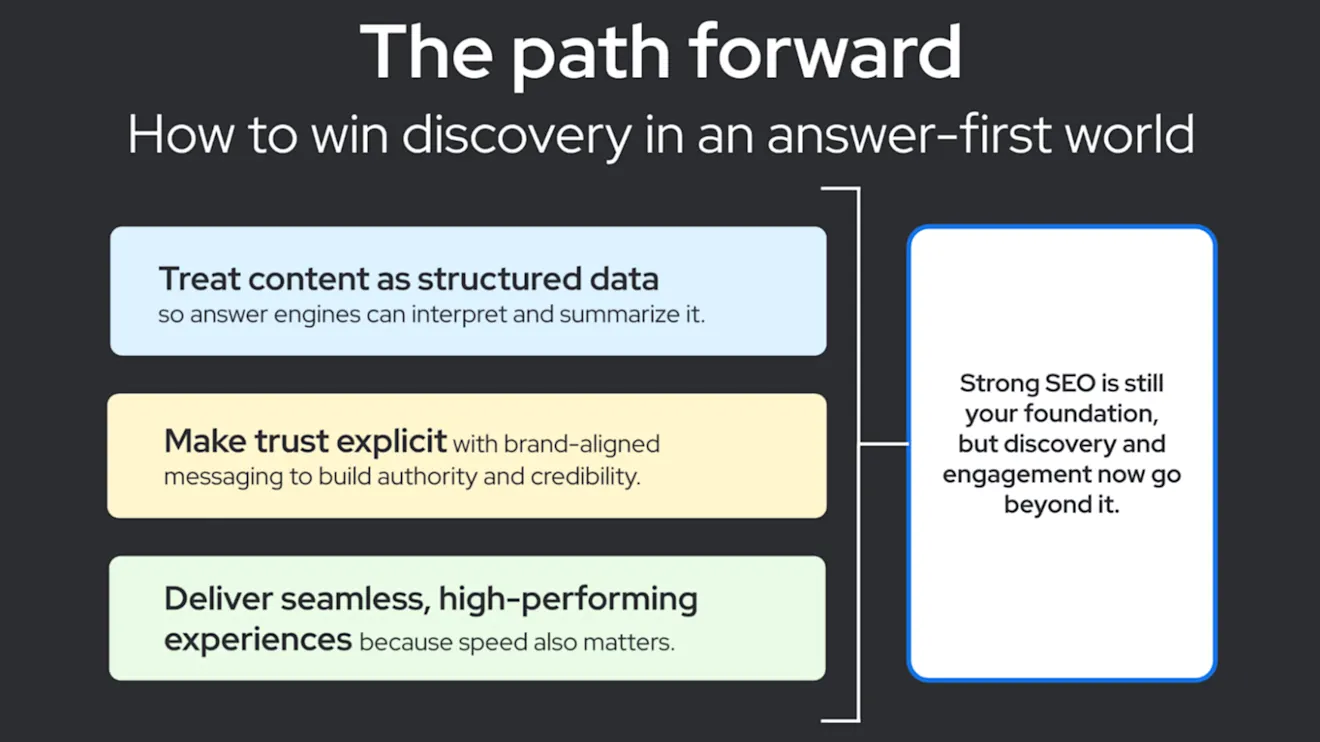
The principles to keep in mind are these: content structure determines whether engines can interpret your content. Authority determines whether they trust your brand. Operational speed determines whether you remain current enough to surface.
When discovery starts before the visit, infrastructure and governance are no longer back-end considerations but strategic levers that put you ahead of the competition.
This is not about chasing algorithms. It’s about building a content foundation that is structured, consistent, and adaptable enough to operate in an answer-driven environment.
Please check out the on-demand recording of the webinar to see the full discussion. My thanks again to Shannon for his thoughtful participation. And if you’d like to explore how to modernize your content infrastructure for AI-driven discovery, contact our sales team and we’d be delighted to show you how.

Inspiration for your inbox
Subscribe and stay up-to-date on best practices for delivering modern digital experiences.
Meet the authors

Cj Pace is a Product Marketing Manager at Contentful with a track record of bringing complex digital products to market at global scale. His experience spans launching worldwide gaming experiences at Activision, driving enterprise analytics adoption at Tableau from Salesforce, and now leading go-to-market strategy for composable content platforms and AI-driven personalization. He focuses on translating technical capability into global go-to-market strategies that drive measurable growth.
Related articles

Web service vs. API: A starter guide
June 3, 2025

Website replatforming explained: Mitigating risks and maximizing your ROI
March 21, 2025

Enterprise generative AI: Transforming operations and unlocking new possibilities
June 26, 2025