Headless commerce solutions: What to know before you build
Published on November 26, 2026


Inspiration for your inbox
Subscribe and stay up-to-date on best practices for delivering modern digital experiences.
Headless commerce solutions provide the backend functionality for e-commerce systems, storing product data and providing checkout, payment, and other features. By detaching the front-end website or app, you're free to build your own just the way you want it. Headless commerce solutions give you a lot more flexibility and future-proofing options, broadening how and where shoppers can browse your catalog and make purchases.
This practical guide explains headless commerce (known also as headless e-commerce) solutions, detailing the factors you need to know about and compare to assemble your ideal e-commerce stack.
What is a headless commerce solution?
A headless commerce solution is part of a headless architecture for e-commerce use cases. It provides the backend storage and logic, performing tasks like storing product catalogs, tracking stock, and providing endpoints for checkout and payment. Unlike traditional or monolithic commerce solutions, it doesn't tie any of this functionality to a frontend presentation layer (usually a rigidly structured set of catalog and product web page templates).
Decoupling the front and back end of an e-commerce system offers the following advantages:
You can choose, build, and customize your front ends to match your unique design, brand, and business goals.
Managed headless e-commerce solutions take care of all of the scaling, performance, maintenance, and security overheads for backend services, providing a consistent set of APIs for your front ends to connect to.
You can experiment with new front ends, optimize, localize, and run experiments to see what you can do with your product and user data without compromising your production websites and apps.
You can be channel agnostic and follow customer journeys across different channels with consistent product information, media, and supporting content.
Decoupling the presentation and logic layers of e-commerce doesn't just have technical advantages. E-commerce isn't just about online shoppers clicking “Check out” — many businesses sell through multiple online stores for different brands or regions, take sales on the phone for manual entry in an order management system, and operate brick-and-mortar storefronts. Each of these is a “front end” that can be connected to a headless commerce solution and that you interact with in a different way, in a different context.
Building a headless commerce solution with a single source of truth results in consistent product information, stock levels, and other data for reliable omnichannel commerce.
A new kind of shopper is also arriving at online stores. You need to be ready for agentic commerce, where customers send AI agents to discover, compare, and purchase products on their behalf. This is already happening, and headless commerce allows you to take your existing product catalog and make it clearly understandable for AI shoppers, with suitable checkout and payment mechanisms.
What do you need to build a headless commerce solution?
A headless commerce “solution” isn't necessarily a single product. It's a software stack with each piece providing functionality that your business needs to operate. Some stacks will contain different things.
While there are headless e-commerce platforms that provide the majority of functionality, none are truly “complete” — every business has a unique operating environment that reflects regional legal requirements, customer expectations, trends, and other factors.
This is another benefit of headless e-commerce: If your solution doesn't do something you need, you can add it without having to worry about a platform update breaking templates or plugins. This is also known as modular or composable commerce.
The core components of a headless commerce solution that you’ll build on are:
The commerce engine
This is the core of your headless commerce solution and will usually include, at minimum, functionality such as the PIM (product information management system), which provides your product database and the tools and interfaces to manage it, including product data like names, descriptions, variants, prices, and metadata. It’ll usually also include an OMS (order management system) that takes, tracks, and fulfills orders.
You may choose to evaluate and bring your own external core components like OMS, especially if your enterprise already relies on one, rather than relying on native components.
Checkout and payment
This may be part of the commerce engine and provides functionality including:
Checkout: The functionality that tracks users' carts so that they can make purchases or return later.
Payment gateways: You need to be able to take payment using a method your customers have ready access to — from credit card services, PayPal, and Apple Pay to legacy methods like bank transfer, which some regions still expect.
Offers, vouchers, abandoned cart: You can add or build extra functionality that factors directly into order management or accounting, including managing vouchers or sending users follow-up offers.
These are more frequently split out from the commerce engine for greater control, especially when integrating with local payment systems or to meet local tax or record-keeping requirements.
Search and discovery
This is a critical component for discoverability. Some commerce engines will include it, but many larger enterprises will use tools like Elasticsearch or Algolia to make sure search covers data and content from all components. For a complete experience, product, content, and merchandising data all need to be searchable.
Fulfillment and shipping
Every country has its own post and parcel services, each with its own tracking systems and integration APIs. Headless e-commerce solutions let you connect to these with your own code and standard APIs, rather than hoping that a monolithic e-commerce platform supports the specific shippers where your customers are.
The content layer
Appearance is where headless commerce lets you really define your brand and shopping experience beyond the templates many commerce platforms offer.
Shopping is a visual experience, so appearances matter. Users expect high-quality images and videos showing the product they’ll pay for and receive, alongside relevant descriptions and other product information. A content platform is required to host and manage this, and can also act as the home for user-submitted reviews and content (like videos of customers using your product). Although content is separate from your PIM data, when you pair them wisely, your brand benefits significantly.
The content layer is also an ideal place to track engagement that’ll help you assist your customers to find products relevant to them based on signals from their devices. Rather than just a content delivery network (CDN), your content platform should provide a headless CMS for management and content ideation, creation, and management tools that let you act on engagement data.
Your front ends
The final (but separate!) piece of the headless e-commerce solution, the front ends present all of the above to the intended audience.
For users, you can have storefronts that target different demographics, regions, and devices built on the framework of your choice (like React or Vue). For staff, you can connect interfaces for managing orders in person or in-store, and in-store you can integrate EPOS and self-checkout terminals. For AI, you can provide structured catalog data and checkout endpoints that help agents discover and interact on behalf of shoppers using standards like MCP.
How a headless commerce stack fits together
Once you've decided to go headless and decide on your stack, you need to fit them together. This usually requires a developer to build the integrations and front ends that’ll turn the components into a bespoke headless commerce solution that meets your business goals.
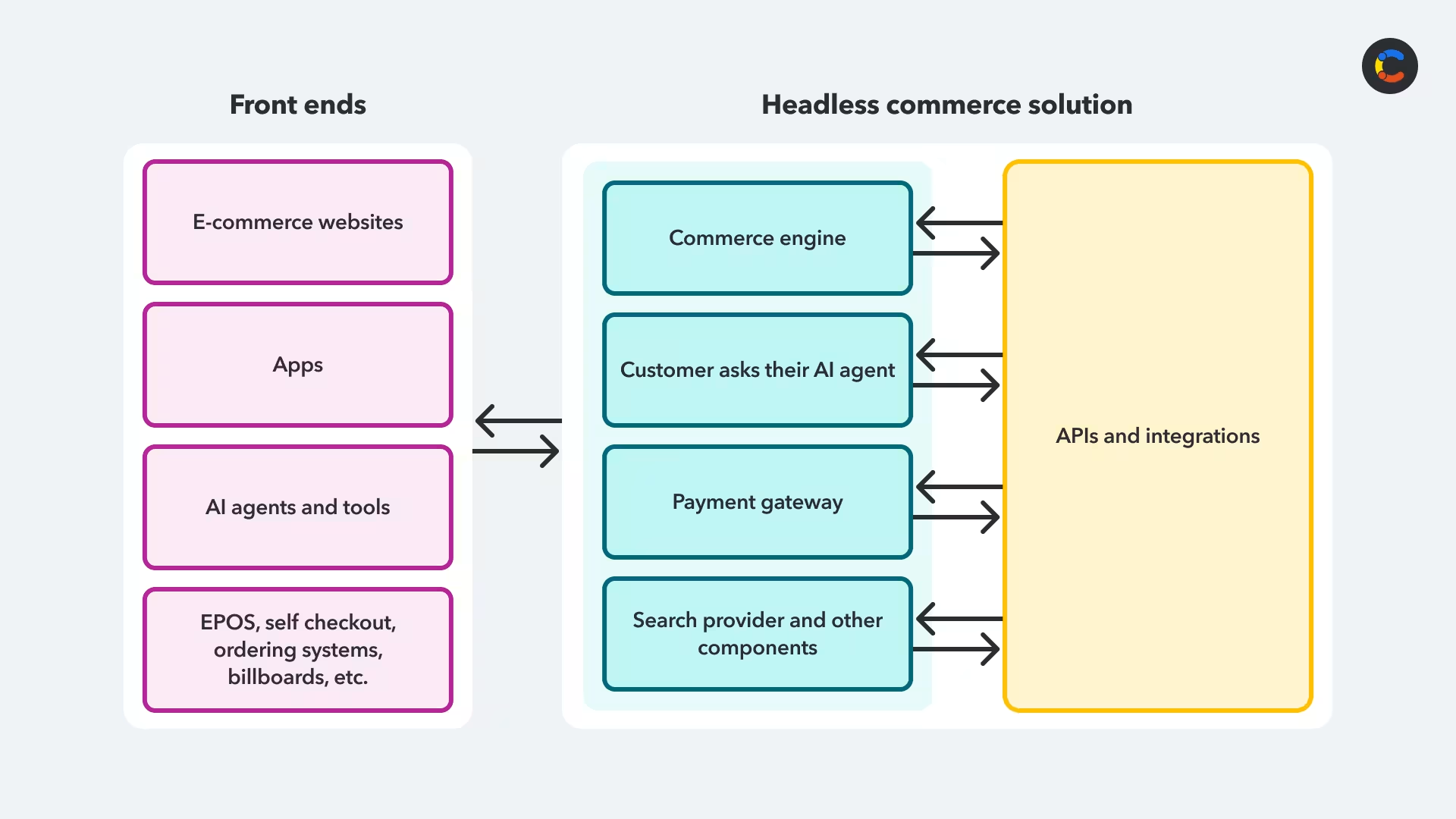
An e-commerce engine and content layer are practically mandatory — you wouldn't have a viable e-commerce presence without them. Once those are in place, other components can be phased in, allowing you to get up and running and then scale and add functionality based on demand for them.
When building your headless commerce solution, you should consider connectivity and performance across the entire process. Decoupling frontend presentation from backend logic should let you scale each component individually, but this is hampered if components rely on slow integrations.
Should you go all in on the same vendor?
Some commerce engines take a “kitchen sink” approach, offering headless commerce with ready-to-use front ends, payment processing, and order management included.
The fundamental concept of headless commerce is the decoupling of the front end and back end, so getting all the parts from one vendor will impact some of this flexibility. However, it can act as a starting point, allowing you to get up and running, and then gradually swap parts out with ones more suitable for your business.
Comparing headless commerce solutions based on your business needs
A headless commerce solution is the sum of its parts. When comparing the different components (or whether you need them at all), you should consider the following features and aspects.
Headless commerce component feature | What it means |
|---|---|
API features, functions, and quality | Which operations are exposed, REST or GraphQL, rate limits, etc. |
Extensibility | Can you add custom logic, and how easy is it? |
Integrations | Ready-made connectors for the other parts of the stack; for example, connecting your commerce engine to a payment portal. |
Developer experience | What your engineering team gets: test environments, ready-made code libraries, documentation, and other features that make development faster with high-quality results. |
Support model | Support response times, implementation partners that’ll work with you to build custom functionality, community, and overall reputation. |
Pricing model | Whether you pay for hosting your own open-source or licensed code, or whether it's a periodic subscription, or a subscription based on the number of products, user seats, or other metrics. You'll also need to factor the costs of implementation and integration (and those of your front ends, too). Watch out for hidden costs, like paywalled features and low headline pricing leading to increasing usage charges down the line. |
If you are replatforming, you should also assess how you're moving your product data and content from your old e-commerce platform. A composable commerce migration, including a content migration, is a multi-step process that requires careful planning to make sure you get your data transferred completely and with its context, and that there is no service interruption.
Getting started with a headless commerce solution
There are different routes you can take to your headless commerce solution. You can stay within a vendor-supplied ecosystem and use all of their components, source pre-built components from multiple vendors that suit your needs, or develop all or some of them from scratch.
Whether you build or buy, the key is to make sure you're retaining the benefits of a headless e-commerce solution that your business needs. For most enterprises, control is most important — if you can't readily swap out a component for something better suited to your goals, you may as well not use a headless architecture at all.
Generally, it makes sense to use a solid e-commerce engine and content platform as the foundation of a headless e-commerce solution. These will provide APIs and SDKs for readily connecting different front ends, and take care of all of the scaling and security concerns. This way, you can focus on building the unique business functionality you need, and the best digital experiences for your audience.
Contentful from Salesforce is the ideal content layer for headless commerce solutions. It includes tools for omnichannel ecommerce content delivery. Structure your product data for online stores, ads, and AI, store and deliver high-quality media assets to websites, apps, and any other front end, and optimize based on user engagement.

Inspiration for your inbox
Subscribe and stay up-to-date on best practices for delivering modern digital experiences.
Meet the authors

Esat is a Senior Product Marketing Manager at Contentful and enjoys sharing his thoughts about personalization, digital experience, and composable across various channels.
Related articles
What is vibe coding? Moving fast (and not breaking things) with AI assistance
February 3, 2026
React Suspense explained: How to use it for lazy loading and data fetching
April 25, 2024
What is a REST API?
February 13, 2024

Ready to start building?
Put everything you learned into action. Create and publish your content with Contentful — no credit card required.