Personalization, customer experience, and content platforms
Published on September 17, 2026


Inspiration for your inbox
Subscribe and stay up-to-date on best practices for delivering modern digital experiences.
No successful brand sees personalization as optional. Especially not when over 75% of customers get frustrated when their brand experience isn’t personalized, and when almost 40% of marketers cite personalization skills as critical to their job.
But meeting those internal and external expectations takes more than customer data. Brands also need the right people, processes, and technology in place to turn their customer insight into effective personalized experiences at scale.
In this guide, we'll explain what personalized customer experiences are, why they matter, and why the content infrastructure and the content platform powering them make all the difference.

Personalized customer experiences explained
Personalized experiences are shaped by the customer’s preferences, behaviors, and context, with the goal of making every interaction more relevant.
For example, two visitors landing on the same retailer's homepage might see entirely different product recommendations based on their browsing history or previous purchases.
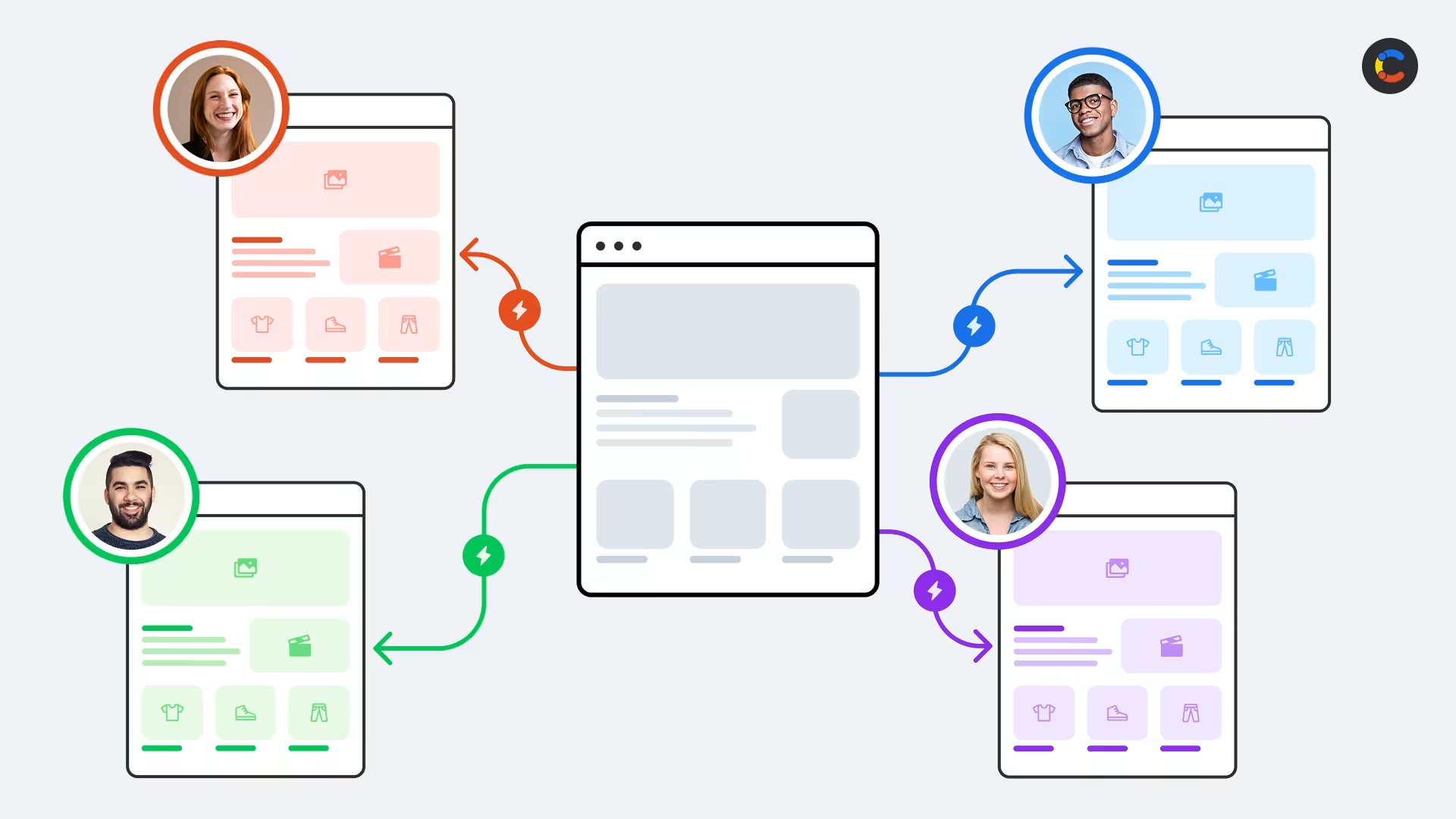
Each personalized experience is a variant. Rather than delivering the same content to every visitor, brands tailor the content to the individual.
Personalized variants of content experiences take many forms:
Welcome back messages for returning website visitors.
Email campaigns tailored to individual interests.
In-app reminders about abandoned shopping carts.
Loyalty-based offers and promotions.
Product recommendations based on location, season, or previous purchases.
While some of these examples are tied to individual marketing channels, effective personalization extends beyond interactions in isolation.
Imagine a customer adding products to their basket on a retailer's mobile app — then pausing the purchase and completing it later on the company's website. The items remain in their cart, ready for checkout. And, if they don't complete the purchase, they receive a reminder email. Later, if they contact customer support, the agent already has visibility into their recent activity and purchase history.
Customers don't think about these interactions as separate experiences — they expect them to feel like one continuous conversation with the brand.
To create that conversation, brands first need to understand their customers: collect and analyze customer data to build insights about individual preferences and behaviors. They can then use those insights to determine which content, products, or messages are most relevant at a particular moment in the customer journey.
A signal and a variant
None of that means you have to wait until you’ve built a perfect, comprehensive profile of a customer before you start personalizing.
Effective personalization doesn’t need a huge lift — in fact, all you need to personalize an experience is a signal and a variant.
That signal could be as simple as "This person clicked on an ad focused on Message A" — so they should be served a Message A content variant to validate their journey. Every company has access to these kinds of simple signals: first-time or returning visitors, location, UTM code, and so on. You flag the experience they clicked on to land on a page, and then learn which variants drive engagement and conversions.
The point is that understanding your customers is essential for personalization, but don’t underestimate the value of starting small and then iterating and scaling as your framework grows.
Why customer experience personalization matters
Customer journeys rarely happen on a single device or through a single channel.
Someone might discover your brand through social media, research products on your app, compare alternatives on your website, and then complete their purchase in-store. Throughout that journey, customers aren't looking for personalization for its own sake — they simply want the right information at the right moment, without having to start over every time they switch channels.
Helping customers find what they need more quickly improves their experience, keeps them engaged, and makes them more likely to convert. It also drives the metrics that matter, helping marketers improve engagement, conversion rates, customer retention, and, ultimately, lifetime value.
Delivering that kind of seamless experience consistently is easier said than done. As digital touchpoints continue to multiply, brands need to deliver experiences wherever customers choose to engage — across websites, mobile apps, email, social media, and more.
And customers notice when they can't quickly find the information they're looking for or when the content they receive doesn't reflect their needs. Irrelevant recommendations, outdated content, or technical issues, such as page “flicker” when the wrong content briefly appears before the personalized variant loads, all undermine the personalized experience.
When customers think the brand isn’t listening, the journey isn’t taking them anywhere, or the experience isn’t for them, they're more likely to abandon their journeys and look elsewhere.
So how does personalization help? Let’s look at some direct impacts.
Relevance
Personalization allows businesses to match content to each customer's context instead of presenting everyone with the same experience. That might mean recommending new products based on previous purchases, highlighting articles related to recently viewed content, or surfacing support resources for customers who have already bought a product.
Journey friction
Customers rarely complete their journey in a single session. If they’re browsing products on their phone during a morning commute, for example, they might jump to a laptop after work to complete the purchase.
Without personalization, that kind of transition risks becoming disconnected. Customers opening their laptops may need to search for the same products again, rebuild abandoned shopping carts, or sift through pages of irrelevant information before finding what they need.
Personalization helps remove that friction by maintaining continuity throughout the journey. Customers can move between devices and channels without losing context, creating a smoother, more intuitive experience from beginning to end.
Loyalty
Brands that consistently demonstrate they understand their customers build stronger relationships over time. Relevant and useful recommendations show customers that their interactions are designed to help them, rather than simply sell to them.
That doesn't mean personalizing every piece of content. In fact, excessive personalization can feel intrusive and even raise privacy concerns (more on that later). It can also waste valuable marketing time and resources for little value in return.
Effective personalization delivers moments in the journey that add value and build trust — ultimately, encouraging customers to return. For example, Contentful customer Personio personalized the logos it used for specific audiences in order to boost social proof — and saw a 26% uplift in conversions and a 62% uplift in contact form conversions.
Profit
While personalization is fundamentally about boosting customer satisfaction, the commercial benefits are significant. Brands with greater personalization maturity are almost 50% more likely to exceed their revenue goals, and over 70% more likely to see an increase in customer loyalty.
Greater content relevance leads to higher engagement, increased conversions, stronger customer retention, and improved customer lifetime value. In other words, when businesses consistently create experiences that customers find useful and relevant, they set the stage for commercial results.
Examples of personalized customer experiences
Personalization isn't just a tool to boost ecommerce results. Organizations across industries use it to deliver positive business outcomes.
Netflix
Every Netflix account holder sees a homepage tailored specifically to them. The mix of films, television shows, and recommendations is influenced by viewing history, watch time, preferred genres, and previous interactions.
Because both the viewer and the content catalog are constantly changing, the experience evolves every time someone signs in and interacts.
Amazon
Amazon personalizes almost every stage of the shopping journey, from homepage recommendations and shopping bundles to Prime offers, subscriber discounts, and post-purchase recommendations.
Like Netflix, no two customers receive exactly the same experience when they use Amazon. The platform continuously adapts to each shopper's browsing and purchasing behavior.
Personalized email campaigns
Email is one of the most effective personalization channels because brands have complete control over the content, timing, and presentation of each message they send.
In this context, the personalized email might be a set of product recommendations, or onboarding information for a recently purchased product or service. In essence, the channel is highly versatile and provides a space to present a range of relevant customer experiences.
B2B experiences
Personalization principles apply just as much in B2B contexts. Marketers can tailor website experiences according to visitor intent, industry, company size, previous interactions, or existing customer relationships.
And in this case, the experience can be shaped around business needs, so that prospects see case studies or educational resources while returning customers see product documentation or event invitations.
What does an effective personalization strategy look like?
The most effective personalization strategies focus on the moments where the experience can meaningfully improve the customer journey, rather than tailoring every single content asset to each individual visitor.
So, how do you identify those moments and personalize them?
1. Build customer understanding
Customer research and data are the foundation for every successful personalization strategy, and the best way to start understanding who’s engaging with your site or product.
Even simple signals such as “first-time visitor,” “site arrived from,” or “type of content engaged with” can help deliver more relevant experiences. As you collect data and generate insight, you can build a deeper understanding of your customers.
You can use that insight to build customer segments, but those segments shouldn't become rigid definitions that dictate the shape of experiences over the long term. Customer context matters: a first-time visitor looking for educational content, for example, needs a different experience than an existing customer searching for product documentation, support resources, and so on.
To find out what that “different experience" looks like, you test your content. Start with a simple customer signal — customer “has trait X” — and a small content variation, then use A/B testing to determine which variant experience resonates most with that trait.
To do this, build a segment based on customers that “clicked on an enterprise ad” (“UTM_campaign=enterprise”), and then show them relevant enterprise-focused content.
Testing and experimentation should become part of the broader personalization process, with AI-powered analytics helping teams learn and iterate more efficiently.
2. Create flexible, reusable content
Customer insight is only part of the personalization equation. You also need enough content available to create meaningful experience variations across audiences, channels, and journey stages.
In some cases, especially for brands using legacy content platforms, that involves creating entirely separate pages, campaigns, or websites for different customer segments. That process can quickly become difficult to manage.
A composable content platform changes the picture.
Instead of treating every webpage as a standalone asset, content is broken down into its structural components that can be reassembled and reused in different experiences as needed. Headers, product descriptions, calls to action, customer testimonials, images, and other content assets are managed centrally and reused across channels.
This allows the same product description to appear on an ecommerce website, inside a mobile app, in a personalized email, or on an in-store kiosk — with all instances managed from a single source of truth.
Rather than duplicating entire pages or campaigns for every audience, marketers create reusable content for the elements that stay the same. They then focus attention on developing new variants only where personalizing will add value.
For example, a product description might remain unchanged, while banners, calls to action, recommendations, or promotional messaging vary for different audience members and contexts.
3. Deliver consistent experiences across channels
Because customers expect every interaction to feel connected, personalized experiences can’t end when the customer closes their laptop or puts their phone in their pocket.
In practice, this requires an omnichannel strategy. You’ll need to ensure your content platform can extend personalized experiences across channels — with no fragmentation, inconsistency, or technical problems (the “flickering” we mentioned earlier) when customers engage via different touchpoints.
4. Measure, learn, and improve
Successful brands continuously measure how their personalized experiences perform in order to understand what's working and where improvements can be made.
At the enterprise level, that means bringing together data from multiple channels and integrating AI-assisted analytics tools for support. The goal isn't simply to amass as much data as possible but to shorten the feedback loop between measurement and action.
The faster teams are able to turn those insights into new content variations, experiment on those variants, and optimize them, the faster they'll optimize the customer experience and achieve their business goals.
Why content infrastructure is essential for personalization at scale
Most organizations don't struggle with content volume — because AI tools have made content creation faster than ever. What’s tricky is personalizing that content at scale.
As brands expand into new markets, launch new digital channels, and create more personalized experiences, they increase the risk of fragmenting content experiences — and by extension, personalization.
Personalization problems stick out to customers; sooner or later, they notice the drop in quality. The good news is that composable architecture and structured content can solve that.
In a structured model, content components can be retrieved and assembled into different experiences quickly, and then delivered consistently across channels.
Because content is managed centrally, teams only need to update information once — and the changes are reflected wherever that content appears. That simplicity reduces duplication, improves governance, and ensures customers receive accurate, consistent information regardless of how they engage with your brand.
Most importantly, structured content makes personalization easier to scale.
As new audiences, markets, channels, and touchpoints are added, your marketers don't have to start from scratch on new personalized experiences. They can reuse existing content to create new variations that add value, and continue delivering all that without dramatically increasing the work burden.
In other words, while customer data determines who should receive a personalized experience, your content platform ensures you deliver the experience consistently at scale.
Privacy, personalization, and customer experience
We talked about the need for brands to understand their customers, but that also means collecting and using customer data responsibly. Customers need to understand what information is being collected, how it's being used, and — most importantly — what they receive in return.
From a personalization perspective, people are generally willing to share information when it improves their experience. That might mean receiving more relevant product recommendations, finding the right content more quickly, or avoiding repetitive interactions across channels.
The most effective personalization strategies are built on first-party data: information that customers voluntarily share with a brand. This might include purchase history, newsletter subscriptions, product preferences, account information, or customer feedback.
Collecting first-party data doesn't remove the need for transparency. You need to be clear about what you’re collecting, obtain the appropriate consent, and give customers meaningful control over their data — in compliance with privacy regulations.
Trust makes personalization sustainable. When customers believe their data is being used responsibly and can clearly see the value they're receiving in return, they're more likely to continue engaging with personalized experiences.
Get personalization and customer experience right
Customer data is only part of the personalization challenge. To deliver meaningful experiences consistently, you’ll need a content platform capable of creating, managing, delivering, and governing content across every touchpoint.
Contentful Personalization is your foundation for that.
An AI-powered personalization platform, Contentful Personalization gives marketers everything they need to tailor digital experiences quickly and conveniently based on customer behavior, audience segments, and real-time analytics.
They’ll have a suite of powerful AI tools and automations that help to reduce manual effort and human error, and they’ll be able to implement your personalization strategy without relying on developers.
Personalize with Contentful
Good personalization requires brands to deliver both content and results. Customers get what they need, fast, and businesses get conversions — moving their metrics, hitting their KPIs, boosting their bottom lines, increasing loyalty, and powering growth.
In other words, experiences that work seamlessly across channels, that can be modified and improved quickly and efficiently, that can be reconfigured and reused, and that continue to deliver value as their customers and markets evolve.
Ready to launch better personalized experiences at scale? Let’s talk. Reach out to our team to arrange a demo.

Inspiration for your inbox
Subscribe and stay up-to-date on best practices for delivering modern digital experiences.
Meet the authors

Kate is a Solution Engineer with 15+ years helping marketers create, measure and scale content that drives KPIs. She’s co-written written two books, Return on Engagement and O’Reilly’s Civic Apps Competition Handbook, and most recently prototyped Contentful’s new Content Operations Agent.
Related articles

An introduction to CMS migration: Tips for a smooth transition
January 7, 2025

Personalization today, tomorrow and beyond
July 1, 2025

What is a content management system?
November 5, 2024

Ready to start building?
Put everything you learned into action. Create and publish your content with Contentful — no credit card required.