Three personalization strategies to get more value from your existing traffic
Published on September 4, 2026



Inspiration for your inbox
Subscribe and stay up-to-date on best practices for delivering modern digital experiences.
Marketing teams work hard to bring people to their websites. They invest in paid campaigns, email, and search. Referrals and newer discovery channels create more opportunities to attract visitors. Yet the experience after the click often loses sight of what brought someone there.
Personalization can close that gap. It doesn’t have to begin with a major data overhaul or an ambitious artificial intelligence initiative. A team can start with signals it already collects, apply them to one focused use case, and measure the result. From there, it can build with greater confidence.
In a recent webinar, we explored how Ruggable, Pets Deli, and Personio have put this approach into practice. Their examples highlight three useful strategies: respond to the intent visitors have already shown, use what you know about existing customers, and combine behavioral and customer data as your program matures.

1. Start with the intent visitors have already shown

The point of acquisition is often the easiest place to begin.
When someone clicks an advertisement, an email, or a referral link, they arrive with context. The campaign may focus on a product, audience, or offer. But many organizations still direct that visitor to a generic homepage, where the original message disappears.
That disconnect creates extra work. Visitors have to search for the information that caught their attention, confirm that an offer still applies, or interpret broad homepage messaging on their own.
A better destination continues the conversation the campaign started.
Ruggable offers a useful example. The company ran campaigns for dog owners and cat owners, then adapted its homepage content for each audience. Visitors arriving from a dog-related promotion saw imagery and messaging tied to dog ownership. Those coming from a cat-focused campaign saw content that matched their interests.
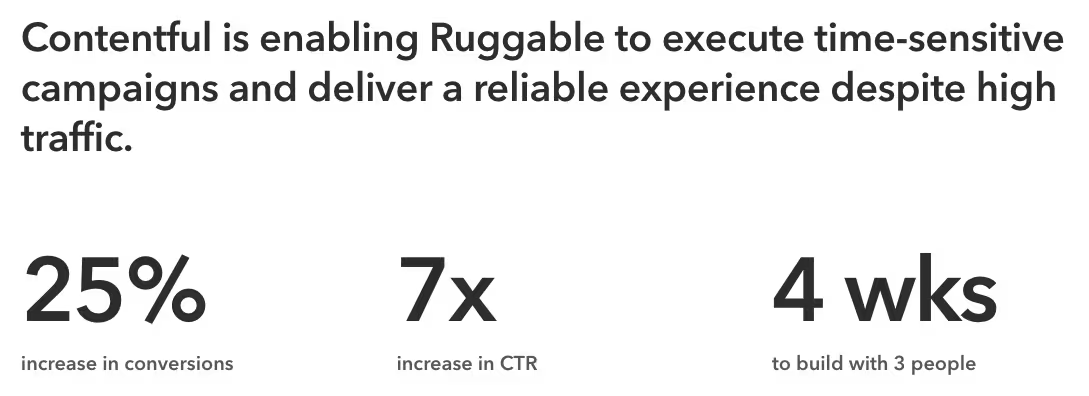
The takeaway isn’t that every brand needs separate dog and cat experiences. It’s that the campaign itself reveals something useful about intent. When you know which message or offer generated a visit, you can carry that context into the next interaction.
UTM parameters can help identify visitors arriving from advertisements, emails, or partner referrals. Marketers can use those signals to define an audience and connect it with a relevant content variation.
A practical place to start is a high-traffic campaign with a clear promise. Compare the campaign message with the page visitors see next. Where does the experience fall short? The first improvement may be as simple as changing a headline, image, or offer. In some cases, adjusting the call to action may be enough.
This isn’t about redesigning the site for every audience. It’s about removing friction when you already have a strong clue about what someone wants.
2. Build on what you already know about your customers

Acquisition signals can explain why someone arrived. Customer signals can help determine what they may need next.
A first-time visitor and a returning customer aren’t usually trying to accomplish the same thing. New visitors may need an introduction to the brand, reassurance about the product, or an incentive to make a first purchase. Existing customers may be looking for loyalty benefits, complementary products, or a logical next step.
Showing both groups the same message can make the experience less useful for everyone.
Pets Deli applied this principle during a Black Friday campaign. The company distinguished between first-time visitors and previous customers, then adjusted its messaging for each group. Rather than showing everyone the same banner and offer, it used the customer relationship to shape the experience.
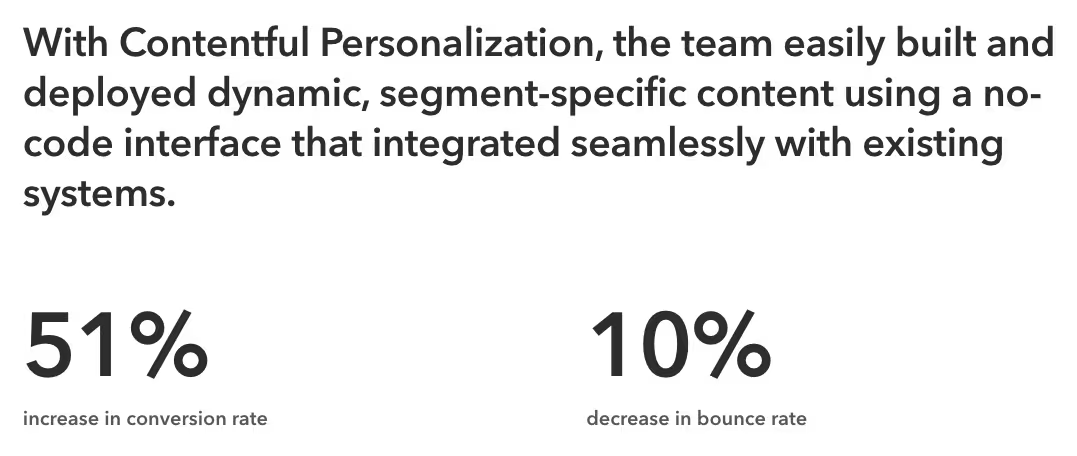
The same idea works beyond retail. A software company might distinguish between prospects and authenticated customers. A financial services provider could show an account holder a relevant next action instead of a general introduction. A subscription business might adapt content for current subscribers, former subscribers, and people who haven’t registered.
The strongest starting point is one reliable signal that changes what would be most useful to the visitor. That might be login status, purchase history, or subscription status. Other useful signals include loyalty membership, product ownership, and previous engagement.
Once the audience is clear, the next question is how much of the experience needs to change. Often, the answer isn’t an entire page. A single component, such as a hero, promotional banner, or recommendation, may be enough. A tailored call to action can also make a meaningful difference.
This component-level approach keeps the work manageable. Shared parts of the page stay the same, while only the elements that need to reflect the audience change. That makes the experience easier to test, maintain, and improve.
The goal isn’t to use every available customer data point. More data doesn’t automatically create more relevance. Use a dependable signal when it supports a clear visitor need and a measurable business objective.
3. Combine behavioral and customer data for richer experiences

Campaign and customer-status signals offer practical entry points. As a personalization program develops, teams can begin combining signals to better understand what a visitor may be looking for.
Personio’s approach shows how this can work. The company recognized that organizations evaluating its services could have different priorities depending on their size and requirements. A midsize business may be looking for something quite different from an enterprise with more complex operational needs.
Instead of treating every business visitor as part of one broad audience, Personio tailored its messaging for distinct company segments.
Behavioral data can add another layer of context. Repeated engagement with enterprise-focused content may suggest that someone is researching capabilities for a larger organization. Visits to specific service pages or downloads of specialized resources can provide further clues.
Those signals become more useful when paired with customer or firmographic data. Firmographic data describes traits such as industry, company size, and location. It may come from a customer relationship management system, a customer data platform, or an account-based marketing system.
Together, these signals can help distinguish casual interest from a meaningful pattern. Someone who reads one enterprise article may not need a different experience. A visitor from a large organization who repeatedly engages with enterprise content presents a stronger case for tailored messaging.
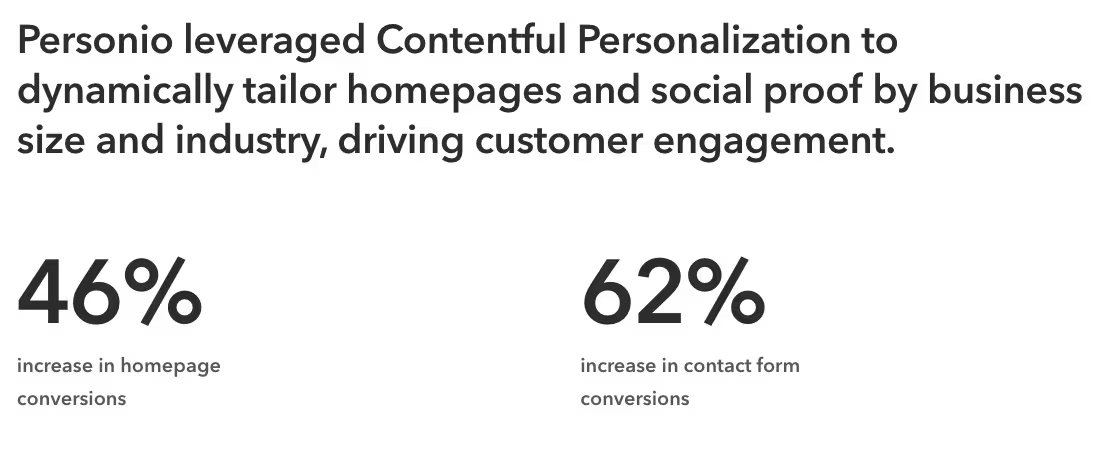
This kind of personalization should develop gradually. Each additional signal raises new questions about data quality, consent, and audience rules. It also adds work around content maintenance and measurement.
It’s better to build on use cases you understand than to create highly specific audiences without a clear reason.
The principle remains simple: Personalization should help people find relevant information faster. It shouldn’t exist simply because the data makes it possible.
Treat personalization as an ongoing capability
These examples come from different industries, but they share the same working pattern.
Each one begins with a useful signal. A campaign can show why someone arrived. A customer relationship can suggest what they may need next. Behavioral and business data can reveal more complex priorities.
From there, a team can form a hypothesis, create a relevant content variation, and measure the outcome.
That final step is essential. A personalized experience shouldn’t be assumed to perform better simply because it’s more specific. It needs a defined objective, a fair comparison, and enough evidence to guide the next decision.
A focused test might ask whether a campaign-aligned homepage hero increases engagement. Another might measure whether a tailored offer improves conversion among returning customers. For a business audience, the goal may be to help visitors reach relevant product information faster.
This cycle turns personalization from a series of isolated ideas into an ongoing capability. A program can begin with one high-confidence use case, learn from the result, and expand over time.
A documented framework can support that growth. It gives teams a consistent way to connect audience decisions with measurable business objectives. It also helps prevent disconnected experiments that become difficult to maintain or evaluate.
Start with one relevant experience
Many organizations already have enough information to improve what happens after a visitor arrives. The opportunity may be visible in campaign parameters, login status, or purchase history. Browsing behavior and existing customer information can provide further context.
The best first step isn’t to personalize everything. It’s to identify one moment where visitor intent is reasonably clear. A more relevant experience should either remove friction or support a meaningful outcome.
Start there. Define what you expect to change, decide how you’ll measure it, and use the result to guide what comes next. Watch the full webinar recording for more insights.

Inspiration for your inbox
Subscribe and stay up-to-date on best practices for delivering modern digital experiences.
Meet the authors

Patrick is a Solution Engineer at Contentful, helping enterprise teams unlock the power of composable content. His sweet spot is where strategy meets implementation — translating big ideas into scalable architectures that actually ship. He loves connecting dots between marketing, product, and engineering to build systems that are flexible, future-proof, and a little bit elegant.

Esat is a Senior Product Marketing Manager at Contentful and enjoys sharing his thoughts about personalization, digital experience, and composable across various channels.
Related articles

How conversational AI is reshaping analytics
September 22, 2025
Digital touchpoints in the AI era
July 14, 2026

6 exciting customer experience (CX) trends to watch
February 26, 2025

Ready to start building?
Put everything you learned into action. Create and publish your content with Contentful — no credit card required.