Content mapping that converts audiences into customers
Published on February 5, 2026


Inspiration for your inbox
Subscribe and stay up-to-date on best practices for delivering modern digital experiences.
Maps reveal what’s around us, the lay of the land: highways, back roads, alternate routes, lunch spots, traffic jams — you get the idea.
Maps give us options. And, while we’re talking about maps for physical journeys, the principle holds for customer journeys.
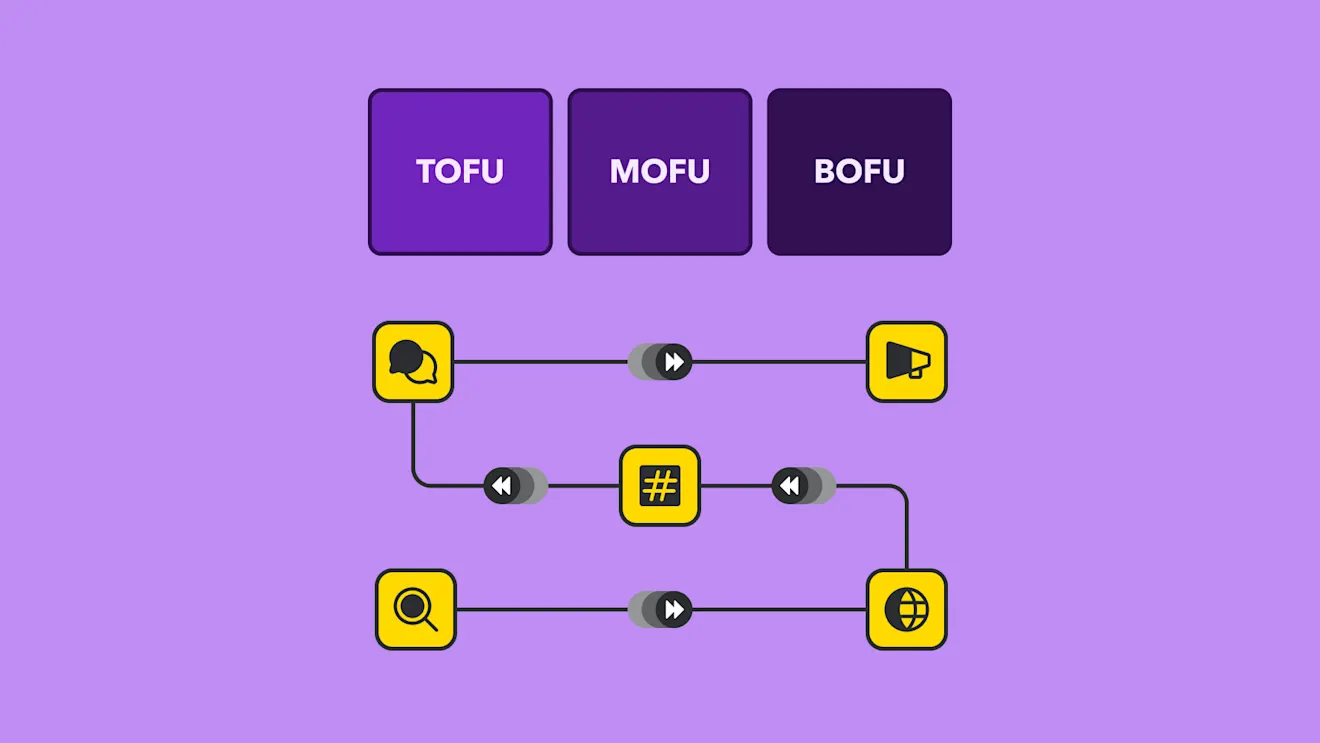
It especially applies in digital marketing contexts, where brands need to make sure that their users have the content they need to fully nurture their journey, from the top-of-funnel (TOFU) awareness stage, to the middle-of-funnel (MOFU) consideration stage, to the bottom-of-funnel (BOFU) purchase-decision stage.
Architecting that journey is known as content mapping.
What is content mapping?
Content mapping (or content journey mapping) is an internal process that brands use to work out whether they have enough content to cover every stage of the customer journey for their target audience (or audiences). More importantly, it’s a way for brands to ensure that the content they have aligns with customers’ needs at those stages.
For example, at the top of the funnel, visitors arriving on a homepage usually have little context. They need quick orientation — what the brand does, why it matters, who it’s for — not dense product detail. Light, introductory content at this stage helps them see themselves in the problem and understand that the company gets them without becoming overwhelmed, think a short explainer video or a “how to solve X” blog post.
Further down the funnel, returning or more qualified users don’t need that baseline orientation — they’re evaluating fit. Here, content should shift to specificity and differentiation: a rundown of product options, for example, or a clear competitor comparison that sets out how your approach solves their exact pain point.
What is a content map?
The goal of the content mapping process is to produce a document — a content map — which is, in the most basic sense, a list of content aligned to that very customer journey.
While the content obviously varies by brand, it would likely include everything from landing pages, product pages, blog posts, ebooks, webinars, whitepapers, videos, images, and so on — each of which supports a specific need.
Like any map, that list needs to be organized in a way that makes it understandable and navigable by its users — primarily, content teams. And, while there’s no single correct way to design a content map, and no universal content mapping template, setting the information out in a grid is often effective, with the stages of the customer journey along one axis, and your business priorities along another.
The customer journey axis is relatively straightforward: top to middle to bottom-of-funnel — the journey from audience member to satisfied customer.
The business priority axis is (slightly) more complex – it might include personas, industries, use cases, geographies, content pillars, etc.
By tracking content against business priorities and the stages of the customer journey, it’s easy to see a visual representation of your content ecosystem, which is not only super helpful for content and campaign teams seeking to identify gaps in their content catalog, but can be used to shape future content strategy.
Why use a content map?
The content mapping process seems straightforward in principle, but organizations that publish content in multiple global markets, for global audiences, and maintain vast databases of thousands of assets, need to keep tabs on what is living in their digital ecosystems.
That said, an effective content mapping strategy should help brands understand what content they have available and, importantly, what content they’re missing.
For example, content mapping might reveal that, while a brand has plenty of TOFU and BOFU content, a lack of MOFU content is undermining the flow of the customer journey for several personas, and preventing interested users from converting into customers.
By building business priorities into the map, brands can track who they’re prepared to market to in almost any context: from personas (that represent the journeys of individual types of users), to journeys involving specific product lines, geographic locations, or industries.
It pays to think outside the box here: Business priorities could also entail storytelling narratives that the brand wants to focus on, seasonal changes in the markets, specific product use cases — any kind of journey with the brand can be tracked and mapped.
Content mapping in action
Let’s dive into a hypothetical content map for an online clothing store.
The store creates a persona for “seasonal style seeker,” a type of customer who closely follows seasonal trends and wants to stay up to date with the latest looks as they drop. The content team adds the persona to the content map and then charts relevant content available to serve that journey through the funnel:
TOFU | MOFU | BOFU |
|---|---|---|
Inspirational, eye-catching blog posts; “The top 10 must-have styles for spring” or “What’s hot this season: Colors and patterns to watch.” | An instructional video: “How to update your wardrobe for the new season.” | A dedicated product catalog: “This season’s trending styles.” |
User-generated photos of influencers sharing their seasonal looks. | Customer testimonials highlighting how the brand consistently delivers on-trend pieces each season. | Personalized product recommendations, based on browsing history. |
An explainer video on “Why ‘X’ is out this summer.” | Time-limited seasonal bundles and promotions. | |
Detailed size guides specific to seasonal items. | ||
Easy exchange and return policy information. |
At a glance, our clothing brand has the whole customer journey covered. But if you look closely, there’s a lack of MOFU content, at least compared to the other stages.
Now your team can create a plan to fill the gap by producing MOFU content for that persona — like a competitor price comparison infographic, a page explaining your corporate sustainability commitments, and so on.
Content mapping vs. customer journey mapping
The term “content mapping” is often used in close proximity to “customer journey mapping,” but it’s worth making a distinction.
The customer journey map illustrates a customer’s learning journey in detail. Like a content map, it’s a visual representation — but from the first-person perspective of the customer. It’s a way for brands to identify pain points in the journey itself, and eliminate friction as the customer moves through the funnel.
Content mapping focuses on there being content available to experience at each stop along the journey.
Think of the customer journey map as the floorplan for a department store. It gives customers a connected route through their desired departments and then to checkout. Meanwhile, the content map ensures that all the things that customers expect to find on shelves during that journey are physically there. It ensures that there are clothes in the “Clothing” department and sofas and chairs in the “Furniture” department.
Making your content map matter
A content map is only as valuable as your ability to act on it.
Identifying gaps in content, understanding business priorities, and organizing assets across the customer journey are useful foundational steps — but without the right technology, the map is just a static document.
This is where the Contentful digital experience platform shines, empowering content teams to activate their content map. Here’s how we do it.
Structured content: Contentful supports structured content models that enable brands to break their content down into its component parts — text, headers, images, and so on. Content teams can then use those components like modular building blocks to spin up new content, filling gaps revealed by the content map quickly and easily with assets pulled from existing content structures.
Tagging and content discovery: Contentful’s digital asset tagging enables teams to assign tags to assets and content entries in order to organize and locate content by a vast range of variables — everything from persona and funnel stage, to content type, product, use case, and more. Even better, Contentful’s automated AI-powered tagging capabilities mean that you can do that at scale, keeping your content library clean, searchable, and aligned with the content map as it evolves.
Omnichannel delivery: Contentful’s headless architecture and application programming interface (API)-first design philosophy ensures that content experiences extend seamlessly across all brand channels. With all content assets stored in a centralized database, content teams can adopt true, omnichannel marketing strategies, publishing to any touchpoint within the digital ecosystem (web, mobile, store display, etc.) without risk of formatting error, duplication, or brand voice fragmentation.
Workflow independence: Contentful’s marketer-friendly UI enables content teams to collaborate effortlessly in the front end without having to depend on developers when they’re creating, reviewing, and publishing content. That independence means that, when the content map highlights a gap, teams can move quickly to fill it, prioritizing and shipping content without getting bogged down in the dev queues common to less flexible CMSes.
AI Actions: Contentful’s AI Actions helps content teams streamline bespoke elements of the content creation workflow, including outlines, SEO-ready metadata, translation, localization, and more. When it comes to the content map, AI Actions automations help teams rework content for different funnel stages, adapt language and tone for specific personas, or create new assets from scratch.
Personalization: Where a content map ensures brands have enough content to serve their audience, personalization fine-tunes the appeal of that content to boost engagement, loyalty, and the likelihood of conversion. Contentful pulls personalization into the front end with a suite of AI-powered tools, including native analytics, automated segmentation, localization, and more, designed to streamline the process for marketers.
Wrapping up
A content map should be a living document that sits at the heart of your content operation and serves as a foundation for strategy, operations, campaigns, and your general sense of whether your ecosystem is truly meeting the needs and expectations of your customers.
Like any map, however, its value depends on the detail you put into it. The more accurately you develop and document your personas, customer journey stages, and available assets, the easier it will be to see what’s working, what’s missing, and what needs to come next.
It’s here that a digital experience platform like Contentful becomes essential. Contentful provides the functionality and flexibility that your content teams need to turn content mapping into meaningful content management — in other words, creating, adjusting, and publishing content at the speed and scale that the global market demands.
Ready to start exploring what’s possible with Contentful? We’re here to guide you: Dive into our latest features and releases, explore the full range of our AI Actions automations, or reach out to our sales team for a demo.

Inspiration for your inbox
Subscribe and stay up-to-date on best practices for delivering modern digital experiences.
Meet the authors

An experienced marketing leader with a passion for storytelling, Anne leads a full-funnel content marketing team. She excels at creating and implementing omni-channel strategies – including SEO, social media, video, and events – to drive engagement and nurture customer relationships.
Related articles
Content creation workflows that scale high-quality content across regions
June 19, 2025

Why content velocity matters more than ever
February 11, 2026

Website replatforming explained: Mitigating risks and maximizing your ROI
March 21, 2025