The power of personalization frameworks
Published on April 14, 2026


Inspiration for your inbox
Subscribe and stay up-to-date on best practices for delivering modern digital experiences.
Successful brands know that content personalization delivers results. Not only do the vast majority of customers now expect personalization, they’re also twice as likely to complete a purchase if their experience is personalized.
Although the data shows that personalized experiences matter, it’s worth remembering that personalization isn’t an end in itself. You aren’t tailoring content to your customers preferences for the sake of it — you’re seeking to connect it to meaningful business outcomes and sustain those outcomes over time to deliver value.
The complexity of personalization makes it difficult for some brands to make that connection. They struggle to understand the how and the why behind personalization, and end up stumbling over questions like: “Where do I start?” “What objectives are we trying to achieve?” “Which tools do I need?” “When do I need to experiment on content?” and “How do I scale my personalization program?”
A personalization framework makes answering those questions easier.
What is a personalization framework?
A personalization framework relates to the strategy behind personalization — how the brand should be using its personalization capabilities to achieve its business objectives and generate return on investment (ROI).
Put simply, a framework helps brands understand which content experiences they should be personalizing, where that personalization should happen, and how to personalize for different customer segments. It defines the data that the brand needs to collect to perform personalization, and charts the path to scaling personalized experiences as the brand grows.
A framework helps to ensure that personalization doesn’t become a series of disconnected content tasks, but an integral part of the content strategy that delivers ongoing benefits.
Why frameworks matter
When brands dive into a personalization campaign without considering strategy, they risk undermining the impact of the experiences they create.
Here's an example: A brand decides that it has the means to start personalizing email correspondence with customers in the hope that adding customer names to the copy boosts newsletter sign-ups. The problem is that, since their customers rarely engage with the brand’s email content, they disregard the personalized messages sent via email and don’t convert. That outcome means the brand isn't able to justify its investment in the personalization and, worse, can't explain why it failed.
Had the brand identified and analyzed the right data and set clear goals, it would have realized that the first-name personalization tactic would have had a greater impact on a landing page call-to-action (CTA) button.
In this scenario, a framework would have helped the brand establish what business outcomes it wanted to influence, what data it needed to activate to achieve them, and what key performance indicators (KPIs) it could use to gauge success — in this case, an increase in CTA conversion rates. That foundation would, in turn, help them align their technology and resources with their personalization strategy, and clearly demonstrate ROI.
Enabling omnichannel
A personalization framework should account for where personalization happens. In other words, it should support omnichannel personalization — because most brands don’t limit their content experiences to websites; customers move between mobile apps, email, and other digital channels throughout their journey.
Omnichannel is about persistence and consistency. Not only do customers expect the brand to be consistent across those channels — the same aesthetic, products, information, and so on — but they expect to be able to pick up where they left off: For example, the same products added to their carts, the same saved preferences, and the same recommendations.
That makes omnichannel content delivery a framework priority — especially on mobile, where content experiences are smaller, faster, and more intent-driven. If mobile users don’t see relevant content immediately, they’ll bounce.
An effective framework ensures that brands are able to identify and factor mobile experiences (and all other relevant channels) into their personalization solution efficiently — rather than scrambling to create and deploy that content as they scale.
Personalization everywhere
With omnichannel and the need to scale factored in as priorities, a framework prevents personalization from becoming a series of isolated tactics applied to individual content assets or campaigns.
Instead, it supports a holistic, connected approach to personalization that spans the brand’s ecosystem, covering every touchpoint, feeding data back instantly, evolving continually, and adapting to user behavior in real time.
That’s a long way of saying that the framework closes the loop between content performance and business outcomes. It becomes a foundation on which brand teams can improve their own understanding of their content — by analyzing, experimenting, and making better decisions.
More importantly, that foundation triggers a mindset shift. Brands no longer see personalization as a “nice to have” add-on to the content stack, but a living, breathing part of the content ecosystem that grows and evolves over time, and drives long-term ROI.
Building your framework
The shape and size of a framework will vary business by business. Organizations starting from “no personalization" will, obviously, have different needs than those with an existing solution that needs adjustment — for example, different tools, data, and expertise.
Let’s make the picture simple by organizing the development of a framework into three phases.
Phase 1: Ideation and insight
Organizations starting from a position of “no personalization” should create their framework on a foundation of planning and learning.
Analyze data: Leverage analytics to identify pain points, segment audiences, and uncover opportunities for personalization. Focus on high-traffic, low-performing areas.
Brainstorm personalization concepts: Engage cross-functional stakeholders to generate ideas for testing. Consider personalization across banners, layouts, offers, and messaging. Emphasize the “why” behind each idea.
Define hypotheses and KPIs: For each idea, create a hypothesis: “If we change X, then Y will improve.” Align KPIs with business goals, such as conversion rate or retention.
Prioritize test ideas: Evaluate each idea based on impact versus effort using an impact/effort matrix. High-impact, low-effort tests should be prioritized for immediate execution.
Assess capabilities: Establish whether personalization ideas can be achieved with existing content management capabilities. Identify the tools and technology necessary to implement ideas, and support experiences across the relevant channels.
Phase 2: Build and optimize
Following the development and definition of personalization objectives, brands should seek to implement their personalization process, and refine it.
Build and develop the personalized experience: Execute creative design and technical implementation of personalized content experiences. Leverage technology to streamline — for example, reusable content templates and automated content generation. Ensure quality assurance and stakeholder approvals before launch.
Evaluate and optimize: Measure performance of personalized content experiences once statistical significance is achieved. Capture both quantitative and qualitative insights to inform future initiatives.
Phase 3: Iterate and scale
With a personalization process in place, organizations can focus on continuous improvement.
Feedback loops: Connect content performance to business outcomes by feeding data and insight back into the framework, documenting insights extensively.
Scale: Based on data-driven insight, expand personalization into new segments, channels, and experiences.
Cultural evolution: Building on personalization success, institutionalize a culture of experimentation to ensure long-term scalability and impact, and appeal beyond the customer base.
Framework challenges
Creating a framework gets easier if you’re working with the right software architecture.
Legacy limitations
Legacy content platforms limit the development and implementation of personalization frameworks because their monolithic architecture typically locks brands into a page-based approach and undermines workflow efficiency.
In these platforms, new experiences must be built from scratch, and content copied, pasted, and duplicated across an increasingly vast and chaotic content ecosystem. That severely limits the potential for agile workflows, and undermines omnichannel delivery because new versions of the same content must be created for each channel.
Legacy platforms also usually prevent brands from integrating specialized personalization tools and modules, including analytics software. That means content teams often need to rely on third parties to refine their personalization solutions, or develop workarounds for missing capabilities.
That inefficiency poses obvious problems for teams seeking to build frameworks because not only do they struggle to create, optimize, and publish personalized experiences, but to learn from their content once it goes live.
Composable personalization potential
The Contentful digital experience platform (DXP) provides the ideal environment for creating and implementing an effective framework because it removes those legacy limitations, and unlocks personalization potential for every brand team.
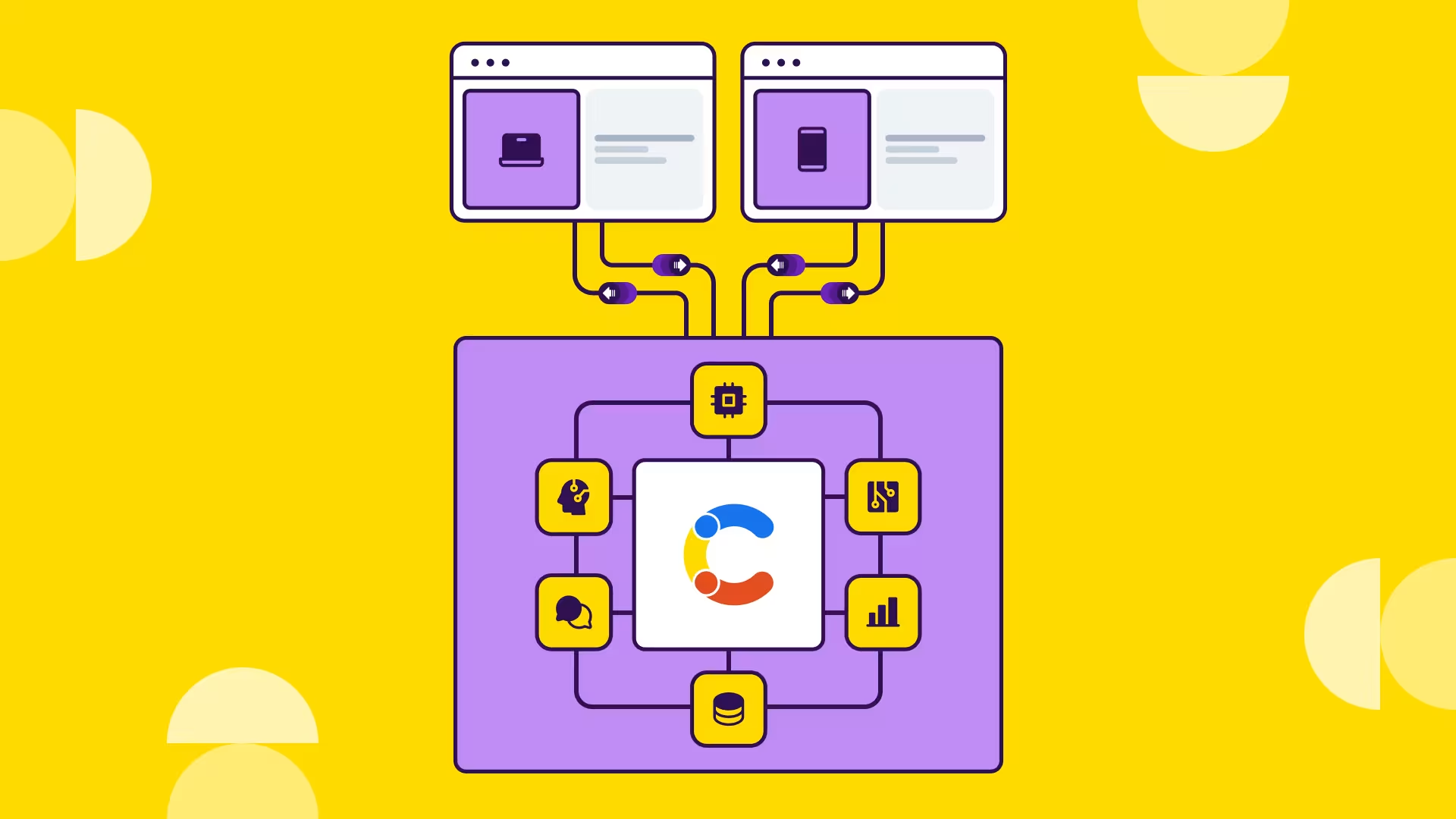
The key to that access is Contentful’s composable architecture, which enables brands to integrate exactly the tools and modules they need to align their personalization process with their framework, and empower users to achieve their personalization goals.
Here’s how it works.
Structured content modeling: Contentful breaks content down into its smallest structural components, which can be reassembled like modular building blocks. Structured content frees brands from rigid, page-based content creation in which content has to be duplicated constantly or rebuilt from scratch. Instead it supports the flexible reuse of existing content to spin up new experiences, precisely tailored to user preferences, faster than ever.
Omnichannel scope: Contentful's API-first design philosophy builds omnichannel scope into the heart of personalization solutions. Brands only need to create an asset once, and then can deploy it instantly across every channel and touchpoint in every corner of the digital ecosystem, leveraging APIs to ensure compatibility and consistency however customers engage.
Tech stack flexibility: Contentful’s composable architecture allows organizations to integrate best-of-breed tools across their personalization stack, including CDPs, analytics platforms, and experimentation tools. And because Contentful is API-first and not locked into a closed vendor ecosystem, teams can evolve their personalization capabilities over time without friction, even as business needs, data sources, and technologies change.
Marketer-friendly tools: Contentful Personalization empowers non-technical users to work on personalized experiences autonomously. Marketers can create customer segments, set up and run experiments, and manage other critical personalization tasks from within the Contentful platform itself, with no need for developer hand-holding. That access and agility reduces bottlenecks, increases iteration speed, and enables continuous improvement.
AI-powered personalization: Contentful leverages AI automation at every stage of the personalization process — via AI Actions. The feature includes templated automations for content creation, translation, and localization, search engine optimization (SEO), and more, but can also be customized for specific content management tasks. AI Actions ensures that teams can execute on the goals of their personalization framework, even as their content ecosystem expands across markets and audiences.
Instant feedback: In Contentful, marketers can connect content performance to business outcomes effortlessly. Contentful Analytics pulls critical performance data into a single location, removing the need to navigate multiple dashboards or leverage third-party apps. At the same time, agentic search functions ensure anyone can find and access insight, understand what it means, and use it to optimize content experiences.
Wrapping up
Personalization only becomes valuable when it’s measurable. Your personalization framework is how you achieve that. Without a framework, personalization remains fragmented across channels, is difficult to scale, and is hard to justify to financial decision-makers.
A well-defined framework changes that. It provides a way to align personalization efforts with business goals, define the metrics that matter, and create a repeatable process for testing, learning, and improving over time.
That’s where Contentful makes a difference.
Our platform gives brands everything they need to build, shape, and evolve their personalization frameworks, automating content management, capturing and acting on data in real time, and delivering seamless, personalized experiences across every channel that customers use.
Ready to start building your framework? Find out more about Contentful Personalization, AI Actions, and our agentic analytics platform — or arrange a platform demo by getting in touch with our sales team.

Inspiration for your inbox
Subscribe and stay up-to-date on best practices for delivering modern digital experiences.
Meet the authors

Meron is a Senior Solution Engineer at Contentful, where she helps organizations bridge the gap between technical solutions and real business outcomes. When she’s not working, you'll find her hiking with her family, eating her way through a new city, or dancing!
Related articles
Agentic AI vs generative AI: When you need AI to act, not just create
August 24, 2026

Digital touchpoints in the AI era
July 14, 2026

How to accelerate speed to market and increase content velocity
April 30, 2025

Ready to start building?
Put everything you learned into action. Create and publish your content with Contentful — no credit card required.