How to prepare your website for AI agents without rebuilding everything
Published on September 29, 2026



Inspiration for your inbox
Subscribe and stay up-to-date on best practices for delivering modern digital experiences.
Ask a marketing team about AI agents today and you'll usually hear a version of the same worry: if agents start answering questions and making recommendations on our behalf, is the website still worth investing in?
We think that's the wrong question. The agentic shift doesn't make your website less important. It raises the standard for the content layer behind it. Your site still has to persuade people, and it now also has to be legible and trustworthy to software that reasons over information and acts on it. The good news is that these are not two separate projects.
From "help me understand" to "help me get it done"
It helps to be precise about what we mean by an agent, because three different things are currently described with the same word.
Generative AI helps you understand. You ask a question, you get a synthesized answer. Automation executes a predefined series of steps, and any one of those steps might use AI for a specific task. An agentic system is different: you give it an outcome, and it determines how to get there. It reasons over information, selects tools and APIs to act with, and comes back to you with questions when it needs clarification.
The shorthand we keep coming back to is the move from "help me understand" to "help me get it done."
Brian Browning, VP of Enterprise Solutions at Apply Digital, recently joined us in a webinar to talk through what this looks like in delivery:
"Agents help us put the intelligence in artificial intelligence. It requires a lot more governance and a lot more understanding of how that's going to be driven in a way that drives a business outcome that we care about, but it's also the most powerful and most revolutionary form of AI."
Both halves of that matter. More autonomy means more value and more governance, not one without the other.
This isn't only a customer-facing story either. In our work with large enterprise customers, agents are already changing how marketing teams operate inside their tools: drafting, translating, checking against brand guidelines, moving work through review. The shift is arriving on both sides of the website at once.
What actually changes for your website
Your website remains a brand experience. What changes is that it also becomes a source of context, and over time a set of services that agents can use. That has a few practical consequences.
Content has to communicate clear intent. A product page, a comparison page, and a support article each do a different job, and that job needs to be legible to a machine as well as to a reader.
Decision data has to be accurate and current. Pricing, availability, specifications, inventory. When an agent is researching or acting for someone, stale data isn't an inconvenience; it's a wrong answer delivered confidently.
Format has to be adaptable. A narrative that works beautifully for a person may need a structured, comparison, or question-and-answer format to be useful to an agent. Brian's example was the infographic: effective at explaining a complex process to a human, close to useless to an agent unless the same logic also exists in structured form.
Measurement has to expand. Visits, page views, and conversions still tell you about human engagement, but they say nothing about whether you're discoverable and trusted in answer engines.
And there's a risk to name directly: fragmentation. When the same information is duplicated across systems and markets, consistency quietly decays. A person will squint at two different prices and work out which is probably right. An agent won't. It will either pick wrong or decide your source can't be trusted.
Two audiences, one content layer
This is the part we'd most like teams to take away: your content layer is your context for agents.
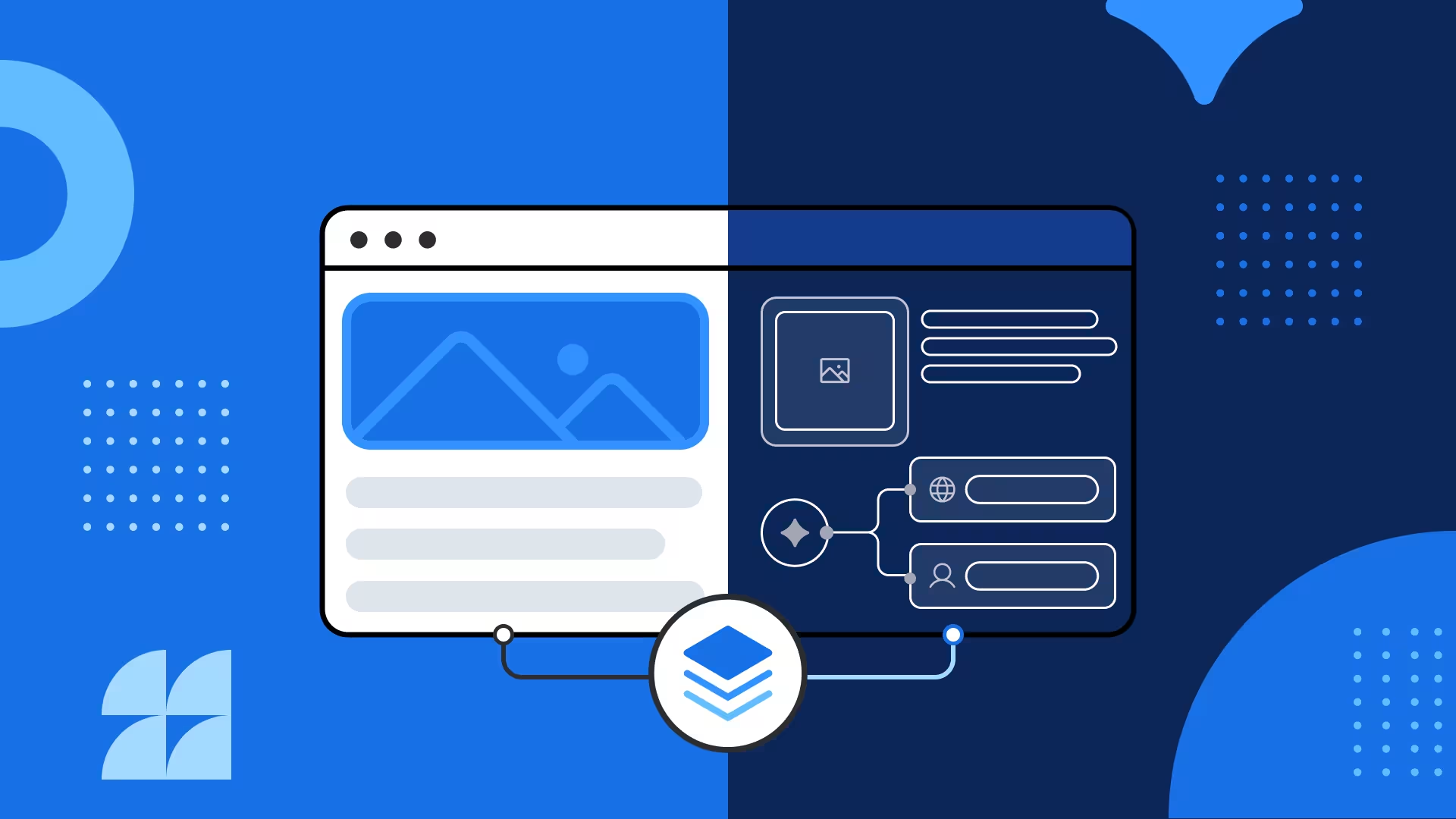
People need story, design, emotional relevance, and reasons to trust you. Agents need accurate, structured, machine-readable information they can query and reason over. Those are genuinely different needs, and the instinct is to build a second thing to serve the new audience. That instinct is expensive and wrong: two sources of truth become two versions of the truth.
Create content once instead, structured and modular, and reuse it everywhere: the human-facing site, answer engines, customer-facing agents, internal marketing workflows, and whatever channel arrives next. That's what a content layer is for, and it's the practical advantage of a structured, API-accessible platform over a page-centric one.
None of this is a new problem. Content sprawl, duplicated product data, inconsistent localization, and unclear ownership have drained marketing teams for years. Agents don't create those weaknesses; they just make them consequential.
Four dimensions of agent readiness
When we assess whether a digital experience is ready for agents, we look at four things.
Intent and quality: is the content accurate, trustworthy, and structured so its purpose is clear? Agents need to be able to tell which information is relevant to the task in front of them.
Personalization: if you already personalize for segments, you have a foundation. The shift is to think about the job the agent is doing. A shopping agent needs price and availability. A comparison agent needs specifications, reviews, and third-party evidence. Swapping the hero image does very little for a channel that isn't swayed by emotion.
Localization: more than translation. Content has to be discoverable and relevant in each market, including the regional nuances that shape how people and agents search and compare. Read more about how Contentful supports global content workflows with AI.
Governance: the more autonomy an agent has, the more this matters. Consistent messaging, trusted sources, clear ownership, visibility into where AI has made changes on your behalf, and a human in the loop where the stakes justify it. This is the dimension we see teams underestimate most, and it decides whether AI-assisted content creation scales or gets reined back in.
Where to start
You do not need to rebuild everything first. Here's the sequence we'd suggest.
Start with a real customer or business problem, and a specific point in the journey where an agent could create value. Not a transformation program, a journey.
Then check your foundations. Is your content structured and composable? Can the systems underneath it scale across channels and markets without content being rewritten each time?
Then do the hygiene work: content modeling, discoverability in search and answer engines, Schema.org JSON-LD on key page types, a robots.txt file that reflects which bots you actually want reading you, and semantic markup that carries meaning rather than styling. Other approaches are emerging here too, though the standards are still moving.
Then experiment, on one focused journey rather than everywhere at once.
Almost all of that is work you need to do anyway, which is why we'd rather teams started now than waited for clarity. Brian made the case for urgency pretty clear:
"Agents are going to hit, and when they hit, they will be everywhere. That's the wrong time to start thinking about ‘how do I prepare.’ The smartest organizations see this coming and are starting to plan for, experiment with, and take advantage of this kind of technology today."
Five questions for your team
For a quick read on where you stand, try these.
Can we identify the trusted source behind our top products and best-performing marketing assets?
Can that information move across channels and markets without being rewritten each time?
Does it carry enough structure and metadata to be machine-readable and useful as context?
Do we know where AI is making changes on our behalf, and where a human stays in the loop?
Can we measure which experiences worked, and turn that into a recommendation for the next campaign or market launch?
Notice how few of those are technology questions. Agent readiness is mostly a content operations problem wearing a technology costume.
Build for humans today, and be ready for agents tomorrow. If you'd like the longer version of this conversation, including Brian's examples from live agent deployments, the full webinar recording is here: What if your next visitor isn't a person?

Inspiration for your inbox
Subscribe and stay up-to-date on best practices for delivering modern digital experiences.
Meet the authors

Pieter is Director of Product Marketing at Contentful, where he leads the core product marketing team. He has spent more than 20 years working where technology and marketing meet, as a lead developer, entrepreneur, and product marketing leader.

Neha Khawas is a Principal Solution Engineer at Contentful. She partners with enterprise brands to enable teams building digital products for the modern, personalized, omnichannel world. With over a decade of experience in technical sales and content management, she helps customers navigate their digital transformation journey.
Related articles

Understanding omnichannel analytics to provide better digital customer experiences
August 12, 2026
Three GEO playbooks: How to prepare your content for generative search
June 17, 2025

39 ecommerce personalization statistics to inform your strategy
January 28, 2025

Ready to start building?
Put everything you learned into action. Create and publish your content with Contentful — no credit card required.