Structured content for AI: Why content architecture is the foundation
Published on August 26, 2026


Inspiration for your inbox
Subscribe and stay up-to-date on best practices for delivering modern digital experiences.
You've probably heard that structuring your content is good for multi-channel publishing, as each channel can pull the raw fields it needs from a single source and display the content in whatever format suits it. What gets talked about less is that the same structure makes your content easier for AI systems to understand.
For instance, if the information you provide to a large language model (LLM) is unstructured, inconsistent, or ambiguous, it’s more likely to produce poor output. So while it's good for multi-channel publishing, structured content can also be the foundation that decides whether an AI initiative works.
What makes content structured?
Structured content is content that is broken up into smaller, meaningfully typed components, each one defined by a content model that separates meaning from presentation. This separation allows it to be processed more easily, providing benefits such as multichannel delivery, content reuse, queryability (filtering and search), consistency, and compatibility with AI.
Structured content is semantic: It contains meaning and hierarchy. This comes from a few building blocks. Content types define the shape or essence of a thing, for instance, an ```Article or an ```Author. Fields are the typed containers within them, holding the actual data: An ```Article may have a ```title (text) and a ```publish-date (date). Relationships link types together, so an ```Article can reference an ````Author. And metadata (tags, locale, status) describes the content for systems that consume it.
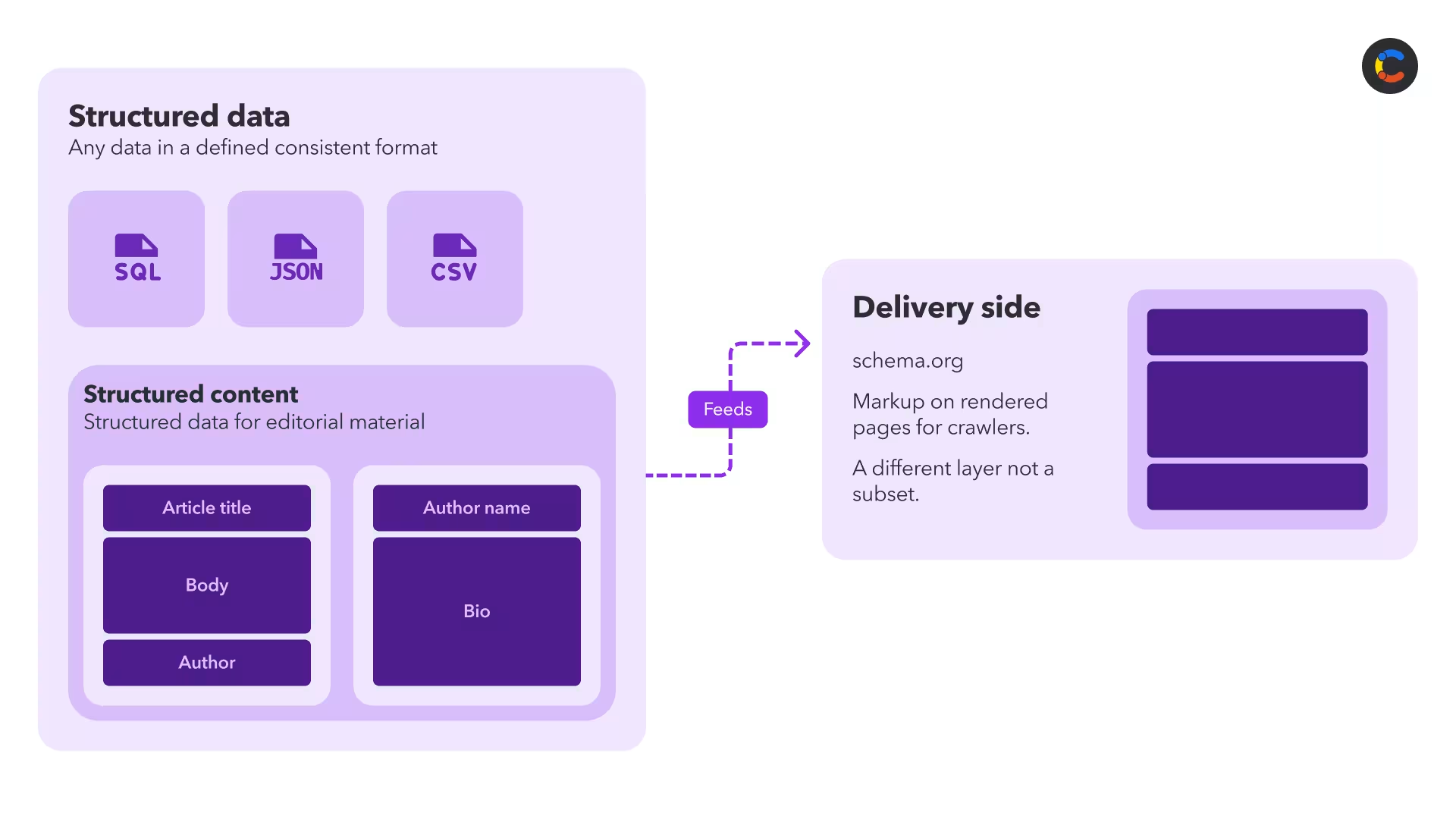
Structured content shouldn't be confused with ```schema.org markup or conflated with structured data in general. ```schema.org is markup added to rendered pages so that search engines and crawlers can understand them. Structured data is data that conforms to a defined, consistent format, such as database rows, CSV files, or JSON with a known shape, as distinct from unstructured data like free text or images. Structured content is really structured data applied to editorial material, in that you're giving content the same predictable, machine-readable shape.
Why do AI systems need structured content?
AI needs what structured content provides: meaning that is declared so that it doesn't have to infer it.
For example, take the word "football" in a conversation between two people. AI can usually work out whether it's the English or American game – the context usually clarifies that. "Usually" is the problem here: Can you trust it to be resolved correctly every time? The two speakers know which game they mean, so they never say it; if the rules, venue, or location never come up in the transcript, the disambiguating signal isn't there for the AI to use. Structured content, however, removes the guesswork because the meaning is declared in the content.
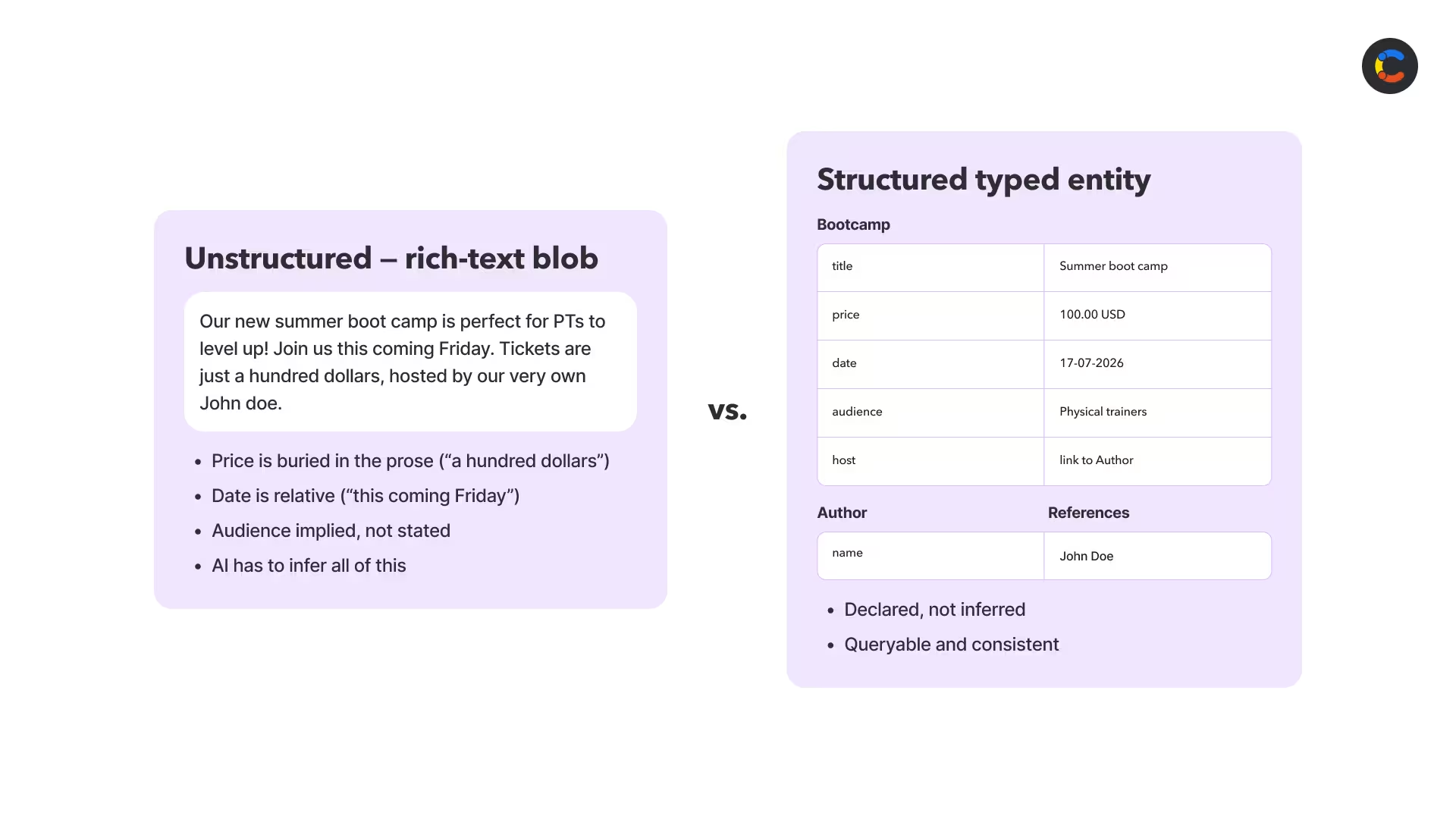
It also allows systems to perform actions (filter or sort) based on information. It's the difference between a blob of text containing something like "The price is $100" and something more structured like "price: $100". AI is less likely to hallucinate with the latter, making it more reliable to work with. Without structure, AI has to work out what each value is every time it reads an item – that means thousands of repeated inferences (not always guaranteed to be correct) and more tokens used.
When you use structured content, the meaning is stated rather than inferred, which gives AI systems less to guess at. With less ambiguity, there are fewer ways to go wrong.
What does structured content enable with AI systems?
Above all, structured content enables AI systems to be more efficient and accurate. The following use cases work well because the model is reading from separate, typed fields rather than parsing unstructured text:
Personalization at scale: Structured content allows you to treat your content as modular components that get assembled based on the audience, saving you from having to maintain separate versions of a page. The metadata (audience, locale, segment) is what the system filters and selects on. This allows you to have many assembled variants of the same page to personalize the content for your audience, avoiding manually maintained copies that drift out of sync. AI can help assemble variants on the fly because it is organized into easy-to-understand components.
Automated content workflows: Automation can act on fields/types because they're predictable. For example, you could send every ```Article type without an ```Author relationship to be reviewed or auto-translate content that has a field flagged ```locale: "pending". Structured content also enables you to slot AI into a workflow as a step. For instance, it could generate a meta description from the ```body field and write it to the ```meta-desc field.
Agentic content operations: In addition to reading content, agents need to be able to act on it. Structured content allows AI to query for the right item, update a field, create a related entry, link relationships, or move something through a workflow.
Content as data (feeding LLMs / RAG): With retrieval-augmented generation (RAG), content needs to be split into chunks, which are retrieved from a vector database at query time to be given as context to an LLM. Structured content provides natural boundaries (e.g., a field, a component). Splitting on semantic boundaries keeps coherent units intact – it's the difference between a retrieved chunk being a coherent piece of text or a fragment broken off mid-idea, which is hard for AI to then reason about. Contentful has a feature called Content semantics, which continuously indexes everything in your content space into a vector database. This helps you to avoid duplicate content, link to other content with suggestions, and improve your content quality with AI actions.
GEO (generative engine optimization) / AI search visibility: AI search synthesizes a short, justified shortlist rather than handing back a page of links to click through — so content has to be structured for a machine to extract why something fits: comparison tables, explicit specs, clear value statements. One thing to note: Although structure makes your content usable to these systems, it doesn't earn the citation by itself. That said, it is an important building block to help with GEO.
How content modeling builds the foundation of structured content
The above also weighs heavily on how you design the content model. If you get this right, then you set your future AI initiative up for success.
Content modeling means defining the types of content that will exist (```BlogPost, ```User), what each one will contain (fields), and how those pieces of content will relate to each other (```BlogPost referencing a ```User). This answers the three questions AI systems need to know: What types of content exist, how are they related, and what do they contain? Modeling content types and their relationships is what makes content traversable. An agent can follow the relationship from a ```BlogPost to a ```User and then to other blog posts by that user because the path is declared in the content model.
To build a strong foundation that will run smoothly with AI features, read more about content architecture best practices.
How APIs and MCP expose structured content to AI
A well-designed content model makes your content usable to AI – but structure can only help if the AI can get to the content in the first place. This is a question of delivery: How do you make the modeled content in your CMS available to your AI systems?
The answer is twofold: API and Model Context Protocol (MCP). Both APIs and MCPs depend on the model underneath. They are tools that help expose your structured content so that AI can make good use of it.
APIs serve your content as JSON, handing over the structured fields to whatever consumes them (e.g., a UI layer or an AI agent). It requires you to programmatically call it via HTTPS. In the case of an AI agent, the API allows it to receive clean, labeled data rather than having to scrape a webpage.
MCP goes a step further in that a server is available that provides a contract your AI system can understand and interact with via tool calls. In practice, you could complete tasks through an AI chatbot using natural language (bypassing the UI), or your AI agents could call the content repo autonomously to answer its own questions and allow it to form a response or complete an action.
How to avoid content that will block AI adoption
Below is a list of signals to consider and how to implement to be AI-ready:
Signal | AI-ready | AI-blocking |
|---|---|---|
Content units | Typed entities (Article, Author, Product) | Undifferentiated blobs of rich text/HTML |
Relationships | Explicit references between entities | Implied in prose or duplicated by hand |
Consistency | Reused types with a consistent shape | One-off structures per page |
Delivery | Reachable as structured data over an API | Only available as a rendered page to scrape |
Metadata | Tagged (locale, audience, status, taxonomy) | Untagged, meaning left implicit |
It can be helpful to conduct a practical audit on your content, too. Don't try to fix everything at once. Opt instead to start with your highest-value content type: the one piece of content most queried or most central to the AI use case. Model that well and then expand from there.
The success of your AI initiative depends on the content architecture beneath it
Every AI initiative inherits the quality of the content architecture that underpins it. With a well-thought-out, structured content architecture, AI can assemble components for personalization, agents can traverse relationships, retrieval has clean boundaries to chunk on, and AI search has explicit entities to extract.
You get all of this upfront from the model you designed and the content you structured. Modeling your content well now allows you to adopt each new AI capability as it's released, future-proofing your content operations.
Contentful is built structured-first: content modeled as typed entities and components, delivered as JSON over an API, and made available through MCP. That structure is what AI systems need to retrieve, parse, and act on your content.

Inspiration for your inbox
Subscribe and stay up-to-date on best practices for delivering modern digital experiences.
Meet the authors

Asia is the SEO & GEO Manager at Contentful, where she supports organic search and AI-driven content discoverability strategies. Based in Berlin, Germany, she’s passionate about the evolving intersection of search, AI, and customer experience.
Related articles

Personalization today, tomorrow and beyond
July 1, 2025

From AI experimentation to AI advantage
August 6, 2026

Omnichannel customer engagement: Strategy, challenges, and how to get it right
September 24, 2026

Ready to start building?
Put everything you learned into action. Create and publish your content with Contentful — no credit card required.