Designing content for answerability: Why structure, authority, and consistency matter for AEO
Published on June 11, 2026



Inspiration for your inbox
Subscribe and stay up-to-date on best practices for delivering modern digital experiences.
AI-generated answers are changing how people discover information. Instead of choosing from a list of links, people increasingly receive synthesized responses from tools like Google AI Overviews, AI Mode, ChatGPT, Perplexity, and other AI answer engines.
For content teams, that shift raises a practical question: when these systems talk about your company, are they drawing from content that’s accurate, current, and aligned with how you want your brand to be understood?
That’s where answer engine optimization (AEO) comes in. Instead of optimizing only for clicks, AEO focuses on helping AI systems accurately understand and reflect your content. What AEO doesn’t do is change the fundamentals of getting discovered online.
AI answers still depend on strong source content
Google’s recent guidance for generative AI features in search says the building blocks of SEO still apply, including helpful content, crawlability, indexability, and a clear technical structure. Google also says there’s no need to break content into tiny pieces for AI systems to understand it.
That means AEO depends on the same foundation as strong search performance: useful content, clear writing, consistent messaging, and content operations that treat every owned channel as part of the brand story.
OpenAI also notes that ChatGPT can surface publisher content and send referral traffic to websites. The implication is that AEO is still connected to SEO. If your content can’t be crawled, indexed, understood, trusted, or connected to the right topics, it’s less likely to shape AI-generated answers in the way you want.
That doesn’t mean every page should be redesigned for AI. It means the fundamentals matter across more places: clear pages, useful content, accurate product information, internal links, metadata, documentation, and support resources.
Answerable content provides clear, relevant information
Answerable content isn’t necessarily short or FAQ-style. It’s content that helps a person or system understand the topic, context, and source without stripping out nuance, brand voice, or narrative. It uses specific language, explains important concepts, and avoids claims that sound polished but say very little.
For example, this is vague: “The solution helps teams work better across channels.”
This is clearer: “A content model defines the structure of content, including fields, relationships, and rules. It helps teams manage information consistently so the same content can be reused across websites, apps, campaigns, and other digital experiences.”
The second version is more useful because it explains the concept, how it works, and why it matters. Regardless of whether the audience is a person or an AI system, specificity adds clarity.
Good AEO writing is still good writing. It uses headings that describe the topic plainly, and it defines acronyms and proprietary terms when needed. It connects related ideas without forcing readers to decode internal language. Most importantly, it makes the structure serve the purpe of the content.
AEO doesn't flatten every format into one template. Product pages, support articles, technical docs, and thought leadership each have different jobs. Each should be clear about what it is saying and who it's helping.

Your whole content ecosystem shapes AI perception
One of the biggest shifts in AEO is that marketing pages are only part of the story.
When answer engines describe a company or product, they’ll likely draw from a variety of sources. These can include product pages, documentation, support articles, release notes, and structured business data. A support article might become the cited source for a product limitation. A developer doc might shape how an answer engine explains an integration. An older knowledge base article might appear because it is specific, crawlable, and useful.
That creates a broader editorial responsibility. Content teams need to understand not only what the brand says on campaign pages, but what the full content footprint communicates.
This doesn’t mean every page should sound like marketing copy. Documentation should still help users solve problems. Support content should still be direct and practical. Developer content should still be precise. But all company content should share a consistent foundation: accurate terminology, current product information, clear positioning, and useful links between related topics.
Many content operations were designed around pages and campaigns, not reusable information that needs to stay consistent everywhere. That can create gaps: inconsistent product descriptions, outdated positioning, and branded terms without plain-language explanations.
AEO doesn’t create those problems, but it makes them harder to ignore.
For many organizations, this is a real opportunity. AEO gives teams a reason to look across their owned content and ask whether it tells a coherent story. When answer engines cite the brand, those citations can influence perception. When they don’t cite the brand, or cite an unexpected source, that can reveal gaps in SEO, authority, freshness, specificity, or content coverage.
Structure helps teams govern meaning
Structure still matters, but not because AI systems can only understand small fragments. It matters because structure helps teams create, update, and reuse information consistently.
Clear structure can include headings that describe the topic, definitions for important terms, internal links that connect related concepts, metadata that reinforces meaning, and content models that standardize information across teams and channels.
Specific headings give readers and systems a clearer signal about what each section covers.
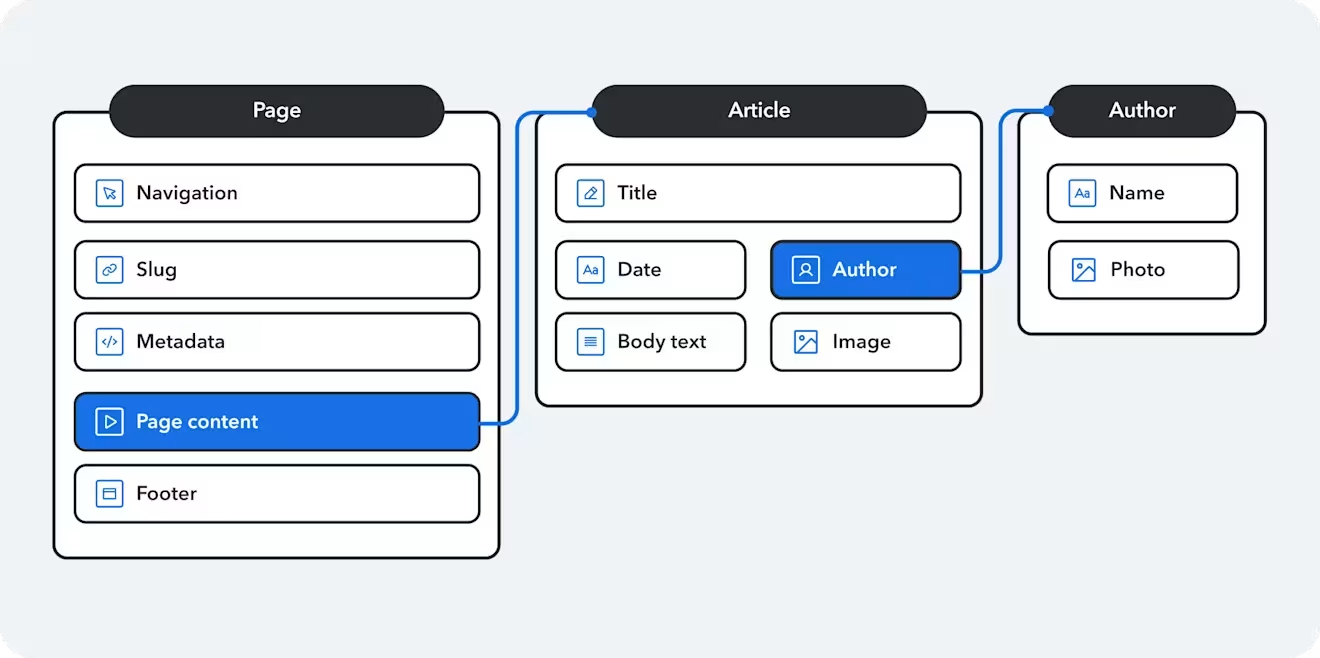
Content models define the structure and organization of content, with content types acting as building blocks that can be connected through reference fields. Structured content breaks content into labeled, reusable components that can work across platforms and devices.
For AEO, the benefit isn’t that structured content automatically makes AI systems cite you. It doesn’t. The benefit is that structured content gives teams a better way to govern the information AI systems may encounter.
If a product description, feature definition, or industry point of view is managed centrally, teams are less likely to leave outdated or conflicting versions scattered across their digital touchpoints.
Start with the fundamentals
You don’t need to rebuild your content ecosystem around speculative AI tactics. Start with the fundamentals that help both search engines and users.
First, audit the sources answer engines already cite for your priority topics. Look beyond blog posts. Include product pages, support docs, developer documentation, glossary pages, comparison pages, and help center content.
Next, review whether those sources tell the right story: current product names, consistent definitions, clear explanations, and links back to broader product value.
Then, strengthen foundational SEO. Google recommends focusing on people-first content that is helpful and reliable. It also recommends crawlability, indexability, technical structure, page experience, and avoiding tactics created only for generative AI features.
Use structure to improve governance. Define content types, fields, relationships, metadata, and reusable components for the information that must stay consistent across the business.
Finally, monitor gaps over time. If your brand isn’t cited, cited from an unexpected source, or described inaccurately, use that as an input to your SEO and content strategy.
Pitfalls to avoid
AEO is still an emerging practice, which makes it easy to overcorrect. The goal isn’t to chase every new tactic, but to build a stronger foundation for how your content is found, interpreted, and represented.
Do not treat AEO as formatting. Clear headings, metadata, and structure help, but they can’t make thin content authoritative. The underlying information still needs to be accurate, useful, original, and relevant.
Do not optimize for AI instead of people. Google’s guidance is clear that site owners should focus on people-first content and familiar SEO fundamentals, not special tactics created only for generative AI features.
Do not focus only on marketing content. Documentation, help articles, and technical resources often contain some of the clearest explanations of what a product does. If those pages are inconsistent with the broader story, they can shape perception in ways marketing teams did not intend.
Looking ahead: Structure as a foundation for AI-ready content
No one knows exactly what AI discovery will look like three years from now. That uncertainty is a reason to strengthen the foundation, not chase every new tactic.
AEO is not a mandate to write robotic content or divide every page into tiny answer blocks. The stronger opportunity is to make your expertise accurate, useful, and consistent wherever customers encounter it.
The future of AEO will be shaped by organizations that govern their content well: clear source material, consistent messaging, strong SEO fundamentals, and structured content that helps teams maintain meaning across every channel.

Inspiration for your inbox
Subscribe and stay up-to-date on best practices for delivering modern digital experiences.
Meet the authors

Asia is the SEO & GEO Manager at Contentful, where she supports organic search and AI-driven content discoverability strategies. Based in Berlin, Germany, she’s passionate about the evolving intersection of search, AI, and customer experience.
Related articles
Why you need a content repository (and how to get the most from it)
July 23, 2026

Digital transformation trends shaping the future of customer experiences
June 5, 2026
40 personalization statistics: The state of personalization today
January 22, 2025

Ready to start building?
Put everything you learned into action. Create and publish your content with Contentful — no credit card required.