Translation and localization: What’s the difference?
Published on June 10, 2026


Inspiration for your inbox
Subscribe and stay up-to-date on best practices for delivering modern digital experiences.
Knowing what to say and knowing how to say it are two very different things, especially when it comes to content marketing.
Brands that operate across borders and translate their content for target markets that use different languages understand that gap well. Messaging that resonates in one territory can fail to engage in another or, worse, turn audiences away.
That’s because translating words from one language to another is not always enough when it comes to engaging audiences in different parts of the world. The other half involves adapting what is said to fit the cultural, social, even seasonal norms of the target audiences; a process known as localization.
Going beyond the translation of text, localization is a critical step in the multilingual content creation process, adding value to digital assets and helping the brand export its message across borders.
This is why it’s important for brands to understand the difference between the translation process and the localization process, and how that difference can shape content strategy.
Translation and localization defined
Let’s set out exactly what we mean by translation and localization.
Translation is the process of converting text (written or spoken) from one language to another. In the context of websites, it usually involves the conversion of written text and focuses on linguistic and semantic accuracy.
Localization expands the scope of that conversion process beyond text. When content is localized, it’s adapted to fit the wider context in which it is being published. That context might comprise cultural references, geographical locations, social trends, and seasonal changes, but extends to anything that makes it feel natural, relevant, and appropriate for the local audience.
This means that translation sits within localization as a form of language localization. Meanwhile, the broader category of localization potentially includes every aspect of the content experience: tone of voice, cultural nuance, imagery and visuals, currency, pricing, measurement units, time of year, and so on.
That experiential aspect is critical to engagement because it builds the brand’s credibility with its customers and appeals directly to their personal tastes and preferences. Research from Contentful partner Shopify suggests that localization can boost sales by up to 15%, and increase customer satisfaction by up to 20%.
What do translation and localization look like?
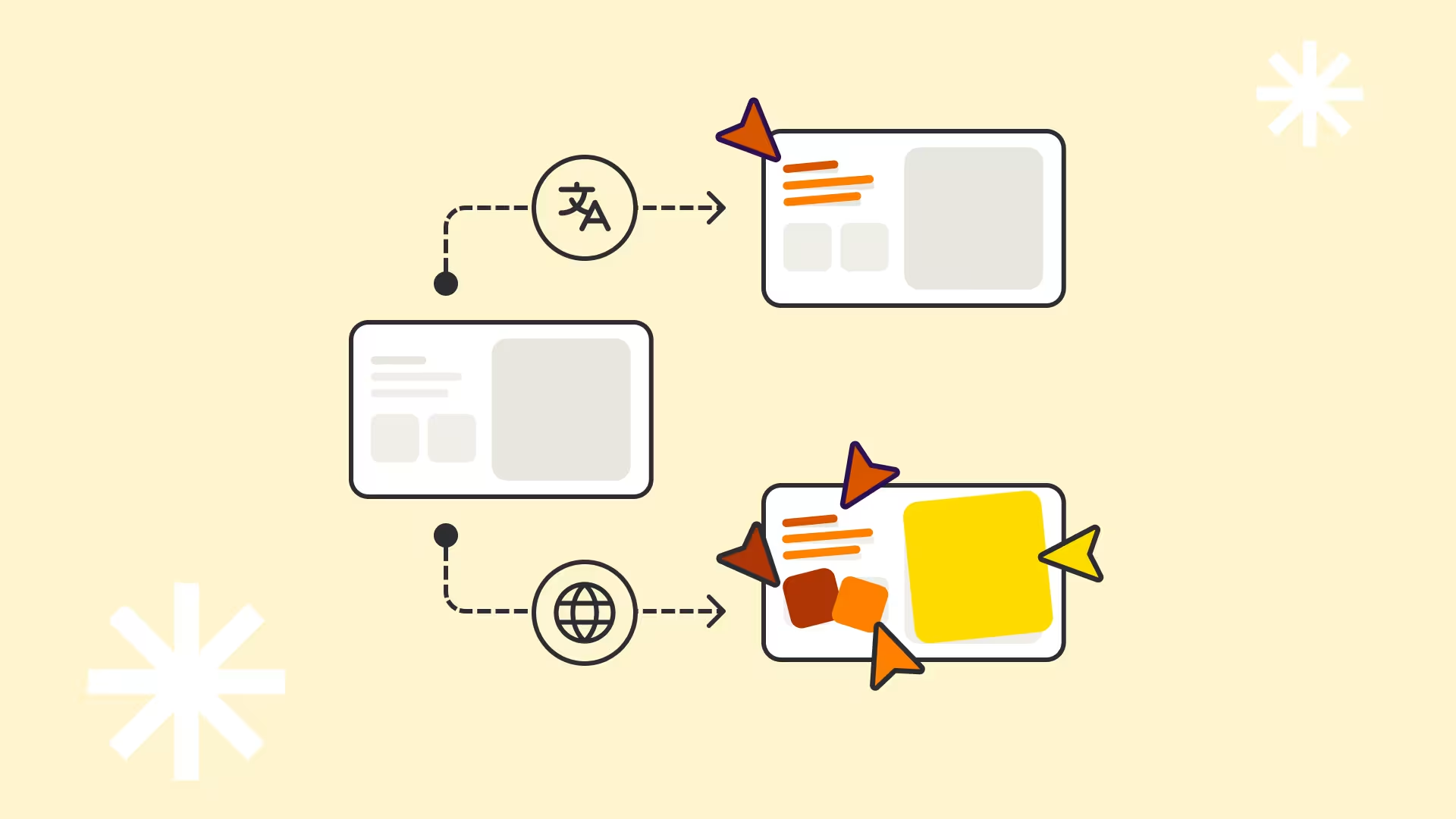
To put the above more concisely, translation handles the conversion of language, while localization handles the conversion of experience.
Here’s an example.
An international holiday company would want to localize its homepage to reflect the tastes and travel preferences of its customers in different countries. So, while the brand translates the copy that it uses on its homepage, it also localizes to ensure that customers in the US see a landing page with images of European or Asian destinations, and those in Europe would see images of Asia and the US.
Language may not even be a factor in localization. Customers in the UK should receive different seasonal content than those in Australia, for example, because of the northern-southern hemisphere seasonal difference — even though both audiences speak (virtually) the same language.
On the other side of that coin, translation might be the primary factor in localization. Customers in Germany, Austria, and Switzerland all technically speak “German” but with regional variations, and so the German text they see must be localized to align with that.
Brands typically need to integrate software to handle their translation and localization needs and may also leverage the expertise of human translators to complete the work.
Why does the difference between translation and localization matter?
The difference here matters because content experiences need to resonate for their target audiences in order to prompt engagement and generate conversions.
When those audiences are scattered across the world, that task becomes much more difficult. Blockbuster campaigns that worked for a “home” audience won’t necessarily travel across borders with a quick translation pass. In fact, they may even fall flat, which not only hurts engagement but also erodes brand reputation and reduces the return on investment (ROI) the brand was hoping for from its content assets.
In increasingly competitive international marketplaces, brands can’t afford to make that kind of mis-step. Since global content delivery is not just a question of converting text to another language, marketing teams need to understand how each experience should change for regional audiences.
Ideally, they’re able to execute that content localization work as quickly and efficiently as possible, without having to create new content from scratch for each region, and without compromising their message or brand identity.
It’s important that brands don’t just think in terms of website localization and translation, either. Their content needs to be deployed across a variety of channels and touchpoints seamlessly, and scale to meet growth goals.
Solving the localization problem
The problem with localization is not in the technical detail of converting and deploying digital content assets; it is in the coordination of workflows behind that process.
That’s because content localization necessarily involves multiple stakeholders and multiple local brand teams, working in different regions, possibly with different external partners and agencies. Layered on top of that are all the tasks and workflows associated with the content creation, review, approval, and publication processes — not least the need to translate and localize meta content for search engine optimization (SEO) purposes.
Each of those issues has the potential to generate delays and bottlenecks that inevitably trip something up. And there’s no one-size-fits-all approach to the problem, either: Brands will have different localization requirements depending on their industry, their audiences, the regions in which they operate, their risk exposure, and so on.
In essence, localization is primarily an orchestration challenge; one that becomes more intense as the brand’s global footprint grows.
On the flip side, the scope and complexity of that challenge also means that every efficiency a brand can build into its translation and localization processes has the potential to deliver compounding benefits — which is especially useful when it comes to boosting critical ROI.
The AI advantage
Regardless of the software tools that brands choose to handle localization, the process presents a highly contextual challenge that demands laser-focus on both the creative process and the logistics behind the content workflow.
Realistically, that means eliminating manual operational effort wherever possible, automating as much as possible. In particular, it means integrating artificial intelligence (AI) tools within localization and translation management systems and workflows.
While human input is always going to be critical to translating content, generative AI (GenAI) can be game-changing for brands tackling the orchestration challenges that localization throws into their path. Essentially, GenAI integration provides a way to eliminate many of the labor-intensive, time-consuming phases of the process. The scope of that automation includes:
Generating first drafts of translated text.
Refining existing translations.
Automatically localizing content.
Applying brand guidelines and style guides to localized content.
Generating suggestions for localized content.
Scaling localization quickly and efficiently.
It’s important to add that human review should always be a part of translation and localization, especially when it comes to high-risk content and brand-critical messaging.
With that said, GenAI makes it possible for brands to throw off the constraints of traditional content operations and take on specific regional localization challenges without introducing inefficient, error-prone manual complexity to their content workflows.
Getting localization and translation right with Contentful
We know what brands are up against when it comes to translating and localizing their content for regional audiences but, more importantly, we know how to help.
The Contentful digital experience platform (DXP) powers multinational content experiences for thousands of enterprise brands every day — by eliminating localization friction and streamlining global content operations from end to end. Here’s how we do it.
Spaces and locales
For multinational companies, Contentful’s spaces make localization work as part of a centralized system.
Rather than relying on separate regional copies, core content assets can be shared to multiple regional locales. Each asset only needs to be created once and can be localized down to entry level for the relevant region. Locales make it easy for brands to retain close control of their global voice and messaging, while authorizing regional variants for specific locales within the same content model.
Contentful also enables brands to localize their workflows, along with content assets. When teams set up a content workflow, they can move different versions of the same assets through their own localization processes simultaneously — rather than forcing each asset down the same pathway. For example, they could assign language-specific reviewers to translated content variants, ensuring linguistic accuracy without slowing time-to-market.
Component-level control
Rather than treating web pages as fixed, monolithic assets, Contentful enables localization at the component level. Regional teams can adjust specific structural elements of existing digital assets, such as hero banners, headers, body text, images, and calls-to-action, without having to rebuild the assets from scratch.
Structuring delivers global operational flexibility. Content only has to be created once, and can be reused anywhere within the digital ecosystem to support localized experiences — without increasing the operational burden on marketers or contributing to an ever-expanding volume of content. It also supports super-efficient scaling because it enables marketers to spin up new, region-specific content experiences faster than ever, complete with search-optimized metadata to fit the locale.
Workflow automation and AI
Contentful accelerates localization with integrated automations and AI tools.
For example, AI Actions can generate first-pass translations of text to a target language. Then, AI Suggestions can review and refine that output, incorporating specific brand guidelines, or suggesting changes to customize for regional variations.
Like our AI tools, Contentful automations are built into the platform, so teams don’t have to switch tools or manually coordinate within the publication workflow. For example, after translating an asset, Contentful can automatically notify a human reviewer, notify stakeholders for when that review is complete, and then trigger the next step in the publication process.
This level of automation is a game-changing scaling advantage. Marketing teams grappling with large volumes of content within a locale, can bulk-translate assets into new languages, applying changes down to the component level by leveraging Contentful’s structured content model.
Analytics and testing
Localization strategies must evolve with market and business trends, which means that brands need to understand how content is performing in regional markets.
Contentful Analytics makes that possible, providing visibility into content performance at the locale-level. Marketers can, for example, analyze data from translated versions of specific assets to understand how regional audiences respond to them. Teams can then use those insights to test variations of the content and refine it based on real-time user responses.
There’s no technical barrier to local analytics insight, either. Marketers can prompt an integrated AI agent using natural language, turning data into action in seconds without any need for a developer in the loop.
Global omnichannel scope
In Contentful, content experiences extend seamlessly across channels and touchpoints, to every global and regional audience. That omnichannel scope is achieved thanks to an API-first architecture that ensures data flows across the entire digital ecosystem without any risk of code incompatibility or formatting errors.
It also means that brands can develop and execute a global and local content strategy, and manage it effortlessly from a centralized location. In that environment, head office teams can retain control of critical content elements, while regional teams can easily add the local variation and nuance they need to optimize for their target markets, however their customers engage.
Wrapping up
Translation and localization aren’t interchangeable, but they are part of the same challenge: communicating your message to a diverse, global audience convincingly.
The localization and translation industry offers plenty of tools to manage the technical details of that challenge, but the primary problem isn’t the mechanics of converting regional variations of text, images, or layouts — it’s orchestrating those processes as part of a global content workflow.
Contentful does that by removing technical barriers and obstacles to content creation and publication, empowering creators and marketers to localize content themselves, and providing analytics data in real-time, to create a feedback loop that drives continuous optimization.
And you can see Contentful in action, powering localization around the world — from simplifying complex global content operations for regional marketing teams, to scaling translations for multiple languages across vast digital ecosystems.
Ready to level up your translation and localization workflows? Browse Contentful’s full range of AI Actions, read more about the experiences of our global enterprise customers, or get in touch with our sales team to arrange a demo.

Inspiration for your inbox
Subscribe and stay up-to-date on best practices for delivering modern digital experiences.
Meet the authors

Rafaela is a Product Marketing Manager at Contentful, focusing on AI and automations. She spent 10+ years as a product researcher asking customers all the questions and now enjoys turning the answers into product stories.
Related articles

Content debt: The hidden challenge in marketing operations
May 21, 2026
These 9 A/B testing ideas will take your conversion rates to the moon
May 27, 2025
RAG hallucinations: Why retrieval augmented generation can give bad answers (and how structured data fixes it)
July 2, 2026

Ready to start building?
Put everything you learned into action. Create and publish your content with Contentful — no credit card required.