Content operations: Getting started with a people-first approach
Updated on May 13, 2026



Inspiration for your inbox
Subscribe and stay up-to-date on best practices for delivering modern digital experiences.
When users visit a website or open an app, they see shiny, eye-catching digital assets, engage with those assets, convert, and build a relationship with the brand.
For customers, that’s as deep as things need to go, but this perspective misses everything below the surface that contributes to an engaging content experience. The operational effort that powers the management and delivery of all digital assets — text, images, videos, and so on — and coordination of people and tools across the brand’s various channels and markets.
If that effort isn’t sufficient, or isn’t applied coherently, the content experience suffers, along with the engagement that it was supposed to create. In an era where brands need to think carefully about how they invest in and create content, that’s a problem.
The good news is, content operations can solve it.

What is content operations?
Content operations — sometimes known as content marketing operations or content ops — refers to the connection and coordination of the people, processes, and tools that a brand employs in the production and distribution of content.
“Production of content” is doing some heavy lifting there. Content operations is a repeatable, end-to-end system that extends across an organization’s entire digital environment and supports efficient processes during the creation and distribution of content.
Every organization that produces content performs content operations of some kind, but effective content operations should improve the work of content and marketing teams by reducing friction and manual effort, removing barriers to production and publication, and optimizing the skills and expertise of team members.
To that end, content operations takes in the work of designers, writers, editors, marketers, content strategists, and any other creatives that intersect with content production workflows and tools. It connects the outputs of these team members, facilitating collaboration and hand-offs.
Similarly, it covers the production of every type of content assets: product pages, blog posts, press releases, logos, and so on. It begins with content strategy and ideation and runs through the production and review, and retirement phases (and everything else in between).
With that coordination in mind, content operations strategy should involve an emphasis on innovation and automation, removing manual effort from workflows and smoothing the path to the integration of new technologies and tools, such as content management systems (CMSes).
What does content operations look like?
The practical, day-to-day business of content operations is more than just administration. While there are elements that involve task and people-management, it’s a practice of ongoing iteration and optimization, which touches on governance, lifecycle planning, and technology acquisition.
That work could include:
Aligning content ideation with keyword research and search engine optimization (SEO) and generative engine optimization (GEO) goals to ensure discoverability.
Maintaining a publication schedule to match campaign objectives, budget requirements, and business priorities.
Assigning briefs to writers and designers, and ensuring they have access to the guidelines, resources, and tools they need.
Managing workflows across the content lifecycle, including content ideation, creation, review, and retirement.
Coordinating at a cross-departmental level — legal, product marketing, compliance, and so on — in order to optimize new and existing content.
Content operations vs. project management
Let’s distinguish between content operations and project management. Content operations is similar to project management because it defines the processes, people, and tools involved in content production.
It diverges from project management because it designs those processes to be repeatable and transferable across the ecosystem rather than specific to a content campaign.
Why content operations matters
The goal of content operations is to make the creation and management of content faster, simpler, and more efficient at every organizational level. Critically, it enables creative teams to focus on their own roles and responsibilities by eliminating workflow friction and manual effort.
That level of operational efficiency is critical in the era of the Great Content Collapse. With generative AI (GenAI) search trends narrowing top-of-funnel opportunities, brands must focus on optimizing content outcomes and the return on investment (ROI) that their content delivers.
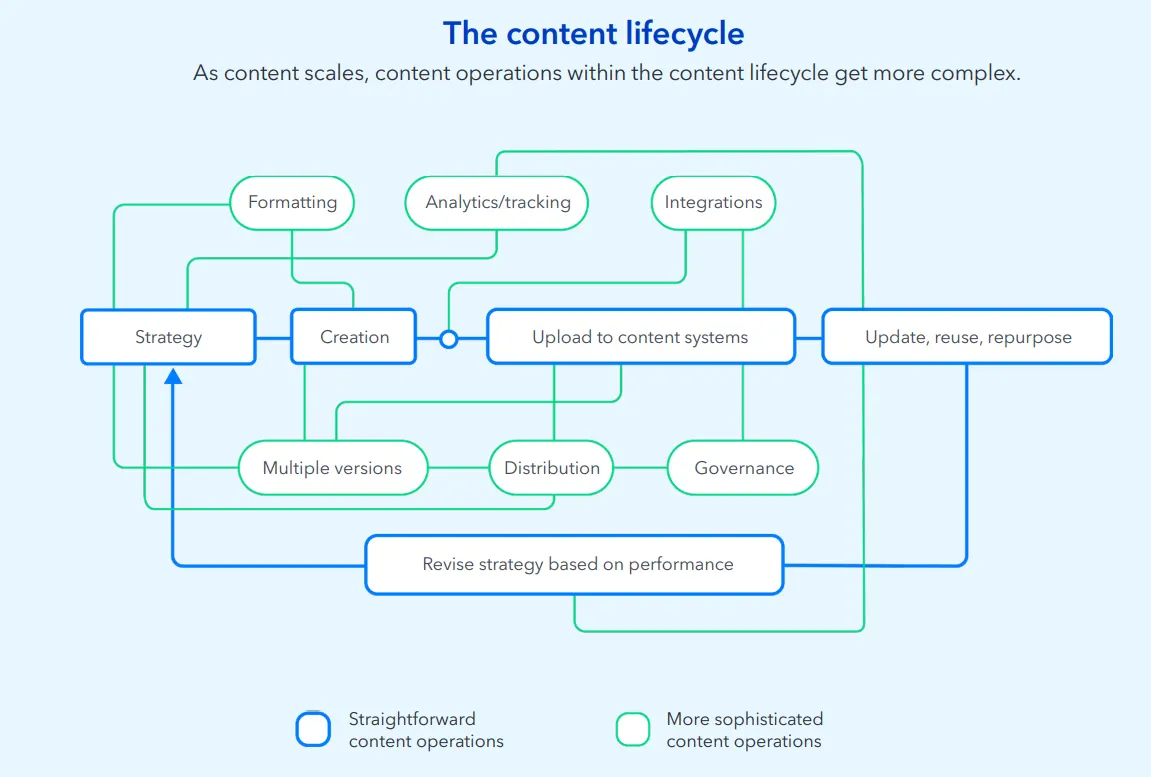
The practical effects of good content operations include:
Scale and complexity: Brands have to publish, manage, and review content in increasingly complex ecosystems spanning multiple channels and touchpoints. Content operations support content quality and cadence as brands increase their output to meet new levels of demand.
Workflow friction: Business growth increases the potential for content workflow friction and the cost of production. Content operations enable brands to smooth out that friction by streamlining workflows while reducing the overheads associated with content creation.
Structure and predictability: Content operations take the guesswork out of content production. Repeatable processes mean that delivery dates and the scope of work become predictable and transparent for all stakeholders.
Technology and innovation: Content workflows that rely on manual interventions risk delays, human errors, and hours of copying and pasting between platforms. Content operations is a way to empower teams with the right tools and technology, and automate as much of the administrative work as possible.
Quality: The streamlining effect of good content operations gives content teams more time to dedicate to high-skill content work. In theory, that creative freedom and flexibility will contribute to an increase in high quality content because teams not only have time to develop better content, but to test, iterate, and align it with their technological capabilities.
Investing in content operations
It should be clear that content operations isn’t defined by any single activity, role, or tool. It’s a cross-functional practice driven by an intent to continually iterate and improve content workflows and customer experiences.
With that in mind, content operations is a strategic investment brands must sustain over time to maintain the quality and consistency of their content output, and protect it against internal and external challenges: employee turnover, shifts in the financial and technological landscapes, and evolving business objectives.
Investing in content operations increases the value of content by:
Speeding up time-to-market
The repeatability of content operations serves as a content assembly line. While the assets you create are unique, the steps involved in production can be itemized to create a replicable process.
That means teams spend less time figuring out what format to use, what design elements are needed, who will approve the content, and what a realistic timeline might be.
Optimizing content performance
Automation streamlines content creation, freeing up time for marketers to analyze content performance. Meanwhile, integrated analytics support the review process: Ideally, marketers can access the relevant metrics quickly and easily, and use those valuable insights to refine the content performance.
Allocate resources to maximize ROI
Content operations helps organizations better understand the cost of the different types of content they produce. That means they can assign an accurate dollar value to processes and employee time, and then assess performance metrics to determine which assets deliver the highest ROI.
Building content operations into your organization
We’ve talked about why investing in content operations is worth it, but what does that investment look like practically? How do you build content operations into your business infrastructure?
The key components of effective content operations include:
Ownership
Without defined accountability, operational work becomes fragmented, and responsibility for addressing that can fall onto creative team members (whose focus should remain on content output).
A content operations manager can serve as a focus point for members of other teams who are working to resolve content creation friction. The manager can provide oversight for all content creation workflows: ideation, creation, review, and publishing, and can coordinate with adjacent teams such as design and product marketing to identify friction and barriers to the movement of content through the organization.
Top-down management
In more complex business environments, content operations may need to originate at a higher strategic level. This top-down approach allows systemic issues such as unclear ownership, approval bottlenecks, and fragmented tools, to be addressed holistically. It also allows the organization to establish governance and workflow standards that apply consistently across content creation functions.
If you’ve appointed a content operations manager, or even a content operations team, implementing content operations at this higher level allows them to bring more teams into the conversation, earlier. They can define roles, responsibilities, and workflows across teams and develop cross-functional processes faster
A people-first approach
Successful content operations unlocks the skill, expertise, and creativity of content team members — by prioritizing their contributions to content workflows. To that end, content operations should be shaped by input from the people involved in the relevant workflows, in order to anticipate challenges and increase the successful adoption of new technologies and ways of working.
Start with a conversation where the team can talk through the organization’s content needs, what the workflows are, what their pain points are, and what they think the ideal content process should be. Remember: content operations is a process: you need to give teams time to try a new methodology before refining it.
Automation
While the foundation of content operations is people-first, organizations looking to scale effectively must leverage automation to make the relevant workflows run smoothly.
That’s because manual systems introduce delays and increase the risk of errors as operational complexity grows. The right content platform should not only eliminate that manual effort through automated speed and efficiency, but support the ambitions and objectives of the brand’s evolving content strategy.
How Contentful unlocks content operations potential
If you’re serious about content operations, you’ll need a platform that both supports your content teams and aligns with your business objectives.
The Contentful digital experience platform (DXP) is designed to deliver that strength and flexibility; a foundation on which to build a content operations framework, develop content operations methodologies, and scale as needs change.
Here’s how our platform delivers game-changing operational advantages.
Single source of truth: By storing content in a centralized database, Contentful creates a single source of truth. Teams can see what content exists and where it’s used, and manage it seamlessly across channels. This visibility reduces duplication, improves discoverability, and strengthens governance.
Create once, use anywhere: Because content is modular and reusable in Contentful, teams can adopt a “create once, use anywhere” model. Instead of rebuilding assets for every channel or market, content can be assembled and reassembled dynamically to build new assets and variations quickly, which means less manual rework, faster publication, and lower operational overhead as business scale to meet growth goals.
Workflow control: Contentful brings consistency to publishing workflows. With centralized governance, role-based permissions, and scheduled publishing, teams spend less time reconciling inconsistencies and more time moving content forward in alignment with their editorial calendar.
Accessibility: Reducing dependency on developers for routine content optimization and updates removes a critical workflow bottleneck. In Contentful, non-technical content teams can edit, preview, and schedule independently of developers, meaning that creative work moves faster, governance becomes easier, and marketers can focus on creating higher-impact campaigns.
Lifecycle management: Remember, content operations doesn’t end with publication. Contentful’s scheduled publishing tools and integrations help marketers connect performance data to business outcomes, by opening up visibility across the content lifecycle. That visibility enables proactive governance, helps teams optimize assets continuously, and make stronger decisions about when to refresh or retire digital assets.
Intelligent automation: Contentful eliminates manual effort from the content creation process with a suite of native artificial intelligence (AI) automations, known as AI Actions. From content generation and metadata tagging to keyword optimization, personalization, and localization, AI Actions automations span content creation and can be customized to align with specific task requirements.
Future-proof flexibility: The Contentful DXP’s value isn’t limited to storage or delivery. Its application programming interface-first (API-first) composable architecture means that organizations can shape their content management tech stacks to their business needs as they change over time.
Analytics: Contentful Analytics offers data-driven insights in real time, integrated as part of the content management workflow so that teams can understand what’s working without switching tools. It uses AI to surface insights quickly and easily, with an agentic interface accessible for non-technical users.
Wrapping up
The advantages may be obvious, but effective content operations don’t emerge on their own. The decision to focus on improving content operations is just the beginning: Organizations should build operational systems into their infrastructure from the ground up, and be ready to support them with the best people and the best tools.
That’s where the Contentful DXP stands out, optimizing and amplifying the work of talented content teams, while also giving organizations the oversight and control they need to connect content to business outcomes, to iterate and improve, and to succeed in markets all around the world.
To learn more about Contentful’s operational advantages, browse our platform's latest features and releases. To arrange a demo, get in touch with our sales team.

Inspiration for your inbox
Subscribe and stay up-to-date on best practices for delivering modern digital experiences.
Meet the authors

Shelby is a Creative Program Manager with extensive experience leading creative, print, and digital initiatives. Skilled in streamlining workflows, managing cross-functional teams, and delivering impactful campaigns. She's also an avid skier and a mom.
Related articles

The shift from SEO to GEO: What marketers need to know about AI and search
August 6, 2025

How firmographic segmentation strategies target audiences more effectively
October 17, 2025

Understanding the different types of AI agents and how they work
February 13, 2026