Why you need a content repository (and how to get the most from it)
Published on July 23, 2026


Inspiration for your inbox
Subscribe and stay up-to-date on best practices for delivering modern digital experiences.
A content repository isn’t just a warehouse for your business’s creative output, advertising resources, and web and app assets. It’s a long-term investment that lets you fully realize the value of your assets, making them available for long-term use and adaptable across channels like apps, websites, billboards, and AI agents.
This post explains the importance of a content repository to your business and how it can be leveraged to provide not just storage but a system for flexibility, collaboration, and continuous innovation.
What is a content repository?
A content repository is a system for storing and organizing digital content. For businesses, this includes things like images and videos used for social media campaigns, text content for blog posts, and structured information to power AI assistants.
However, businesses that rely on online marketing or provide digital products manage large and continually growing content asset libraries that need more than a basic storage medium with a file hierarchy or tagging to be effectively utilized. Dumping files in a file share makes things hard to find and leads to duplication of work, poor collaboration, and unoptimized workflows.
Without a structured and connected repository, your platform is unable to deliver a consistent digital experience across multiple channels and consumer mediums. This means the consumer will not experience a cohesive message from your publishing, which risks limiting accessibility, inconsistent branding, and being unable to measure your brand performance.
Therefore, a content repository (in our context of omnichannel publishing) is a scalable, secure, and cloud-based platform that organizes content and assets. It offers a structured approach with controlled access and seamless integration with various applications. By managing the overall content lifecycle, it minimizes loss, promotes utilization, and enhances your team’s efforts.
Structured content is also vital for modern digital experiences, enabling reusability, automation, and personalization. By breaking content into manageable components, teams can efficiently repurpose assets, streamline workflows, and create tailored experiences for specific audiences. Prioritizing these capabilities in a content repository supports organization, discoverability, and accountability.
Other types of content repository
This article focuses on content in the context of the assets you store for long-term use and distribution for publication. However, there are other kinds of content repositories, for example:
Legal/document management (e.g., MightyDocs, iManage)
Basic file shares for small use cases (e.g., network file shares, Dropbox, Google Drive)
Enterprise-scale sharing (e.g., Box, SharePoint)
While they differ in purpose, content repositories for any kind of data generally provide tools for managing and organizing items and apply versioning, search, and access control.
What to look for when creating a content repository
Choosing the right platform and tools is critical for the success of your content repository.
Maintaining discoverability, organization, and accountability of your assets is the primary concern when choosing a content repository platform. As your content library grows, it will become harder and harder to find what you need if the right features aren’t present.
Tools that help you collaborate with your team members, whether in-house or external, are also vital. Distributed, global teams require a repository that streamlines content creation and collaboration by providing powerful workflows and deployment control.
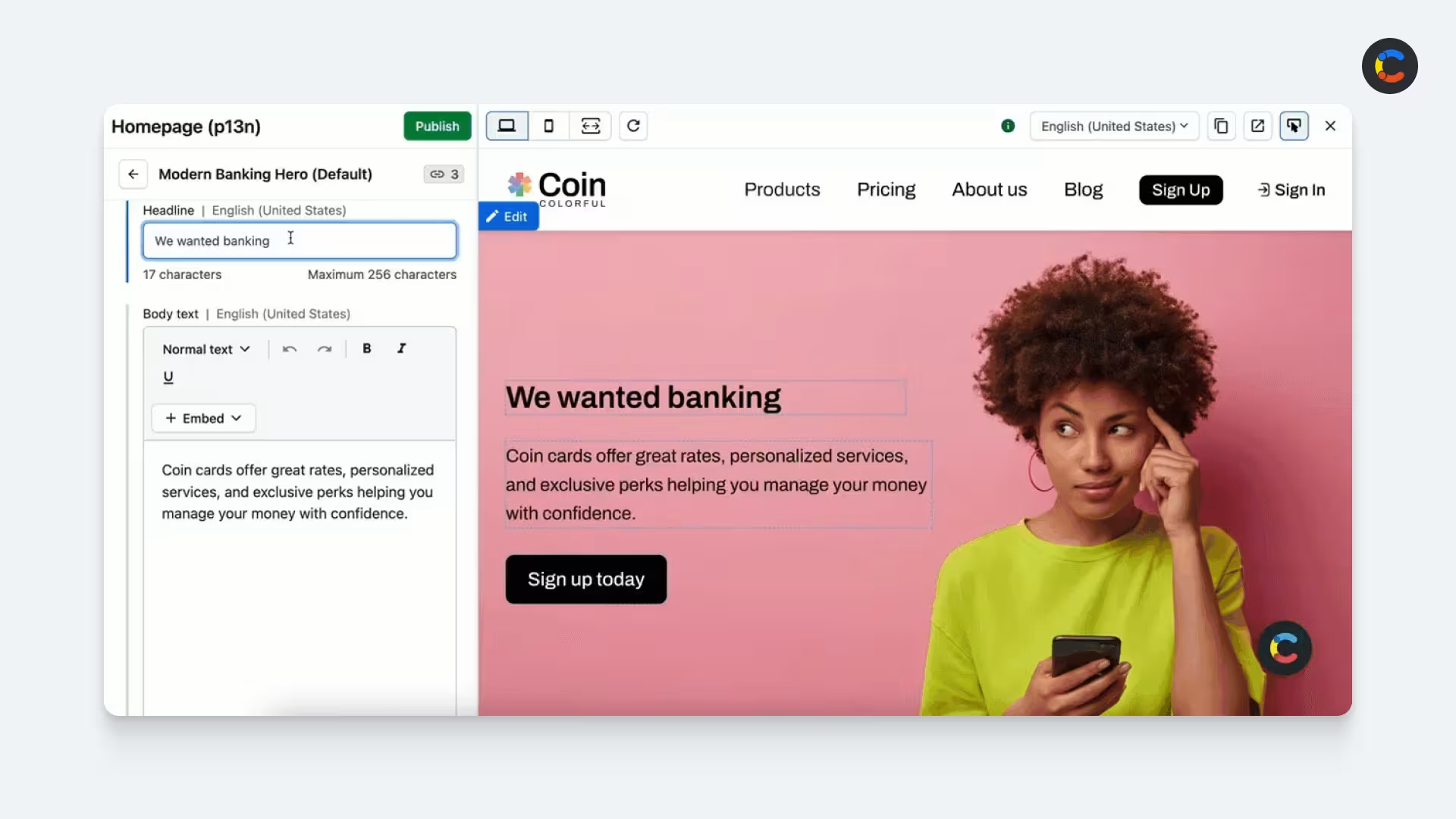
Live preview is a feature that lets you see exactly how content will look when published to websites and apps, helping creative and technical team members stay on the same page.
The ideal repository platform makes organizing your content convenient and straightforward with intuitive tools, helping you to:
Reduce bottlenecks and enable faster deployment across multiple channels with effective asset management
Ensure content is readily searchable with AI-powered, automatic tagging and categorization
Enable content collaboration between team members across locations via workflows and social media integrations for managing checkpoints and approvals
Effectively use metadata to enhance SEO and GEO (generative engine optimization)
Some problems associated with legacy content repositories only became obvious over time, while others were simply caused by a lack of features. Modern repositories should help your team solve problems, like not knowing where and how to locate assets, documents, and data. Furthermore, the addition of controlling workflows and securing access to items can be done by providing a permission system with role-based permissions. Maintaining versioned content and allowing rollbacks when changes need to be reversed or approvals are denied helps ensure that nothing is lost.
Versioning is particularly important because, as the core of a publishing system, no repository is complete without the ability to version content. Versioning allows content editors to monitor and manage changes and actions. This includes tracking changes over time, monitoring who made changes and when, reverting changes to return to previous content versions, and enforcing embargoes to support scheduled content releases for specific times, regions, and outlets.
Contentful gives you all the tools to build an effective, long-term content repository
Contentful is a composable digital experience platform (DXP) that provides structured content management, flexible APIs, governance and management, and powerful integrations to act as a living, scalable repository. Contentful is, at its core, a headless content management system (CMS) that provides a best-in-class content repository and the management tools you need to keep control of all the content you own, at any scale.
Structure and collaboration
For omnichannel publishing, a structured content repository is essential for managing web content and its assets. These include metadata, taxonomies, locales, versions, and linked items, among other standard features like content tagging.
Structured content gives you stronger, scalable websites and apps by allowing you to break down web content into its component parts, such as headers, footers, reusable elements, and banners. All of this needs organizing, and a powerful CMS provides the facilities to do this for any publishing channel you use for the experiences your users need.
Contentful provides industry-best collaborative content modeling tools, along with version control. This enables you to define your content, track changes, see differences between versions, and revert to previous versions if necessary.
The Contentful AI tagging, searching, and management tools help find what you need, when you need it — even when bringing in content from external sources with inconsistent organization.
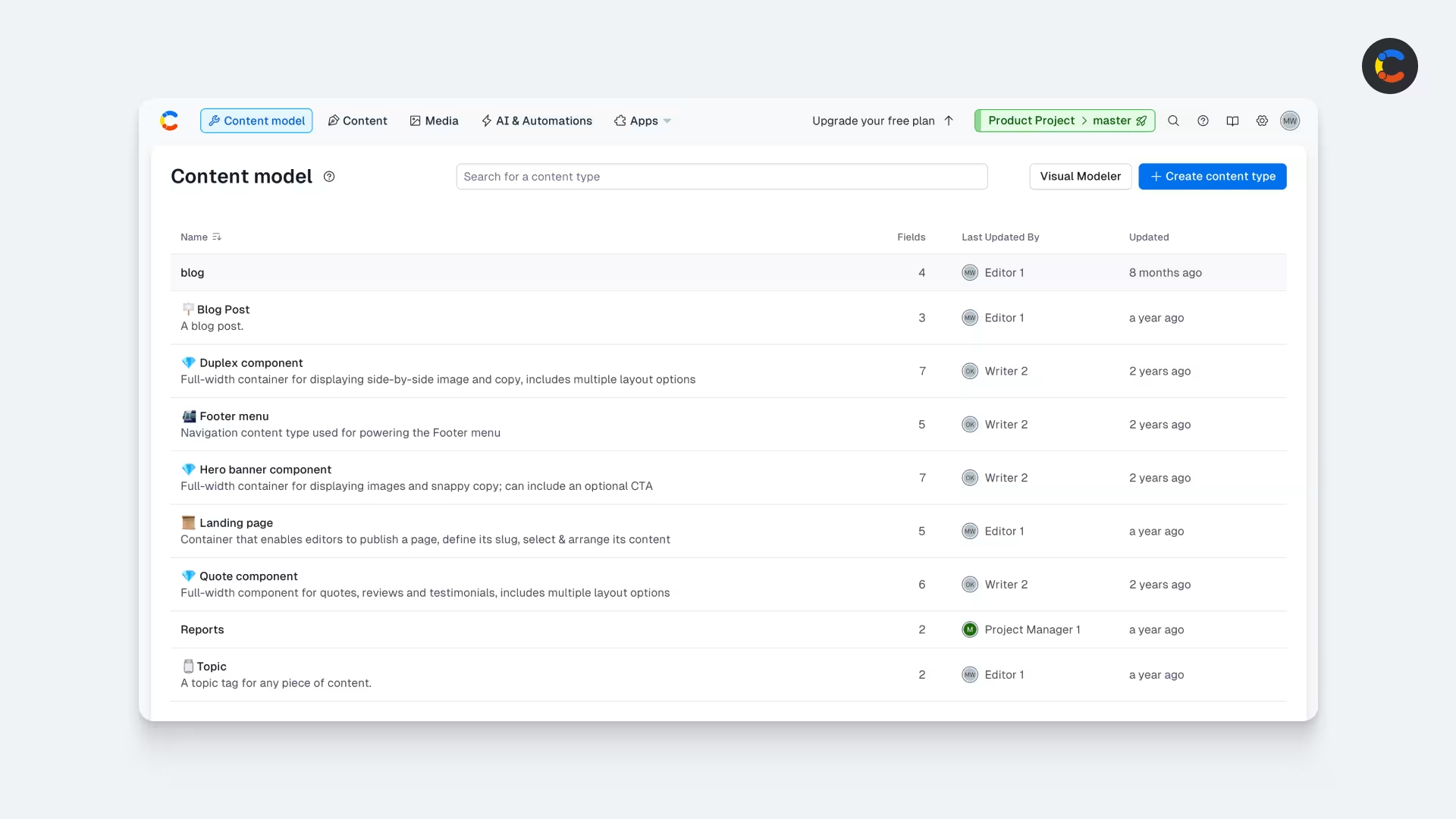
The Contentful content model editor lets you build your content types for structured and organized content.
Contentful has an ecosystem of apps that extend how you can work with the platform, for example:
Bulk edit: Edit many entries at once
Deep clone: Replicate entries with deep content
AI Content Generator: Generate and translate content with AI
AI Image Tagging: Tag images automatically
Extensibility and adaptability
You can also build your own custom apps that add functionality using the Contentful APIs, App Framework, and UI extensions to tailor Contentful for your use case and ideal workflows.
Beyond the curation tools mentioned above, there are also pre-built integrations that connect Contentful with external services to enhance collaboration when working with your content repository. These include social integrations like Slack and Teams, which notify team members about specific events from within Contentful, including publishing events like creations and deletions. There are marketplace apps for directly attaching assets from Dropbox into your content, serving Shopify content and products from within Contentful, and even directly syncing with Braze campaigns.
Governance and security
You need to keep your content safe (so that it’s not lost on a USB stick or accidentally deleted from a file share) and secure (only modifiable or accessible by the right people at the right time). By leveraging features such as workflows and role-based permissions, you can establish content governance to regulate how and when content items are managed and published. This directly supports your organization’s policies and practices for maintaining on-brand, high-quality content.
Practically, this involves effectively implementing content lifecycle management, ensuring content is easily found and integrated, reviewed, and published according to your specific guidelines and procedures.
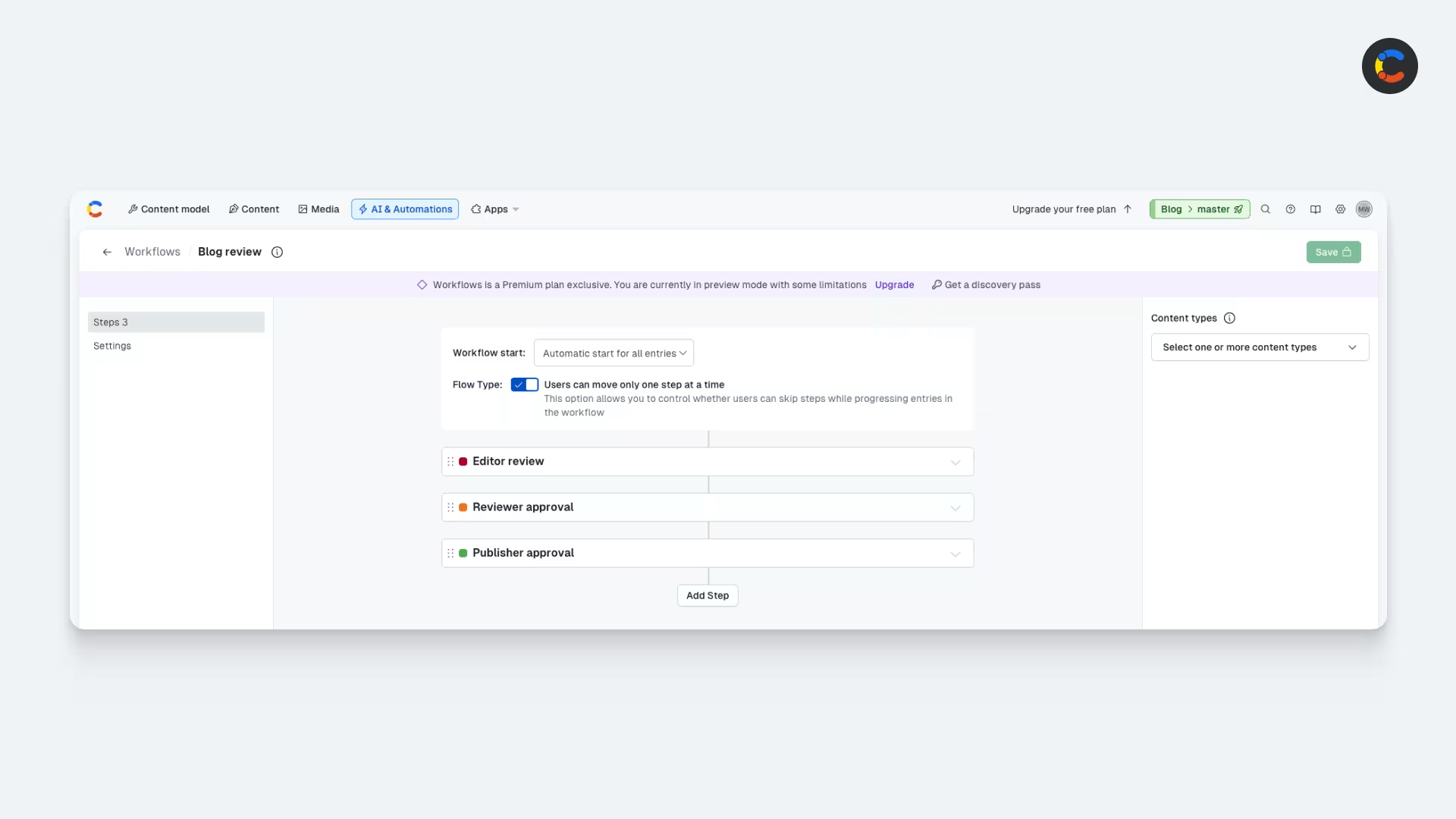
The Contentful workflow editor enables team collaboration and a streamlined process to help you ensure quality through customizable checkpoints and tracking.
The Contentful governance framework places you in control of how your content is created, managed, and distributed. This is crucial for maintaining brand consistency and upholding your quality standards. By defining a clear process, your team can mitigate risks associated with unauthorized changes, accidental deletion, or improper publication.
Contentful provides workflow management and content structuring, allowing your organization to manage content over the long term. Combined with smart tagging and omnichannel management from a central repository, you can develop a strategy for distribution at scale. Modular content management, role-based permissions, and the architectural design of Contentful for powerful global distribution mean that your content can scale as your enterprise grows.
Content optimization and omnichannel reusability
Contentful workflows put you in control of your content governance, defining how content is created, managed, and distributed. The foundation of effective content optimization rests on a robust governance structure that ensures security, maximizes efficiency through streamlined workflows, and maintains compliance across the content lifecycle.
Contentful workflows are scalable and composed of several interconnected aspects that provide security and traceability in content management:
Content Model Management: This is the structural backbone of your content that defines the schemas for your content types. A well-structured content model ensures consistency, making it easier to manage, reuse across different channels, and integrate with other systems.
Role-based access: Security and accountability help prevent unauthorized changes and are enforced through the permissions system. This access control assigns specific roles to users, dictating exactly which actions they are permitted to perform (e.g., an editor can create and edit, a publisher can approve and publish).
Approvals: These are the core of the workflow process and introduce gates where content must be reviewed before proceeding. These flows can involve single or multiple reviewers in specific review stages, guaranteeing quality assurance and compliance checks before publishing.
Version control: This ensures every change made to a content entry is recorded, allowing teams to track the evolution of content, revert to previous states if errors are found, and maintain a complete audit trail of all modifications.
Audit logs: Maintaining regulatory compliance is paramount, so Contentful generates detailed audit logs — comprehensive records of every action taken within the platform (who did what, when, and where). These are crucial for later analysis, proving compliance in regulated industries (e.g., GDPR, HIPAA). They can be batch streamed to your own secure, external platform for long-term security and archival for storage and later analysis.
Scalability and global distribution
The Contentful platform’s content ideation, creation, and management features allow it to readily scale with growing teams. The technology that delivers your content is also ready to scale with your audience as you grow.
With an enterprise-level content repository built on Contentful, content distribution can scale to meet demand from a global audience. Contentful leads the way in fast, efficient distribution via a global network of content distribution nodes (a content delivery network, or CDN). This allows all content from your repository to be locally cached closer to the user, vastly improving the delivery time for subsequent requests to that content.
The Contentful GraphQL API provides precise field selection and deep nested queries and is strongly typed to the entities in your model. GraphQL itself is an efficient query language that enables a single request to perform data fetching for complex page layouts, returning numerous objects in a clean format. This makes it ideal for consumption by frontend apps and static site generation.
Additional information about the APIs and delivery features of the Contentful headless CMS is available in the developer documentation:
Content Delivery API (CDA): The CDN-based, read-only API for quickly and efficiently delivering your content to websites, apps, and other platforms
User Management API: A management API that provides control of your organizations, teams, and spaces
Guides: A plethora of walkthroughs and technical assistance for every feature Contentful provides
Content increasingly needs to be understood by AI agents. This requires a content repository that allows content to be readily adapted. Many businesses have made the move to the Contentful platform from their legacy CMS after discovering that their existing content was being held back in a rigid format that wasn’t suitable for emerging use cases. With the advent of the Model Context Protocol (MCP), Contentful has now introduced the Contentful MCP server to act as a bridge between your Contentful Workspace and AI agents.
Moving your content from WordPress, Sitecore, and other platforms into a new content repository
If you’re relying on your blogging platform, web host, or cloud sync service to host your current content repository, you might find that it’s turned into a disorganized asset silo that buries your valuable media assets and locks them away from omnichannel distribution.
You can liberate your content from it by migrating to Contentful. We provide guides for migrating from popular platforms such as WordPress, Drupal, and Sitecore. If you’re using another platform or a custom CMS, you can also apply the concepts discussed in these guides to migrate from anywhere, or you can reach out to our team for assistance.
You need more than just a content repository
Contentful goes further than other content repository solutions and is at the forefront of the digital experience — a modern content platform built for flexibility, collaboration, and continuous innovation. It’s a platform for dynamic content delivery, utilizing the best of CDN distribution, AI-powered content creation and metadata management, and team-based ownership tooling with an app marketplace to expand its core offerings.
On top of a professional and intuitive user interface built for a world-class CMS — backed by a global CDN providing speed, efficiency, and scalability — the key aspects of Contentful that make it an ideal content repository include control of your content and models via roles, spaces, teams, and granular permissions. All of these are accessible and controlled via powerful APIs for frontend and backend applications.
Start exploring now for free to see what these features can do for you. See why migrating your content to Contentful makes sense for your creative teams and your business.

Inspiration for your inbox
Subscribe and stay up-to-date on best practices for delivering modern digital experiences.
Meet the authors

Marco is a B2B content creator and product marketer blending technical with creative skills. From the early stages of product ideation to a successful market launch, all the way through to sales enablement, he loves to take products and translate them into clear, relatable messages.
Related articles
Understanding omnichannel analytics to provide better digital customer experiences
August 12, 2026
MCP use cases: How the Model Context Protocol is used in real AI workflows
August 20, 2026
Better together: 7 benefits of using Contentful and Ninetailed
January 23, 2025

Ready to start building?
Put everything you learned into action. Create and publish your content with Contentful — no credit card required.