Omnichannel orchestration: How to unify customer journeys across every channel
Updated on September 22, 2026



Inspiration for your inbox
Subscribe and stay up-to-date on best practices for delivering modern digital experiences.
Imagine you're shopping for a new pair of running shoes. You browse a few options on your laptop, add one pair to your cart, and leave without buying. The next day, you get a reminder with the exact shoes you viewed. When you return, your cart is still there and the experience picks up where you left off.
That experience feels simple to the customer, but it only works when content, data, and delivery work together behind the scenes. When those systems are disconnected, the journey breaks quickly: the email does not match the site experience, the app shows outdated recommendations, and each touchpoint behaves as if it knows a different customer.
In contrast, omnichannel content experiences are connected. They share context between channels. And omnichannel orchestration is how a brand gets that done consistently.
In this post, we’re going to explain what omnichannel orchestration actually requires, how it differs from multichannel marketing, and how to build a strategy that connects your channels around one customer journey.
What omnichannel orchestration is, and why it matters
Omnichannel orchestration is the practice of coordinating content, timing, data, and channel execution so the customer journey feels continuous from one touchpoint to the next. It’s extending the customer journey across every touchpoint that an individual might use to engage with a brand.
That makes omnichannel orchestration critical to the delivery of personalized content experiences. Customers already move across web, mobile, email, in-store, and support touchpoints, and they expect brands to bring their personal tastes, browsing history, and preferences with them.
What feels like convenience is really coordination: it’s connected systems carrying context forward and delivering the next best interaction without forcing the customer to start over.
Multichannel vs omnichannel: What's the difference?
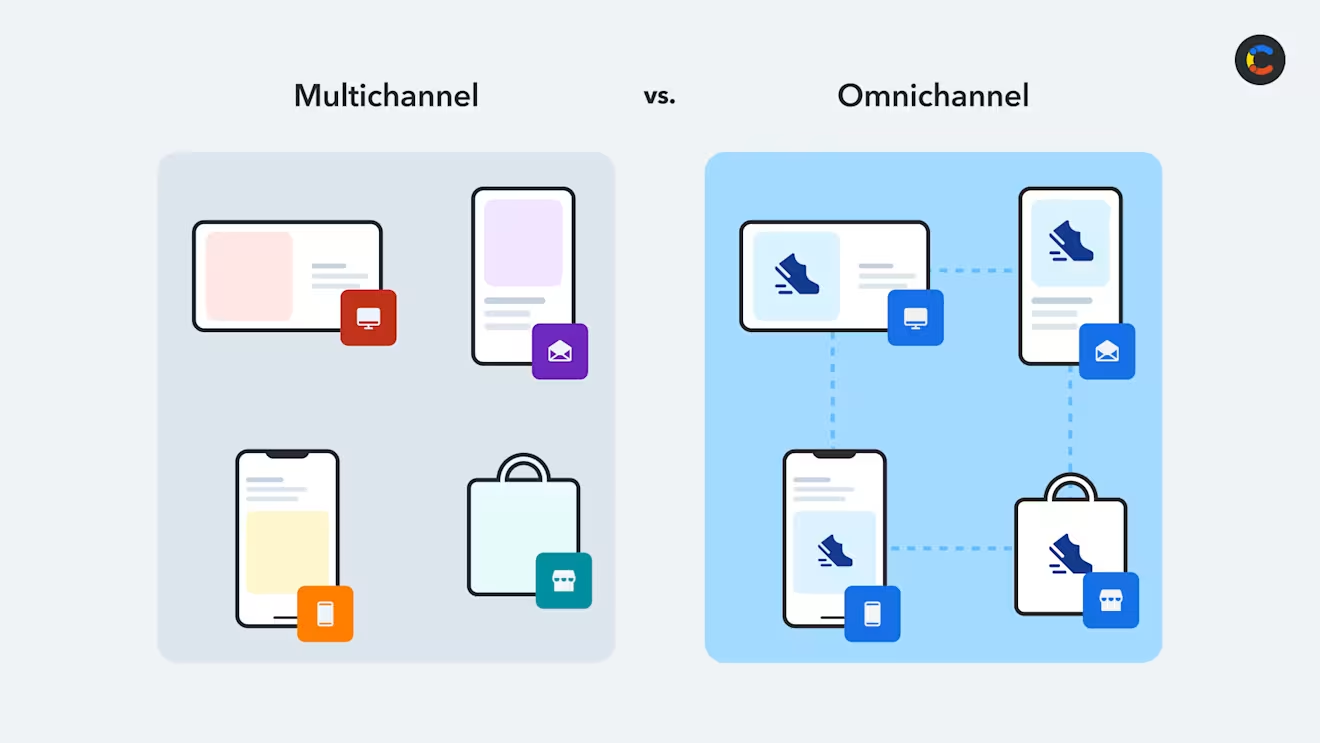
Multichannel and omnichannel marketing seem very similar, but they’re not the same thing — and it’s important to understand how they differ.
Multichannel marketing means that a brand is present across multiple distinct channels: email, web, mobile, and so on. Omnichannel refers to the process of connecting those channels through shared context, so that they support a continuous journey for any given customer.
The distinction matters because multichannel is easier to launch. Teams can run campaigns in separate tools, measure each channel on its own, and expand coverage quickly. But without shared context, each channel acts independently. The result of that lack of coordination can be duplicated messaging, missed signals, and an experience that feels inconsistent even if each channel campaign is performing well on its own.
Omnichannel requires more coordination than multichannel, but it creates stronger outcomes because content, timing, and delivery are shaped by the same customer context. A person who opens an email, ignores an SMS, buys in-store, or returns to the site is not treated as four separate interactions but as one journey that evolves over time.
Multichannel | Omnichannel | |
|---|---|---|
Strategy | Run campaigns across multiple channels. | Coordinate one customer journey across channels. |
Customer context | Stored or acted on separately by channel. | Shared across systems and touchpoints. |
Personalization | Channel-level targeting. | Cross-channel personalization based on journey context. |
Customer experience | Can feel fragmented between interactions. | Feels continuous from one touchpoint to the next. |
Measurement | Channel KPIs such as opens, clicks, or store performance. | Journey and customer outcomes across channels. |
Time to value | Relatively easier to launch. | Harder to set up, but stronger long-term payoff. |
The building blocks of omnichannel orchestration
Shared customer context and structured content are the foundations of omnichannel orchestration.
Without a shared view of customer behavior, preferences, purchases, consent, and content across touchpoints, orchestration becomes guesswork. Teams may still automate campaigns, but they won’t be coordinating journeys; they'll be reacting through disconnected systems that each see only part of the picture.
Here are the components of effective omnichannel orchestration.
1. Unified data, identity, and consent
In many organizations, a customer data platform (CDP) helps unify signals from web, mobile, commerce, customer relationship management (CRM), and offline touchpoints. The prerequisite here is shared customer context, sometimes called a single customer view, that can be used consistently across systems.
Setting up a CDP and the identity resolution layer it depends on typically requires developer involvement, including data pipeline configuration, application programming interface (API) integrations, and consent management setup.
2. Structured content
A connected journey needs content that can move across channels without having to be recreated for each one. That becomes possible when content is structured — which means that content can be broken down into its component parts.
In a structured content model, product information, campaign messages, educational content, offers, and localized variations are completely reusable down to the entry level and available to all systems delivering the experience, regardless of channel or format.
As agentic AI and headless digital experiences become more prevalent, the value of structured content continues to grow. By defining content at a granular level, organizations make it machine-readable and easier for AI systems to understand, retrieve, and use in context.
AI agents are far less effective when the content they rely on is trapped in channel-specific tools, duplicated across teams, or managed inconsistently. Structured content provides a single source of truth, enabling both human teams and AI-powered systems to deliver consistent, reliable, and brand-approved experiences across every touchpoint.
3. Real-time triggers and events
Omnichannel orchestration moves beyond scheduled campaigns by responding to behavior as it happens or shortly after. Common trigger types include cart abandonment, product views, form completions, repeat visits, in-store purchases, support interactions, and churn signals. Triggers are what make channel orchestration timely instead of static.
4. Decisioning
This is where orchestration becomes more than automation. Decisioning determines what should happen next, on which channel, and for whom. That includes next-best-action logic, next-best-channel logic, suppression rules, frequency controls, and handoff rules between automated and human-led experiences.
AI can make this layer more adaptive, but it does not remove the need for clear logic. If the underlying data, content, and rules are weak, AI only makes disconnected experiences move faster.
5. Connected channel execution
Email, web personalization, in-app messaging, and in-store touchpoints do not become omnichannel simply because they exist within an ecosystem. Omnichannel requires that they are coordinated by shared context and shared decisions.
Orchestration is the process of making each channel aware of the larger journey.
6. Measurement and governance
Channel-level metrics such as open rate, click-through rate (CTR), and conversion rate still matter, but they’re not a comprehensive way to gauge the success of omnichannel marketing strategies.
Teams need journey-level measurement capabilities that show how customers move across touchpoints, where they drop off, what combinations of channels reduce friction, and which orchestrated journeys improve business outcomes. They also need governance around consent, frequency, suppression, content accuracy, and AI-assisted decisions. More coordination creates more opportunity, but it also creates more responsibility.
From ambition to operating model
Collectively, the building blocks outlined above transform omnichannel orchestration from a vague marketing ambition into an operating model.
Unified data provides context. Structured content gives teams and AI systems the right material to work with. Triggers create timeliness. Decisioning guides relevance. Connected execution turns decisions into experiences. Measurement and governance show whether the system is improving the journey without losing control of the omnichannel customer experience.
How composable marketing technology enables omnichannel orchestration
Omnichannel orchestration depends on close coordination across the back and front ends, but that becomes much harder when the systems powering content experiences are rigid, disconnected, or organized around channel silos. Composable software architecture changes that picture.
A composable marketing technology (MarTech) stack lets teams connect the capabilities they need across content, data, decisioning, and delivery.
That adaptability matters because customer context is often split across ecommerce platforms, CRM systems, campaign tools, loyalty systems, analytics tools, and content workflows. Each system may do its own job well, but orchestration breaks down when no part of the MarTech stack can carry context across the full journey.
In a composable environment, it’s easier to connect those systems through APIs and shared data models, and teams can act on a complete view of the customer instead of fragmented signals.
Composable architecture supports omnichannel orchestration so well because it allows organizations to build around the customer journey instead of constantly having to deal with limitations of a single platform.
Content can live in one structured system, customer context can be unified in another, decisioning can happen in an orchestration layer, and delivery can happen across the channels that make sense for the use case.
The running shoe revisited
Let’s go back to our running shoe example from earlier.
In a poorly integrated setup, the customer’s website visit, abandoned cart, follow-up email, and app session are separate events handled by separate systems. The email tool sends a vague reminder, perhaps “You have items in your cart.” The app shows a generic promotion, and there are no items saved to the shopping cart. The channels exist, but they don’t coordinate.
In a composable setup, the content platform provides structured product and campaign content, the data layer carries customer context forward, the orchestration layer decides what should happen next, and each delivery channel reflects that context. The follow-up email references the products the customer actually viewed. The app resumes the journey instead of starting from zero. In a mature composable environment, when shoppers decide to buy in-store, the ecosystem updates so that the brand stops pushing the wrong message online; ‘Click and collect’ brands, in particular, care about this capability.
Composable architecture vs composable content
We can distinguish composable MarTech architecture from composable content.
The terms are related, but they aren’t the same thing. Composable content helps teams create and reuse modular content across channels. Composable architecture is the broader systems approach that allows content, data, decisioning, and delivery to work together.
Omnichannel orchestration needs both: structured, reusable content and an architecture that can connect that content to data and delivery across the full journey.
AI readiness and composability
AI agents and decisioning systems need reliable access to customer context and approved content. If that context is fragmented or the content is trapped inside channel-specific tools, AI will struggle to create a more connected experience. A composable stack is a stronger foundation for using AI safely because content, data, and delivery can be connected without losing governance or flexibility.
The argument for composable MarTech is that omnichannel orchestration requires adaptability. Teams need to eliminate silos, connect new channels, evolve decisioning logic, support AI-assisted experiences, and improve journeys over time. A composable approach is better suited to that reality than a stack built on one system trying to define the entire experience.
Building your omnichannel orchestration strategy
A strong omnichannel strategy starts by reducing fragmentation in the journeys that matter most.
For most teams, the most effective path is phased: Identify where the experience is breaking today, connect the minimum data and content needed to improve it, and prove value with a small number of high-impact journeys — before expanding further.
1. Audit where journeys break today
Start by mapping the customer journeys you already have — not the ones you wish you had. Look at the channels involved, the systems behind them, and the points where customers lose context or encounter inconsistent experiences. That could mean a cart that does not carry across devices, onboarding emails that ignore product usage, or support interactions that never inform the next marketing touchpoint.
The goal is to find the highest-friction paths, especially the ones closest to revenue, retention, or activation. Orchestration becomes easier when teams can point to a specific journey problem instead of trying to solve "omnichannel" as an abstract idea.
2. Start with two to three high-impact journeys
If you treat omnichannel orchestration as an everything-at-once transformation, you’ll lose momentum fast. A better approach is to start with two or three journeys where better coordination can clearly improve outcomes. For many brands, those journeys are:
Welcome and onboarding
Cart abandonment
Post-purchase engagement
Reactivation or churn prevention
Pick the journeys where connected content, timing, and delivery can quickly make a measurable difference. Starting small creates focus, reduces implementation risk, and gives teams a clearer path to scale.
3. Build the data, content, and integration foundation
Once the priority journeys are clear, teams can connect the systems needed to support them in phases. This is where developers usually lead the technical foundation: data flows, identity resolution, APIs, events, and integrations that make shared customer context possible across channels.
However, data alone is not enough. Teams also need structured content that can be reused across the journey. Product information, campaign messages, onboarding content, offers, and localized variations should not be trapped inside separate channel tools. If content has to be recreated for every channel, orchestration slows down before it scales.
Marketers play a different role. They define the journey logic, decision points, content variations, and business rules that shape the experience.
Developers make orchestration possible; marketers make it meaningful.
4. Add decisioning gradually
Not every orchestration programme needs advanced AI from day one. In most cases, teams should begin with clear rule-based logic: if a customer abandons a cart, send a reminder; if they convert in another channel, suppress the follow-up; if they engage with onboarding content but stall in-product, change the next message.
Over time, those rules can become more adaptive. Teams can layer in next-best-action logic, channel prioritization, frequency capping, intent signals, and AI-assisted recommendations as their data quality and operating model mature. AI should strengthen a clear orchestration model, not replace one.
5. Measure, govern, and expand
The final step is proving that the strategy is working by measuring both the journey and the channel. Look at where customers move forward, where they drop off, how quickly they convert, and whether orchestration reduces friction or improves relevance across touchpoints.
Teams should also define governance early. That includes consent, frequency rules, suppression logic, content accuracy, brand consistency, and human oversight for AI-assisted decisions. More connected journeys create more opportunities to personalize, but they also require more control.
Once a few journeys show measurable value, teams can expand with more confidence. That might mean adding channels, introducing more dynamic decisioning, or applying the same orchestration model to other lifecycle stages. The path to scale is not starting bigger; it is learning faster from a focused set of journeys.
Developing and implementing a pragmatic omnichannel strategy means creating enough alignment between data, content, logic, and delivery to improve the journeys that matter most, then scaling from proof, not ambition.
Wrapping up
Most omnichannel initiatives stumble because the brand’s content platform — content, data, and delivery infrastructure — was built for a different era. In these legacy platforms, each channel typically operated as its own product, with its own workflows, its own copy of the customer, and its own definition of success.
Today, the landscape has changed. The organizations that succeed with omnichannel marketing strategies are those that treat content as infrastructure rather than a channel-by-channel deliverable.
However, when content is structured, governed, and available through APIs, it becomes the connective tissue between data and delivery. Every channel draws from the same source. Every AI agent works with the same approved material. Every journey update propagates without manual duplication.
This is where the composability makes the difference. Orchestration demands the ability to change one layer — content, data, decisioning, delivery — without rebuilding others.
Omnichannel orchestration in Contentful
Contentful provides flexibility across your entire content ecosystem.
As a structured content platform with API-first delivery, it gives teams a single source of governed content that every channel, every journey, and every AI agent can draw from. In Contentful, content updates propagate across touchpoints without manual duplication. New channels connect without re-platforming. And because Contentful integrates with CDPs, personalization engines, and orchestration tools through open APIs, it fits into the composable stack rather than trying to replace it.
The result is a content layer that powers orchestration at scale instead of slowing it down, which is ultimately what separates brands that talk about omnichannel strategies from teams that deliver them.
Get your omnichannel content experiences right: Browse Contentful’s capabilities or talk to the team to set up a platform demo.

Inspiration for your inbox
Subscribe and stay up-to-date on best practices for delivering modern digital experiences.
Meet the authors

Chigo is a Senior Solution Engineer at Contentful who enjoys helping customers solve complex technical problems. He works with teams to uncover the right questions, identify gaps in their understanding, and find practical solutions that move their projects forward.
Related articles

Why content velocity matters more than ever
February 11, 2026
Agentic AI vs generative AI: When you need AI to act, not just create
August 24, 2026
AI localization: How Contentful changes global content workflows
September 9, 2026

Ready to start building?
Put everything you learned into action. Create and publish your content with Contentful — no credit card required.