
Deliver personalized ecommerce experiences
Updated on February 4, 2025
Summary
An ecommerce personalization strategy elevates online shopping experiences, transforming transactional pages and forms into personalized touchpoints that delight customers with new discoveries, special offers, and targeted messaging.
Ecommerce personalization rewards customers with personalized shopping experiences based on purchase history, browsing behavior, and other customer data, resulting in increased spending and customer loyalty.
In this chapter, we’ll show you how, with the right ecommerce personalization tools (think AI native), brands can analyze customer data, predict what customers want, and deliver highly personalized shopping experiences that give customers that feeling of getting the perfect gift they didn't know they wanted.
What is ecommerce personalization?
Shoppers don’t just choose ecommerce retailers by their price points or product catalogue anymore. Today, they also pick brands based on their relevance — how closely they align with their personal preferences and needs.
An ecommerce personalization strategy helps brands achieve that alignment. It transforms what were once templated web pages, apps, emails, and any other digital touchpoints into unique experiences that appeal to individual customers.
Yet, despite that advantage, there are often gaps between the personalized ecommerce experiences that brands promise and those they deliver for customers. In fact, while 92% of retailers believe they deliver “great” personalized experiences, only 48% of customers agree.
To help you resolve that disparity, this chapter will break down the fundamentals of ecommerce personalization: What it is, why it’s important, and why it’s challenging.
We’ll also examine how data and structured content are critical to successfully delivering tailored experiences across all digital channels and touchpoints.
What is ecommerce personalization?
Ecommerce personalization is the practice of applying personalization to an online shopping experience in real-time.
That includes tailoring product recommendations, images, offers, search results, and messaging to individual buyers. That process may be based on their user preferences, browsing behavior, purchase history, geographic location, demographics, and real-time context.
For example, an online retail brand offers a special discount for first-time visitors to its ecommerce site. To deliver that personalized experience, the retailer would need to gather data to determine which visitors were arriving for the first time, and then deploy the relevant offer at the right moment (early enough) in the customer journey.
If the customer subsequently returns to the ecommerce store, the retailer might personalize by offering them recommendations based on their past purchase, or products that customers from similar demographics also bought when they returned.
Core personalization capabilities
To deliver personalized ecommerce experiences, enterprise marketing teams typically rely on three core capabilities working together:
Rule-based personalization: Implementing contextual rules in order to serve targeted variants based on customer segmentation, or explicit in-session behavior.
Content testing: Experimenting with multiple content and layout variations simultaneously to validate what resonates with specific segments.
Optimization analytics: Analyzing real-time performance data to understand why certain variations perform better, and continuously refining the customer experience based on those results.
Customization vs. Personalization
The terms customization and personalization are often used in close proximity, but it’s worth making a clear distinction. While both tailor the content experience, customization allows customers to explicitly set preferences (such as notification frequency, default shipping options, currency, or subscription cadence).
Personalization is driven by the brand. Marketing teams use data and real-time signals to adapt the customer’s experience automatically in response to the customer's browsing behavior.
Why ecommerce personalization matters
The goal of an ecommerce personalization strategy is to increase the customer’s time on the site or app, their chances of conversion and their loyalty to the brand. Effective personalization improves the digital experience to the extent that customers prefer shopping with a given brand over switching to a competitor.
Amazon, for example, offers deeply personalized shopping experiences for every customer across the customer journey. It uses browsing data and purchase data to vary every new visit in numerous ways: recommended items, offers, price drops, items back in stock, and so on. The experience is designed around convenience and customer behavior — making it easy for customers to find what they want, discover new products, and re-order previous purchases.
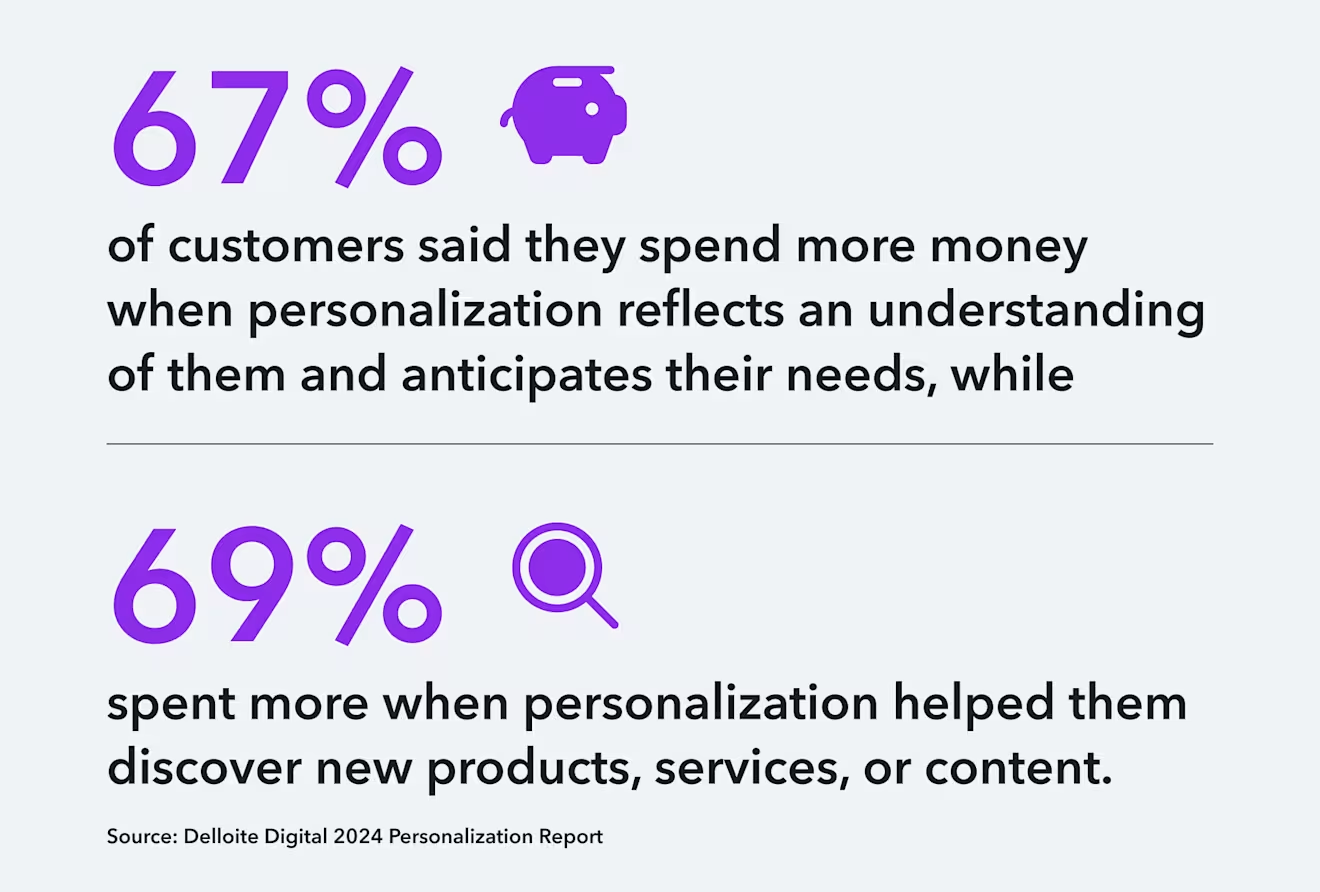
And, while ecommerce personalization used to be a differentiator between brands, that status has shifted to a baseline expectation. Today, the overwhelming majority of ecommerce customers prefer brands that offer them personalized experiences, and that expectation extends across touchpoints.
Examples of personalization in ecommerce
Segment new and returning customers
Personalization by new and returning customer segments is a powerful way to build customer loyalty. Visitors arriving on a site for the first time receive the information they need to make their first purchase, while returning customers are rewarded with content that better serves their intent.
Practical examples might include first-time customer offers, auto-filled forms, or email and text reminders prompting refill orders.
Loyalty programs
Loyalty programs essentially help customers derive greater value by sticking with brands in competitive markets.
In theory, the more a brand personalizes its loyalty programs to individual customers, the harder it will be for those customers to give up that special treatment and start over with a new brand. Diversifying loyalty perks like early product access or free shipping strengthens and differentiates a brand’s program, while protecting long-term customer retention.
Personalized product recommendations
Customers don't always initiate engagement with a brand knowing what they want. And even if customers do have a product in mind, there may be opportunities to upsell.
Generative AI and customer data analytics have made it easier to make predictions about what customers want and, in turn, build personalized recommendations into content experiences based on where customers are in the funnel:
Product detail pages (PDPs): Focus on cross-sells — for example, a "complete the look" fashion bundle.
Shopping cart: Surface low-friction, high-impulse add-ons that don't disrupt the checkout process.
Post-purchase: Leverage predicted product-consumption timelines to deploy recommendations and reminders as the customer is running low.
Personalized search results
Using integrated search tools like Algolia, retailers can personalize search results based on browsing behavior to better meet customer needs.
Let's say a shopper is browsing men's sweaters on your website before they type “men’s wool” into the search field. A standard search engine algorithm might show mittens or wool socks as the closest match, but because personalized results use browsing history, the personalized results prioritize wool sweaters.
Cart or checkout process personalization
Personalization remains worthwhile at the end of the shopping journey. Remembering customer preferences, suggesting a relevant accessory, auto-filling saved shipping preferences, and making it easy to reorder favorite items make checkout easier for your customers and reduce cart abandonment.
Cross-channel campaign alignment
Personalization should carry across a brand’s digital ecosystem — an ongoing conversation with customers however and whenever they engage. With that in mind, brands should aim to combine ecommerce personalization with an omnichannel marketing strategy targeting customers with tailored content across channels.
Personalization problems: Why traditional tools fail
Personalization software isn't new. Legacy ecommerce personalization software platforms such as Adobe Target have been around for decades, yet, despite heavy enterprise investment, many organizations fail to gain traction with them, and many abandon them after a year or two of frustration.
Here are the key reasons why that happens:
CMS burden
Legacy personalization software often operates separately from your core content management system (CMS). This forces teams to effectively maintain two CMSs: one for standard brand content management, and another inside the personalization solution to create variant experiences.
For non-technical marketing teams, this workflow can be overly complex, disconnected from core content operations, and prone to content drift — resulting in inaccuracies, messaging fragmentation, and wasted operational effort.
"Flicker" and conversion shortfall
Older personalization architectures rely on client-side JavaScript execution. The browser starts rendering a baseline webpage, executes the personalization script in the background, and then swaps the baseline content for a personalized variant right in front of the user's eyes.
This causes three major issues:
Jarring user experience: Shoppers literally see a visible "flicker" as baseline images or text jump and swap out.
SEO penalties: Client-side layout shifts degrade Google Lighthouse performance scores, damaging core web vitals and organic search rankings.
Revenue loss: Slower load times directly impact bottom lines — Google data shows that over 50% of customers are likely to abandon their journeys if pages take longer than three seconds to load.
Developer bottlenecks
In traditional setups, launching a new experiment or setting up a personalized rule requires custom frontend code. Marketers become entirely dependent on engineering teams for minor campaign tweaks, turning simple A/B tests into multi-week development sprints.
The GenAI challenge
In addition to traditional bottlenecks, digital teams face an emerging challenge: the rise of AI-powered search.
Generative AI (GenAI) engines — such as ChatGPT, Gemini, Copilot, and Claude — are changing how consumers discover products and brands. Instead of navigating traditional search engine results pages (SERPs), shoppers can now ask AI tools questions and receive direct answers.
To stay visible in this GenAI search ecosystem, brands need ecommerce content that can be easily understood and surfaced by both human shoppers and AI agents. The problem is that legacy personalization platforms can make this harder because they lock content into rigid, page-based templates that limit how easily content can be found, understood, and reused by AI search.
So how do brands solve both their legacy ecommerce limitations and address the AI problem?
Solving ecommerce personalization problems
It’s tempting to jump straight to tactical quick-fixes to manage personalization challenges — such as adding a recommendation carousel, or firing off an abandonment email. But those tactics don’t always have the necessary impact on customers, especially when the customer data needed to make those experiences relevant is fragmented or siloed across the ecosystem.
Data powers ecommerce personalization. Without clean, aggregated customer data, your system can’t evaluate intent or determine what content to serve in real-time.
The solution? Lean into data-driven personalization for ecommerce — in the following ways.
Unified customer profiles and the single customer view
A customer profile is a dynamic record that uses aggregated data to establish who a shopper is, what they've done in the past, and what they’re trying to accomplish now. When customer profiles are updated in real-time, personalization tools can recognize returning visitors instantly across web, mobile, email, and social touchpoints and deliver the relevant content.
To make that work, brands must establish a single customer view (SCV), a centralized dataset that consolidates interaction data across your entire ecommerce ecosystem. The SCV is typically composed of:
Zero-party data: Information volunteered directly and explicitly by the customer — for example, feedback forms, style and sizing quiz responses, and communication settings.
First-party data: Real-time behavioral signals collected from within your ecosystem — for example, search queries, category page views, cart additions, and time spent on specific products.
Transactional history: Data derived from transactions – for example, previous purchase categories, order frequency, total lifetime value, returns, and loyalty status.
Contextual signals: Environment variables from the active browsing session — for example, device type, geolocation, local weather, time of day, and incoming traffic source.
When these signals are consolidated into an SCV, brands can better avoid sending fragmented or contradictory messages — such as retargeting a shopper with web ads for a sweater they bought in-store two hours ago.
Composability and structured content
Managing vast amounts of customer data means building your personalization solution on the right kind of content architecture.
In this context, "the right content architecture" means a composable content platform.
Unlike legacy page-based systems that silo data away and hard-code content to templates, composable architecture enables brands to connect ecommerce tools, data platforms, and delivery channels. They can then use that combination to implement a critical foundation of effective personalization: the structured content model.
A structured content model frees digital assets from page-based limitations. Structured content breaks content down into its component parts — headers, body text, images, author bios, CTA buttons, badges, and so on — so that they can be reassembled and reused to spin up new content variants, including personalized experiences.
That flexibility means far more capability for personalized experiences: Brands can dynamically assemble new experiences and swap modular components in and out in seconds across digital channels, based on the needs of the customer.
When your content is structured and reusable, you don’t need to create new landing pages from scratch every time you need a new variant. You predefine rules and algorithms that can map, retrieve, and display the exact right content components for specific audience segments.
Ecommerce personalization for B2C vs. B2B
In B2B ecommerce, personalization isn't typically about suggesting trendy impulse-buy items to individuals. B2B personalization effort should be focused on removing operational friction, enabling purchasing managers to quickly reorder contract-approved items at negotiated price tiers, while automatically routing orders that exceed approved spending limits to the appropriate manager for sign-off.
B2B ecommerce personalization solutions should prioritize the following capabilities.
Custom catalogs and negotiated contract pricing
Unlike B2C shoppers who see a uniform catalog, B2B buyers expect to view only the specifics negotiated in their enterprise contract. Personalization engines use account-level identification to instantly filter product displays and reveal custom tier pricing, discounts, and payment terms in real time.
Role-based user experiences and approval workflows
B2B purchasing often involves multiple roles within a single account. That means brands should think about tailoring digital experiences for procurement, end-users, and finance. Procurement managers can view contract compliance dashboards, end-users can see job-specific product lists, and so on. Automated workflows can route orders exceeding spending limits straight to finance officers for approval.
Account-based marketing (ABM)
Connecting your personalization engine to B2B data platforms allows your website to recognize target accounts before visitors log in and boost the impact of account-based marketing. For example, anonymous prospects visiting your website can see case studies and messaging aligned with their interests.
Reordering
B2B buying is heavily driven by repeat product replenishment rather than new discovery. Personalizing the buyer portal around past order history enables purchasing managers to reorder approved parts lists or upload bulk SKU spreadsheets in seconds. These automated portals cut order processing friction and protect long-term loyalty and account retention.
Ecommerce personalization customer results
The world’s biggest brands leverage Contentful's ecommerce personalization tools to deliver measurable revenue and conversion gains in the real world.
Ruggable increases click-through rates
Direct-to-consumer home brand Ruggable achieved a 700% increase in click-through rates (CTR) by dynamically matching homepage hero banners and landing pages to the exact messaging and creative of incoming paid ads.
For example, visitors arriving from an Instagram ad featuring dogs see dog-focused rug collections which might feature hero images of dogs on rugs. The same goes for cat-focused ads, which lead to cat-tailored landing pages.
These subtle nudges to the experiences had a significant effect: Ruggable saw a 25% increase in conversions for visitors arriving from email campaigns.
Pets Deli increases conversions
Pet food brand Pets Deli needed to create a series of personalized campaigns before Black Friday. The brand wanted a sophisticated campaign featuring tailored pricing for new and existing customers while eliminating the need for manual promo codes.
With Contentful, Pets Deli increased their conversion rate by 51% and reduced bounce rates by 10%.
Personio improves B2B performance
Personio, an all-in-one HR software platform, faced the challenge of catering to large enterprise buyer groups alongside small business owners within the same digital ecosystem.
Using account-based personalization and dynamic content delivery powered by Contentful, Personio increased enterprise account conversion rates by 45% and small businesses by 46%.
Balancing privacy, consent, and data quality
Delivering relevant ecommerce experiences requires brands to walk a fine line — providing value without invading consumer privacy. Here are the key priorities.
Zero-party data
With major web browsers restricting third-party tracking cookies and mobile operating systems giving users explicit opt-out controls over cross-app tracking, brands can no longer rely on purchased third-party ad profiles that have no direct relationship with the customer.
The solution is prioritizing zero-party data: information that customers intentionally share with brands through interactive preferences, feedback, or forms of voluntary communication.
Customers are typically more comfortable sharing data directly with brands when it leads to better, more personalized experiences — yet will avoid brands if they lack trust in how their data is handled.
Data hygiene
Inaccurate or stale data can quickly test and break customer trust. For example, recommending a product a customer previously returned due to defect, addressing a customer by the wrong name, or sending daily marketing emails for an item they purchased an hour ago signals poor data quality.
High-performing customer personalization in ecommerce requires robust data hygiene practices:
Real-time syncing: Ensure purchase events instantly update marketing profiles across all systems to suppress irrelevant ads immediately.
Identity resolution: Accurately merge guest browsing sessions with authenticated account profiles when a user logs in.
Data deprecation: Establish rules to devalue old behavioral signals. For example, a customer browsing baby clothes for a baby shower gift three months ago shouldn't be permanently classified as a parent.
How to get started with ecommerce personalization
Starting a personalization program doesn't necessarily mean personalizing every content experience across every touchpoint at once. Successful digital growth teams build momentum by starting small, testing high-impact use cases, and then scaling incrementally.
This execution roadmap sets out the core steps involved in launching and maturing an ecommerce personalization strategy:
Step 1: Audit content and data architecture
Before buying new software, evaluate your current technology stack by asking the following questions:
Is your customer interaction data centralized into a unified profile, or is it trapped in isolated tool silos?
Is your marketing content structured into modular, reusable components, or locked inside static, hardcoded page templates?
Fixing structural content and data bottlenecks upfront ensures your team can build, launch, and iterate on personalization without requiring custom developer tickets for every tweak.
Step 2: Define high-value audience segments
Avoid trying to deliver 1-to-1 personalization on day one. Begin by grouping your traffic into 2 to 3 distinct, actionable audience segments based on clear business criteria, such as:
First-time visitors vs. returning customers.
High-intent paid traffic (from specific search ads) vs. organic browsing traffic.
Loyalty program VIPs vs. unregistered shoppers.
Step 3: Identify high-friction journey drop-offs
Analyze your web analytics to pinpoint where potential buyers lose momentum in your funnel:
Are paid campaign visitors bouncing off the landing page within 5 seconds?
Are shoppers abandoning search result pages that yield generic results?
Is there a steep drop-off at the cart drawer level?
Targeting personalization at these points delivers the fastest measurable return on investment.
Step 4: Launch targeted pilot experiments
Design low-complexity, high-impact pilot campaigns aimed at solving those specific drop-off points. For instance:
Replace generic homepage hero banners with dynamic messaging that mirrors the personalized messaging that brought the user to your site (the strategy Ruggable used to drive a 700% CTR increase).
Introduce dynamic promo-code-free incentives for first-time visitors (similar to the Pets Deli approach).
Step 5: Measure, refine, scale
Track performance against clear core business metrics — such as conversion rate, average order value (AOV), bounce rate, and customer lifetime value (CLV) — rather than vanity clicks.
Double down on winning variations, archive underperforming rules, and progressively expand your personalization logic into additional touchpoints across mobile apps, email triggers, and customer service portals.
Choose the right platform for ecommerce personalization
Ecommerce personalization is essential for retailers who want to win and retain customers in crowded markets — but finding the right content platform is critical.
With page-based legacy platforms struggling to manage the challenges of the GenAI era, marketers need the flexibility of structured content to keep pace with customer expectations.
Contentful addresses the limitations of legacy tools by integrating rule-based personalization, A/B testing, and optimization analytics directly into your core content management workflow. Because content and customer data are structured as modular, reusable components, your marketing teams can seamlessly convert insight into new variants and then manage segment targeting in the exact same location as their digital assets.
Unlike legacy platforms that rely on client-side JavaScript injection, Contentful Personalization leverages edge-side execution. Personalization rules and targeting logic are evaluated at the network edge in milliseconds before the page renders in the buyer’s browser. By executing rules at the edge, rather than in the browsers, Contentful eliminates client-side page flicker, preserves Google Lighthouse Core Web Vitals, and protects SEO.
Most importantly, it frees growth teams from ongoing developer dependencies and technical limitations — so they can focus on building creative, engaging experiences that capture attention and boost customer satisfaction over the long term.
You can explore those capabilities yourself by signing up for a free Contentful account.
Up next: Hyper-personalization: The next level of personalized content.
Learn how hyper-personalization goes beyond traditional strategies by combining data, content, and personalization to deliver highly tailored experiences.
Up next: Hyper-personalization: The next level of personalized content
Learn how hyper-personalization goes beyond traditional strategies by combining data, content, and personalization to deliver highly tailored experiences.

Start building
Sign up for a free Contentful account
Use your favorite tech stack, language, and framework of your choice.
Meet the authors

Esat is a Senior Product Marketing Manager at Contentful and enjoys sharing his thoughts about personalization, digital experience, and composable across various channels.

Jim is a Digital Strategist at Contentful, enabling companies to use their favorite frameworks and services to build products for the modern, multi-channel world. For fun, he's currently developing a Spotify plugin in Node.js for the open source Volumio audiophile music player.
Related resources