Personalization in digital marketing: A guide for multi-channel marketers
Published on September 30, 2026


Inspiration for your inbox
Subscribe and stay up-to-date on best practices for delivering modern digital experiences.
Is there such a thing as a definitive shopping experience nowadays? Customers engage with brands through websites, mobile apps, social media, email, and other emerging digital channels. Some complete their entire journey in one place; others jump between channels.
That range is an opportunity and a challenge for marketers putting together personalized content experiences. On one hand, brands have more ways than ever to reach customers and build engagement. On the other hand, so does every competitor.
Standing out means creating experiences that aren't just engaging, but relevant — content that reflects each customer's preferences. In other words, it means delivering personalization across every digital touchpoint.
But customers don't think in terms of digital channels. They're simply interacting with a brand and expecting the experience to feel seamless from beginning to end.
That's why, for most enterprises, effective personalization means personalizing across multiple channels so that every interaction feels like it's part of the same conversation.
In this post, we'll explore what personalization in digital marketing means, why it matters, and how brands can deliver personalized experiences consistently across an entire digital ecosystem.

What is personalization in digital marketing?
Personalization in digital marketing is the process of tailoring digital experiences to the needs, preferences, and behaviors of the customers engaging with them.
Instead of every potential customer receiving the same generic content when they land on a website, each sees an experience that changes based on relevant information such as their location, device, previous purchases, browsing behavior, or declared preferences.
But personalization isn't simply a case of dropping a "Hi, [First Name]" greeting into a banner or email. It's about shaping the experience itself around the individual customer.
It’s an online clothing retailer recommending men's clothing to one visitor and women's clothing to another. It’s customers browsing from California seeing lightweight summer clothing, while customers in Alaska see coats, hats, and gloves.
And because enterprise brands rarely operate through a single digital channel, personalization strategy shouldn't stop at the website. It extends across mobile apps, email marketing campaigns, social media, customer portals, and every other digital touchpoint where customers engage.
The goal is simple: make every interaction more relevant to the individual customer. The more relevant the experience becomes, the more likely customers are to take the next step — whether that's signing up to a newsletter, exploring another product, moving further down the sales funnel, or completing a purchase.
Why marketing personalization matters
The business case for personalization has been clear for years. Research suggests that customers spend, on average, 54% more with brands that personalize their experiences, while businesses that get personalization right can increase revenue by up to 40%.
And, although customers don't consciously think about "personalization" or "channels" when they engage, they nonetheless expect experiences to be relevant and consistent. Around 65% of customers expect companies to adapt to their changing needs and preferences, while more than 50% expect to move between channels during a single buying journey.
When those expectations aren't met, customers notice. Almost 65% of consumers say they would abandon a brand that fails to deliver personalized experiences, while more than 30% say they'd switch to a competitor instead.
The point is, personalization isn’t an optional add-on at enterprise level. Customers respond positively to tailored experiences, and react when they don’t happen.
Why multichannel personalization matters
Think about your own shopping habits. You might discover a product while scrolling through your phone on your morning commute. You take a closer look at it on your work computer over lunch. That evening, you revisit the product on your laptop and finally decide to buy it.
To you, that's a single shopping journey, but to a business with disconnected channels, it's three separate customer interactions, which is where things can break down.
If products the customer viewed on the app don't appear on the website, if items in their shopping cart disappear when they switch devices, or if they’re repeatedly shown irrelevant recommendations, the experience quickly becomes frustrating. Instead of feeling like one continuous conversation, every interaction feels like a do-over.
When that happens, customers begin to wonder whether another brand offers a smoother experience. Each interaction in their journey represents an opportunity to strengthen the customer relationship, or lose it to a competitor.
And, as customer journeys grow more complex, those moments become more important. Research shows that B2B buyers now interact with brands through around 10 different channels during the buying journey.
The challenge for marketers is to make sure every channel contributes to the same personalized journey rather than becoming another disconnected experience.
If you want to know more about why personalization has become such a competitive differentiator, you can get up to speed with the personalization state of play here.
How personalization in digital marketing works
We've covered what personalization in digital marketing is, but how do brands actually create and deliver variant experiences across multiple channels?
Here are the core steps to building a successful personalized marketing strategy.
1. Understand content performance
The first step to building an effective personalization process is to work out where and how personalization can have the greatest impact. That means sitting down with your core business key performance indicators (KPIs) and current marketing performance data, and shaping your personalization strategy.
For brands that are working with legacy content management architecture, however, this step can be hampered by the fact that most analytics data tracks at the page level. Marketers can figure out what pages are driving conversions, but don't have any signals about what content elements on that page are driving clicks.
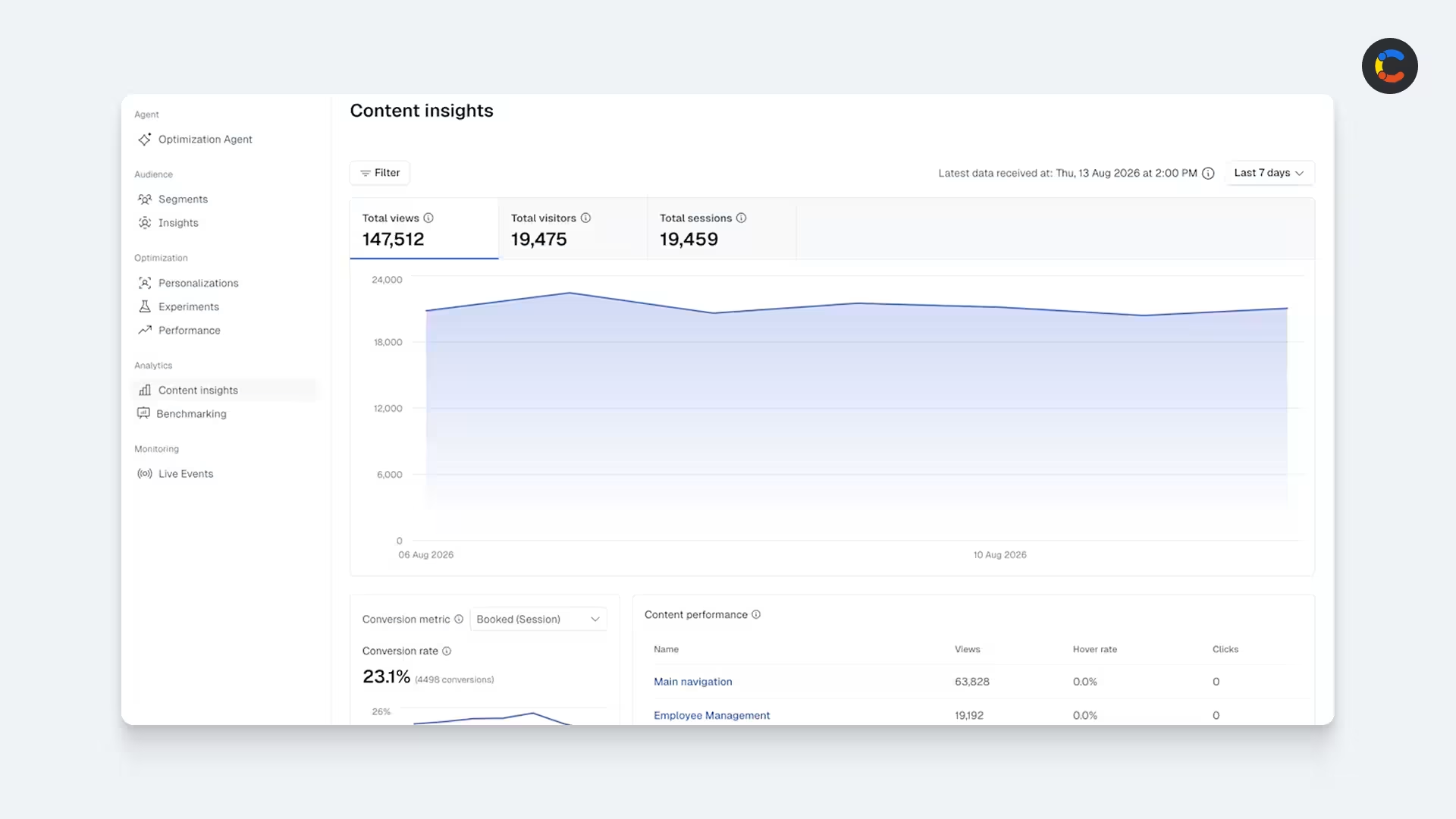
In composable platforms, like Contentful, analytics are component-level rather than page-level. That means marketers can get a clearer signal on exactly what content on the page is being viewed by customers, and clicked on.
Understanding which pages and components are driving KPIs is the foundation of your personalization strategy. From that point, you can start thinking about which audiences to target, what data to collect, and how to tailor their experiences for the maximum impact.
Contentful’s Content Insights is an example of this kind of component-level approach to analytics, with overviews of how individual pieces of content are performing, and metrics such as views, clicks, engagement, and conversion rates.
2. Segment your audience
Once you know where personalization could have the greatest impact, you need to understand which audiences you're trying to reach. Segmentation helps you achieve that: By grouping customers according to characteristics, behaviors, and other defining criteria you can better deploy your personalized content variants.
Customer segments can be created using almost any characteristic that's relevant to your business, such as:
New and returning customers.
Customers who have made recent purchases.
Customers researching a particular product category.
Customers from a specific geographic location.
Customers arriving from a particular marketing campaign.
The more effectively you segment your audience, the more relevant your personalized experiences become. And segments don’t have to be fixed and immutable: You can use them to help you evolve the personalization strategy, refining existing experiences, or surfacing new interests that might resonate.
3. Establish the baseline content experience
All good personalization is rooted in understanding what your audience is currently experiencing. There are two key steps here: mapping the expected content flow for your audience, and then cross-checking that expected flow against the content they're actually looking at.
In Contentful, for example, you can filter your analytics by audience and get a list of their most-viewed content. That capability is a useful foundation for identifying where personalization will have the most impact, and gives you a baseline against which to test new experiences.
4. Build personalized experiences
Next, you’ll decide how those personalized experiences will be assembled and delivered across your marketing channels.
You should work in alignment with your KPIs at this stage: you know what business objectives you’re trying to achieve and you know what audiences you’re trying to appeal to. That information should help you ideate personalization options.
For example:
Should first-time visitors receive educational content while returning customers see product recommendations?
If someone browses a product without purchasing it, should they receive a follow-up email?
Should customers who abandon their shopping cart receive reminders or recommendations for related products?
Should loyalty customers receive exclusive offers that aren't shown to new visitors?
It’s a good idea to connect with sales and customer support teams to answer these questions. They’ll have hands-on experience with customer pain points, and the value propositions that move the needle.
And remember: The goal shouldn’t be to create as much content as possible, but to leverage modular, reusable content components that can be combined in different ways across channels and customer journeys.
In Contentful, you’ll be able to personalize single-page elements (a banner, a CTA, etc.) and then serve those elements to every variant you need — rather than cloning thousands of whole-page variants (more on that later).
5. Measure, iterate, and improve
Because customer expectations change and markets evolve, successful personalization depends on continuous optimization. Marketers need to monitor performance and analyze customer behavior, test new experience variants, and refine their approach over time.
In that sense, personalization should become an ongoing feedback loop in which you publish, measure, review, and improve — in order to keep experiences relevant and engaging over the long term.
In legacy architecture, however, that process can be demanding. Marketers have to rely on analysts, designers, and engineers to interpret data, and create new assets and experience variants, which is a recipe for bottlenecks and delays.
Ideally, marketers own the optimization cycle themselves, leveraging the accessibility of the content platform to test new ideas and respond immediately to what the data is telling them.
Rule-based vs. AI-powered digital marketing personalization
There are two broad approaches to personalization: rule-based personalization and AI-powered (or algorithmic) personalization. Understanding how they differ helps marketers choose the right approach for their business.
Rule-based personalization
Rule-based personalization follows an “if/then” model.
If a customer has a particular characteristic or performs a specific action, then they receive a predefined experience. For example, if a customer lives in the UK, they might see pricing in pounds. If they're a returning customer, they might receive recommendations based on previous purchases.
This approach gives marketers complete control over the customer experience, but it relies on manually defining the rules and maintaining audience segments over time.
AI-powered personalization
AI-powered personalization takes a more dynamic approach. Rather than relying solely on predefined rules, this approach uses data-driven algorithms and machine learning to surface hidden patterns and predict what content is going to be most relevant to a customer.
As customers browse, the AI can adapt experiences in real time by recommending products or blogs, predicting purchase intent, or identifying customers who are most likely to convert.
AI-powered personalization isn't intended to replace marketers. By taking care of the analytics heavy-lifting across vast amounts of data, AI frees human team members from manual tasks so they can better apply their creative and strategic skills to campaigns, and scale effortlessly.
The cost consideration
There’s a cost factor involved too. For most organizations, particularly smaller businesses and those outside large-scale ecommerce, rules-based personalization has a better bang-for-your-buck factor. In many cases, there simply aren't enough content variants or audience variables to justify the additional complexity of AI-powered personalization.
Large B2C organizations, like Amazon, are a different story. They typically have vast content libraries, large audiences, and huge numbers of potential variant experiences. Here, AI-powered personalization can help identify patterns and deliver relevant experiences at a scale that would be difficult to manage with manually defined rules alone.
Common personalization problems
Delivering personalized digital experiences isn't always smooth sailing. Many organizations still rely on legacy content platforms that weren't designed to support dynamic, multichannel experiences. As a result, marketers often struggle to deliver the flexibility, speed, and consistency that effective personalization requires.
Here are some of the most common challenges.
1. Fragmented customer data
When information is spread across multiple platforms and disconnected systems, it becomes difficult to build a complete, accurate picture of individual customers.
And when your CMS, CRM, and analytics tools can't share data effectively, personalization becomes inconsistent. Customers end up getting conflicting messages and irrelevant recommendations, and quickly get frustrated with their experiences.
That problem is precisely why it’s important to find an analytics system that plays nice with others. Or, even better, one that’s integrated into the content platform (like Contentful) so there’s less danger of barriers emerging.
2. Privacy and customer trust
There's a fine line between personalization and intrusion.
When recommendations feel helpful, personalization improves the customer experience. When they feel overly invasive or rely on data customers didn't expect brands to use, trust begins to erode.
With that in mind, being transparent about how customer data is collected and used is essential. Wherever possible, brands should prioritize first-party data collected with consent, and give customers greater visibility and control over how their information is used.
3. Content depth and scalability
As your audience segments grow in number, so too does the volume of content you’ll need to support the experiences you create for them. You’ll need to build out a catalog of digital assets to meet that need, and ensure your content platform is capable of retrieving each asset and publishing it to the relevant touchpoint without friction.
Managing that content becomes increasingly difficult if it's stored across disconnected systems or templated to individual pages. Marketers find themselves having to produce vast amounts of new assets to match each segment, creating an explosion of new content that’s impossible to manage.
As you might have guessed, without the right content platform foundation, personalization can become less effective and more difficult to scale. Structured content helps you avoid that problem.
Wrapping up
Personalization only works when marketers have the flexibility to create, manage, and deliver relevant experiences across every digital touchpoint.
Legacy content platforms make that difficult. In legacy content architecture, content is typically locked into page-based templates and data is stored in disconnected silos, which makes it harder to retrieve and reuse content across channels in personalized experiences and across the wider digital marketing strategy.
And, as brands grow into new markets, marketers are forced to manage expanding content catalogues, more audience segments, and increasingly complex customer journeys — creating exactly the kind of content chaos that can derail personalization strategies.
How does Contentful make personalization better?
Platforms that offer composability and structured content solve that problem. They do that by providing a headless content management environment — removing the limitations imposed by legacy architecture and opening up personalization possibilities.
In Contentful, marketers work with composable architecture and can create structured content models. Instead of creating content for individual pages, they can break content down into its component parts that can be assembled into personalized experiences wherever customers engage — whether that's on the web, in an app, in an email, or any other digital channel.
Customer story: Personio
Software company and Contentful customer Personio offers a real-world example of structured personalization impact.
Using Contentful Personalization, Personio dynamically tailored homepages and social proof based on business size and industry. Doing so, it achieved a 46% increase in homepage conversions and 62% increase in contact form submissions.
But beyond those numbers, Personio demonstrates just how valuable it is to have so many capabilities integrated into the personalization platform
For example, Contentful Insights helps marketers understand how individual content components are performing, and identify the experiences that are having the greatest business impact. Marketers can use those insights to determine which audiences and content are worth developing and experimenting with..
Meanwhile, our Optimization Agent helps marketers consider performance, and take action by building audiences and experiments — without having to deal with lengthy handoffs with technical teams.
In other words, Contentful helps brands build the kinds of personalization feedback loops that power growth and find out exactly where personalization is going to move the needle. Just as important, it ensures marketers can act on those opportunities, continuously optimizing and developing smarter experiences based on hard data.
What’s next? Take a tour of Contentful’s integrated tool, Contentful Personalization, or reach out to our sales team to arrange a platform demo.

Inspiration for your inbox
Subscribe and stay up-to-date on best practices for delivering modern digital experiences.
Meet the authors

Kate is a Solution Engineer with 15+ years helping marketers create, measure and scale content that drives KPIs. She’s co-written written two books, Return on Engagement and O’Reilly’s Civic Apps Competition Handbook, and most recently prototyped Contentful’s new Content Operations Agent.
Related articles
How does Contentful help with SEO and GEO?
July 4, 2025

Maintaining brand consistency across teams and markets
July 29, 2025
Personalization, customer experience, and content platforms
September 17, 2026

Ready to start building?
Put everything you learned into action. Create and publish your content with Contentful — no credit card required.